Showing posts with label AAA Earth. Show all posts

Thursday, September 19, 2024

Floods Wreak Havoc Across Four Continents


The swollen Elbe river in Dresden, Germany, on Tuesday.Credit...Filip Singer/EPA, via Shutterstock

Austyn Gaffney and


Chad. Vietnam. Austria. The American South.

In very disparate regions of the world, extreme rainfall in recent weeks has killed thousands of people, submerged entire towns, set off landslides and left millions without power. It’s a harbinger of the wild weather events that are a hallmark of climate change, driven by the burning of fossil fuels, and it is highlighting the need to urgently adapt, in rich and poor countries alike.

Bursts of extreme rainfall are making both coastal and riverine flooding more dangerous and unpredictable.

“Extreme events are getting stronger everywhere, so we should expect floods to be bigger regardless of where we are,” said Michael Wehner, a scientist at Lawrence Berkeley National Laboratory. “There is no question that these kinds of floods all over the world are getting worse.”

Some of the recent deadly floods, like the landslides in Kerala, in southern India, earlier this summer, can be directly attributable to human-induced climate change.


A scientific study, released in August, found that the downpour that caused the landslide was 10 percent heavier because of human-caused climate change.

There are no similar attribution studies yet for the floods of recent weeks. Though some studies are underway, there simply aren’t enough resources to carry out an attribution study for every single event.

 Sifting through debris at the site of a landslide in Lao Cai province in Vietnam in the aftermath of Typhoon Yagi last week.Credit...Agence France-Presse — Getty Images


Nonetheless, the science is clear: A warmer atmosphere holds more moisture. That can cause bursts of extreme rainfall, on top of other meteorological factors. For instance, Storm Boris, a sluggish, low-pressure system, has dumped five times September’s average rainfall across Europe since the storm began last week. A blast of cold polar air collided with a sweep of warm Mediterranean air dense with water vapor, producing an unusually powerful storm that brought heavy rains and strong winds. As of Wednesday, at least 23 people have died in Austria, the Czech Republic, Poland and Romania, according to Reuters.

In the United States, North and South Carolina are being battered this week by equally rare storms. Some areas recorded 18 inches of rain over 12 hours, an amount so statistically rare it’s considered a one-in-a-thousand-year event.


Typhoon Yagi, one of the region's most powerful storms, brought rain and winds up to 127 miles per hour across northern Vietnam. At least 143 people have died in the aftermath, including 22 who died following a landslide in the Lao Cai, a mountainous province bordering China. The storm marched on to Myanmar, killing at least 110 more people in flash floods and landslides.

The latest floods come on top of accumulating hazards that have whittled away at people’s ability to cope.

Parts of Northern Nigeria were battered by seven days of nonstop heavy rainfall that caused a dam to burst, killing at least 200 people and submerging half the city of Maiduguri. Local officials told Reuters it was the worst flooding in two decades. The rain came just months after scorching pre-monsoon heat and after years of conflict in the area between Boko Haram militants and the Nigerian government forces. The governor of Borno state said that the floods had displaced more than a million people and that there was a high risk of diseases spreading
 
People displaced by floods arrived in Maiduguri, Nigeria, on Sept. 12.Credit...Audu Marte/Agence France-Presse — Getty Images
 
 
Likewise in Chad, reeling from years of conflict and the influx of refugees from neighboring countries, 341 people have died in flooding in recent days, according to the United Nations.
 

Extreme weather is exceptionally costly for African governments. On average, African nations are losing 5 percent of their economies because of floods, droughts and heat, according to the World Meteorological Organization. Many are spending up to a tenth of their budgets just managing extreme weather disasters. Many of those extreme events are driven by the emissions of planet-heating greenhouse gases, but Africa is responsible for only a fraction of the world’s annual emissions.

The latest floods have made it abundantly clear that both rich and poor countries need to invest in shoring up their physical infrastructure and their public policies to minimize the effects of extreme weather.

The United Nations has pressed governments to put in place more early-warning systems, which are relatively inexpensive and potentially effective in saving lives. The U.N. says 101 countries now have early-warning protocols, at least on paper, which is double the number that reported having them in 2015.

There are many feasible measures to reduce the loss of lives caused by flooding. They include giving small amounts of cash to people so they can move out of harm’s way, and putting in emergency water and power systems to prevent the outbreak of disease after floods.


Flooding from Tropical Storm Debby in Isle of Palms, S.C., in August.Credit...Marco Bello/Reuters

Harder to do, but essential, local officials and disaster management specialists say, is to prevent deforestation and construction in areas that are prone to heavy flooding and landslides. The floods in Kerala were all the more devastating because of widespread deforestation and unplanned development in ecologically sensitive areas.

In wealthy countries like the United States, local governments have invested heavily in expensive infrastructure. North and South Carolina, for instance, both veterans of powerful storms, have spent millions of dollars retrofitting roads to better withstand extreme rainfall and starting to protect natural flood barriers, like wetlands, from development.

By contrast, low-income countries that are already strapped and weighed down by debts, have been less able to maintain their roads, let alone build flood-resilient infrastructure.

“We need to develop critical infrastructure,” said Olasunkanmi Habeeb Okunola, an urban planner from Nigeria who is working as a visiting scientist at United Nations University’s Institute for Environment and Human Security. “If you get that right, to some extent, you can lessen the impact of climate change.”

There is little doubt that climate change is making weather wilder and more erratic. That requires preparing for the unexpected.

 “We don’t know exactly when or which type of event will come,” said Diana Urge-Vorsatz, a professor at Central European University and vice chair of the Intergovernmental Panel on Climate Change. “Unfortunately there’s no question that more severe events are coming.”


Monday, June 27, 2016

There are more jobs in renewable energy than in oil, gas, and coal combined.


By Grist.
A word to the burly coal miners who complained that cutting coal out of our energy mix would take away their jobs when the Climate Action Plan was up for debate. Jobs in solar energy now outnumber jobs in coal mining and the oil and gas industry added together, says a new report from the International Renewable Energy Agency (IRENA).
Solar may be taking away old jobs, but it’s offering new ones. That’s especially true for women. IRENA found that the renewable energy sector employs more women than oil, gas, and coal. In fact, the percentage of women working in solar is rising — up from 19 percent in 2013 to 24 percent of the estimated 209,000 solar jobs in the United States. That’s not yet great — women hold 47 percent of the jobs in our economy. But it’s still a higher percentage than in the bro-topia that is the conventional energy industry.
Worldwide, employment in green energy grew 5 percent in 2015, to 8.1 million jobs, while the slump in oil prices that began in the fall of 2015 eliminated an estimated 350,000 oil jobs across the planet.

IRENA_Renewable Energy Gigs by Country
IRENA

Around the world, the solar industry was the largest renewable energy employer — jobs increased 11 percent between 2014 and 2015, to 2.8 million jobs. Most of those jobs — 1.7 million — are in China, because that’s where most solar panels are manufactured. In the European Union, a decline in manufacturing means that the region lost jobs, but high rates of solar installation in the United States kept solar employment high.
One of the most interesting markets for solar is in countries with unstable electrical grids, such as Bangladesh, India, and Kenya. It’s possible that those countries will be at the forefront of adopting small, independent solar systems, in much the same way that Egypt and other countries without widespread telephone access were early cellphone adopters. In North Korea, small, personal solar panels are on the rise, bought by people who need to charge cellphones when the grid goes down.
IRENA_Renewable Energy Jobs
Both the United States and the European Union have accused China of selling solar panels at below-market value in order to drive solar manufacturing in other countries out of business, and have put hefty import tariffs on Chinese solar panels. In response, Chinese manufacturers have globalized their solar operations, setting up solar panel factories in other countries like Malaysia, Thailand, India, Brazil, and the United States.
So, good news. IRENA estimates that if nations follow through on the climate pledges made in Paris last year, this upswing is only going to continue. Their estimate? Jobs in renewable energy will triple to 24 million by 2030.

Friday, February 21, 2014

Freezing January for Easterners Was Not Felt Round the World


An abandoned farmhouse near Bakersfield, Calif., in February. California is struggling with a severe drought. David McNew/Getty Images


For people throughout the Eastern United States who spent January slipping, sliding 

and shivering, here is a counterintuitive fact: For the earth as a whole, it was the

fourth-warmest January on record.

It was, in fact, the 347th consecutive month with temperatures above the 20th-century average, the government reported Thursday.
That may feel plausible to Californians, whose state experienced temperatures 10 or 15 degrees above normal in some places last month, and especially to Alaskans, where the average temperature was almost 15 degrees above normal.
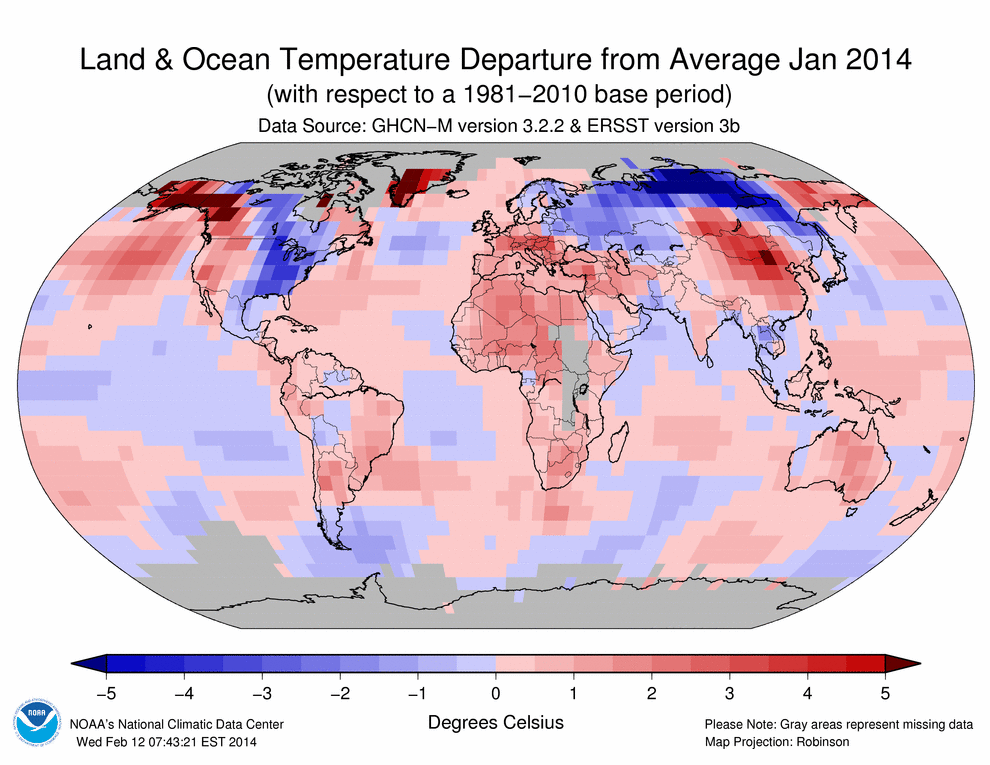
But on a map of January temperatures released Thursday by government weather analysts, the Eastern United States stood out as one of the coldest areas on the planet, compared with seasonal norms.

That is no surprise to anybody living east of the Mississippi River, of course — certainly not to the Atlantans who were caught up in two memorable ice storms that shut down the city, or the New Yorkers who are still picking their way through mounds of dirty snow.

But this might be another surprise: Despite all the weather drama, it was not a January for the record books.
By the time analysts averaged the heat in the West and the cold in the East, the national temperature for the month fell only one-tenth of a degree below the 20th-century average for January. January 2011 was colder.
No state set a monthly record for January cold. Alabama, also walloped by the ice storms, came closest, with the fourth-coldest January on its record books.
The United States covers only 2 percent of the surface of the globe, so what happens in this country does not have much influence on overall global temperatures.
Brazil, much of southern Africa, most of Europe, large parts of China and most of Australia were unseasonably warm in January, the National Oceanic and Atmospheric Administration reported Thursday. That continues a pattern of unusual global warming that is believed to be a consequence of human-caused emissions of greenhouse gases.
Even in the United States, more than a third of the country is in drought of varying intensity. Mountain snowpack in many parts of the West is only half of normal, portending a parched summer and a likelihood of severe wildfires.
“Today’s snowpack is tomorrow’s water in the West,” said Deke Arndt, chief of climate monitoring for the National Climatic Data Center in Asheville, N.C., in a briefing on Thursday. “If it does not recover, this will have consequences for months down the road.”
The Arctic blasts of this winter do stand out in the weather records of this young century, even if they are pretty humdrum when compared with the 1970s and 1980s. Winters have been so mild over the past couple of decades — probably as a result of global warming, scientists say — that some young adults have never experienced cold waves quite so intense.


And the pain may not be over. Forecasters say the northern tier of the United States

may face still more cold blasts, storms and heavy winds right up to the doorstep of 

spring, albeit interspersed with bursts of warmth in some areas.

Over just the next few days, the Southeast may be hit by severe thunderstorms, high winds and even hail. The Midwest may have wind gusts up to 60 miles an hour. And the Northeast could see rain, snow or a mix of the two.
Temperatures across the eastern Great Plains, the Great Lakes and the Mississippi Valley are expected to be below normal for the next month and into the spring.
But the cold weather in the East is being balanced, in a sense, by the bizarrely warm temperatures in the West. And that trend, too, is likely to continue.
The outlook over the next month is for continued above-normal temperatures in the West, the Southwest and parts of Alaska, as well as a continuation of the California drought, despite recent rains that have eased the situation slightly.
The extremes in January were directly related, experts said, with the two regions falling on opposite sides of a big loop in the jet stream, a belt of high winds in the upper atmosphere that helps to regulate the climate.
A dip of the jet stream into the Eastern United States allowed cold air to descend from the Arctic, while a corresponding ridge in the West allowed warm air to hover over California and to penetrate normally frigid regions to the north.
For those ready for the warmth to dip in their direction, mark a calendar: March 20, at 12:57 p.m. Eastern Daylight Time.
That is when the tilt of the Earth causes the sun to pass over the Equator and re-enter the Northern Hemisphere, bringing spring with it.


‘We have lost everything’: extreme rainfall across Asia brings flash floods and typhoons

  Bangladesh is one of several countries in the region to experience heavy rains and flash floods. Photograph: Rayhan Ahmed/Zuma Press Wir...