Showing posts with label Killed. Show all posts

Friday, November 1, 2024

Climate Change Is Making Disasters Deadlier. Here’s How Much. More than half a million people were killed in 10 disasters that climate change worsened, according to a new report.


Rescue workers escorted a stranded couple to safety from their damaged home after heavy flooding in Letur, Spain, on Wednesday. In some areas of the country, a month’s worth of rain fell in less than a day.Credit...Susana Vera/Reuters


Two weeks before world leaders meet to debate the climate crisis, a report released on Thursday shows the 10 deadliest extreme weather events in the past two decades were made worse by burning fossil fuels.

More than half a million people around the world were killed in those disasters since 2004.

“Many people now understand that climate change is already making life more dangerous,” said Friederike Otto, a senior lecturer at Imperial College London and co-founder of World Weather Attribution, the group that published the report. “What did not work yet is turning knowledge into action on a large-enough scale.”

Even with the abundance of evidence on how a warming world is endangering human life, the world keeps burning fossil fuels: 2023, the hottest year on record, also set a record for greenhouse gas emissions.

The stakes are high for how the world will respond in November, with a pivotal U.S. election and an annual climate summit of world leaders, known as COP29, hosted in Azerbaijan. Developing countries, hit hard by climate disasters, are pressing for rich countries to make good on their pledges to curb emissions and fund climate adaptation projects.


“The U.S. and really the world face a very sharp fork in the road,” said Michael Gerrard, a professor of environmental law at Columbia Law School.

Next week, the United States, the highest per-capita emitter of greenhouse gas emissions in the world, will vote on its climate future. A Kamala Harris presidency could continue the work of the Biden administration in transitioning to renewable energy, largely through tax credits and increased American manufacturing on clean energy technologies.

 
Portraits of the dead hung on what was left of a home in Myasein Kan, a village in Myanmar, after Cyclone Nargis in 2008. The storm killed more than 138,000 people.Credit...Getty Images


If returned to office, Donald J. Trump could roll back environmental regulations, including those that limit greenhouse gases, and continue development of fossil fuels. He could also pull out of international agreements to fight climate change, as he did in his first term as president.

“It will be extremely difficult for the world to take on the climate crisis if Trump is president of the United States,” said Lena Moffitt, executive director for Evergreen Action, a climate nonprofit.


A week after the Election Day, the world’s leaders will meet at COP29. In Azerbaijan, a tiny petrostate on the borders of Russia and Iran they will seek to agree on how to lower global emissions fast enough that temperatures remain below 1.5 degrees Celsius, or 2.7 degrees Fahrenheit, above preindustrial levels.

But the planet has already warmed 1.3 degrees Celsius, or 2.3 degrees Fahrenheit, since rich countries began burning fossil fuels like coal, oil and gas on an enormous scale. The world may now be on track to reach 3 degrees Celsius of warming by the end of the century, according to Dr. Otto and other climate scientists.

Last year, summit attendees pledged to transition away from fossil fuels, but the pact came with heavy caveats. Dr. Otto said she hoped this year’s conference would create a stricter timeline for that transition that could hold countries accountable.

The group of nations also set up a damages fund to help poorer countries with historically low emissions adapt to climate change. The fund, which currently has about $700 million pledged, is dwarfed by the hundreds of billions of dollars in climate-related damages developing countries may incur by 2030.

 Health workers tending to a person who fainted during a heat wave at the Acropolis of Greece last year.Credit...Milos Bicanski/Getty Images

“It’s a ridiculously and insultingly low sum of money to help the most vulnerable countries with dealing with the losses and damages,” Dr. Otto said. “That needs to be orders of magnitude bigger.”

The new study showed that death tolls from extreme weather events are often higher in poor countries. Researchers culled the list of weather episodes from the International Disaster Database, and included three tropical cyclones, four heat waves, two floods and a drought. They noted that the high death toll was “a major underestimate,” with potentially millions of unreported heat-related deaths not included.

Europe faced well-documented heat waves in 2015, 2022 and 2023 that led to almost 94,000 deaths. Another report released this week shows that during a 2022 heat wave in Europe that caused 68,000 deaths, more than half of those deaths could be traced back to human-induced climate change.

But poor countries suffered more in extreme weather. In Somalia, a 2011 drought made worse by rising temperatures that sucked water vapor from plants led to 258,000 deaths; in Myanmar, Cyclone Nargis formed in 2008 over warmer seas and most likely had higher wind speeds and more intense precipitation as a result of climate change. It killed more than 138,000 people.

Climate attribution studies are now 20 years old, and more than 500 have been published by researchers. The first was published in 2004, according to World Weather Attribution; it showed that the likelihood of Europe’s 2003 summer, the hottest the continent had seen since 1500, was doubled by climate change.

To make such assessments, scientists pair weather observations with climate models and work with local experts and meteorological agencies.

 
Burying a 4-year-old who died in a refugee camp in Dadaab, Kenya, during the famine that struck Kenya and Somalia in 2011.Credit...Tyler Hicks/The New York Times


Attribution studies can help raise awareness of climate change, but researchers have a hard time finding funding, said Michael Wehner, a senior scientist in applied mathematics at the Lawrence Berkeley National Laboratory.

“We have the technology and we have the methodology and the machines, the data and the experts,” Dr. Wehner said. “But they’ve got to be paid to do this, and they’re not.”

In its report, World Weather Attribution highlighted the need for protecting vulnerable people, improving early warning systems, and strengthening infrastructure like homes from flooding events, before the world reaches its limit for resilience.

But some events are now so extreme, experts warned, that governments could reach the limits of adaptation, underscoring the need to try to curb global warming as quickly as possible.

“Climate change has already made life incredibly hard and really dangerous, and we’re only at 1.3 degrees of warming,” said Joyce Kimutai, a researcher at Imperial College London. “We’re likely to see an escalation of impacts and the continual suffering of vulnerable people.”

Austyn Gaffney is a reporter covering climate and a member of the 2024-25 Times Fellowship class, a program for journalists early in their careers. More about Austyn Gaffney


Wednesday, October 30, 2024

‘We were trapped like rats’: Spain’s floods bring devastation and despair


Pedestrians look at piled-up cars in Sedavi, south of Valencia city, after deadly floods. Photograph: José Jordan/AFP/Getty Images

 Residents describe impact of floods and downpours – with some places hit with a year’s worth of rain in just eight hours

The gratitude that greeted Tuesday’s dawn downpours was short-lived in Utiel. When the longed-for rains finally reached the town in the drought-stricken eastern Spanish region of Valencia, they were merciless in their abundance.

“People were very happy at first because they’d been praying for rain as their lands needed water,” said Remedios, who owns a bar in Utiel. “But by 12 o’clock, this storm had really hit and we were all pretty terrified.”

Trapped in the bar, she and a handful of her customers could only sit and watch as Spain’s worst flooding in almost 30 years caused the Magro River to overflow its banks, trapping some residents in their homes and sending cars and rubbish bins surging through the streets on muddy flood waters.

Damaged cars lie amid debris along damaged rail lines in the flood-hit city of Valencia. Photograph: Manuel Bruque/EPA


“The rising waters brought mud and stones with them and they were so strong that they broke the surface of the road,” said Remedios, who gave only her first name.

“The tunnel that leads into the town was half-full of mud, trees were down and there were cars and rubbish containers rolling down the streets. My outside terrace has been destroyed – the chairs and shades were all swept away. It’s just a disaster.”

By Wednesday afternoon, the death toll in Valencia and the neighbouring regions of Castilla-La Mancha and Andalucía stood at 95 . Utiel’s mayor, Ricardo Gabaldón, told Las Provincias newspaper that some of the town’s residents had not survived the floods, but was unable to provide an exact number.

Hours earlier, Gabaldón had told Spain’s national broadcaster, RTVE, that Tuesday had been the worst day of his life. “We were trapped like rats,” he said. “Cars and rubbish containers were flowing down the streets. The water was rising to 3 metres.”

 People in the town fear some of the dead may have been older people who were unable to escape the flood waters. Remedios said: “Anyone who could get to higher ground did, but there were some old people who couldn’t even open their front doors and they were trapped there inside their own houses.”


Residents of La Torre, on the outskirts of Valencia city, were confronted by similar scenes on Wednesday morning.

“The neighbourhood is destroyed, all the cars are on top of each other, it’s literally smashed up,” Christian Viena, a bar-owner in the area, told the Associated Press by phone. “Everything’s a total wreck, everything is ready to be thrown away. The mud is almost 30cm deep.”

A man carries a dog in Letur, Albacete province, after flash floods hit the region. Photograph: Mateo Villalba Sanchez/Getty Images

Spain’s meteorological office, Aemet, said that more than 300 litres of rain per square metre (30cm) had fallen in the area between Utiel and the town of Chiva, 20 miles (50km) away, on Tuesday. In Chiva, it noted, almost an entire year’s worth of rain had fallen in just eight hours.

The ferocious rains have come as Spain continues to experience a punishing drought. Last year, the government approved an unprecedented €2.2bn (£1.9bn) plan to help farmers and consumers cope with the enduring lack of rain amid warnings that the climate would only get worse, and more unpredictable, in the future.

“Spain is a country that is used to periods of drought but there’s no doubt that, as a consequence of the climate change we’re experiencing, we’re seeing far more frequent and intense events and phenomena,” the environment minister, Teresa Ribera, said.

As Wednesday wore on, a distressing picture of the human and economic damage began to emerge. Spain declared three days of national mourning.


The prime minister, Pedro Sánchez, said the entire country felt the pain of those who had lost their loved ones, and urged people to take every possible precaution as the torrential rains moved to the north-east of the country.

The defence minister, Margarita Robles, said 1,000 members of the military emergencies unit had been deployed to help regional emergency services. In a sign that more bodies could be trapped in the mud and in houses, she also offered mobile morgues.

One man used a phone call to RTVE to plead for any news of his son, Leonardo Enrique Rivera, who had gone missing in his Fiat van after going to work as a delivery driver in the Valencian town of Riba-roja on Tuesday.

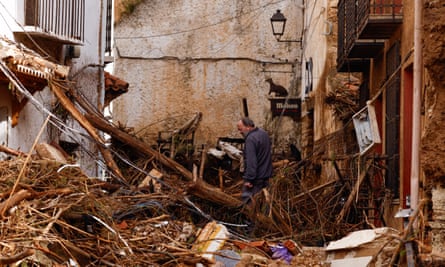
A man walks among the debris in Letur.

A man picks his way through debris in Letur. Photograph: Susana Vera/Reuters


“I haven’t heard from him since 6.55 yesterday,” said Leonardo Enrique. “It was raining heavily and then I got a message saying the van was flooding and that he’d been hit by another vehicle. That was the last I heard.”

Esther Gómez, a town councillor in Riba-roja, said workers had been stuck overnight in an industrial estate “without a chance of rescuing them” as streams overflowed. “It had been a long time since this happened and we’re scared,” she told Agence France-Presse.

As the search for the dead continued, experts warned that the torrential rains and subsequent floods were further proof of the realities of the climate emergency.

“No doubt about it, these explosive downpours were intensified by climate change,” said Dr Friederike Otto, leader of world weather attribution at the Centre for Environmental Policy, Imperial College London.

“With every fraction of a degree of fossil fuel warming, the atmosphere can hold more moisture, leading to heavier bursts of rainfall. These deadly floods are yet another reminder of how dangerous climate change has already become at just 1.3C of warming. But last week the UN warned that we are on track to experience up to 3.1C of warming by the end of the century.”

There were similar, if differently expressed, sentiments in Utiel on Wednesday. “There was one guy here with me yesterday who’s 73, and he said he’d never seen anything like this in all his years,” said Remedios. “Never.”


‘We have lost everything’: extreme rainfall across Asia brings flash floods and typhoons

  Bangladesh is one of several countries in the region to experience heavy rains and flash floods. Photograph: Rayhan Ahmed/Zuma Press Wir...