Showing posts with label Floods. Show all posts

Thursday, August 14, 2025

Alaskan River Reaches Record High From Melting Glacier. An overflowing glacial lake caused a surge in the Mendenhall River on Wednesday, prompting flood alerts and evacuations in Juneau.


A timelapse view from cameras monitored by the U.S.G.S. of the Suicide Basin before the glacial lake outburst flooding from the Mendenhall Glacier, in Juneau, Alaska, covering a period from July 21 to Aug. 13.CreditCredit...U.S.G.S.


An overflowing glacial lake north of Juneau, Alaska, caused the Mendenhall River to surge to a record height on Wednesday, flooding homes and streets in parts of the state capital, which has a population of more than 30,000.

Such floods have been a recurring problem in Juneau since 2011, but recent years have seen record-setting surges as rising temperatures cause glaciers in the area to melt more rapidly. Alaska has warmed faster than the global average, and the fastest of any state, according to the Environmental Protection Agency.

Flooding last August from the same glacial lake inundated several hundred homes in Juneau with four to six feet of water, although no deaths or injuries were reported. The city put up a temporary levee along the river in response. Residents this week were urged to evacuate ahead of the latest round of high water.

Here’s what to know about these floods.

As glaciers melt, they tend to retreat uphill, leaving an empty bowl at the bottom of the valley where the ice once sat. Meltwater from the glacier starts pooling in this bowl, and over time a lake forms.

 But the sides of the lake are fragile. They might be formed of loose dirt and rock or ice. If one day an avalanche or a landslide occurs, or a piece of a nearby cliff plunges into the water, the disturbance can cause the sides of the lake to collapse. In a flash, most of the lake’s water might cascade down the valley, threatening towns and cities below.


Glacial lake outburst floods can be catastrophic because, by the time the water reaches downstream settlements, it has picked up huge amounts of sediment and boulders along the way, turning it into a thick slurry that can knock down buildings.

In 2023, a GLOF in northern India killed at least 55 people and destroyed a hydropower dam. All in all, 15 million people around the world live within 50 kilometers, or 31 miles, of a glacial lake and less than a kilometer from the potential path of a GLOF, scientists estimated in a 2023 study.

The glacial lake that is overflowing this week in Alaska sits at the foot of the Suicide Glacier, an ice mass north of Juneau. Decades ago, the Suicide Glacier flowed into a much larger river of ice, the Mendenhall Glacier. But as the Suicide melts and shrinks, a steep gap has opened up between it and the Mendenhall. This gap is now called Suicide Basin.

(Experts have proposed renaming Suicide Basin to Kʼóox Ḵaadí Basin, which in the Tlingit language translates to “Marten’s Slide Basin.” A marten is a lithe, weasel-like animal found in the area.)

Snowmelt and rain accumulate in the basin, and when the water is high enough, it starts draining through cracks in the Mendenhall Glacier before flooding the Mendenhall River.

The first time this happened was in July 2011, and it took downstream communities by surprise. The basin has since filled and drained at least 39 times, according to the National Weather Service. Early Wednesday, as the basin drained once more, the Mendenhall River peaked at a height of 16.65 feet, exceeding a record set last year.

The glaciers in this region are part of the Juneau Ice Field, a sprawling area of interconnected ice that is melting twice as quickly as it did before 2010, scientists reported last year. More of the area’s glaciers are detaching from one another, the researchers also found, which can lead to the formation of lakes like Suicide Basin.

Accelerated melting is producing more water to fill these lakes and hence more water that eventually floods neighborhoods downstream, said Bob McNabb, a glaciologist at Ulster University who has studied the Juneau Ice Field. “As you get more and more melting coming down, that will fill up the basin a bit more each time,” Dr. McNabb said.

The world’s high mountains are warming more quickly than Earth as a whole. That is causing thousands of glaciers to shrink and new lakes to form beneath them. Since 1990, the number, area and volume of glacial lakes around the world have all grown by roughly 50 percent, scientists estimated in a 2020 study.

But bigger lakes don’t directly translate into greater GLOF hazards. Each glacial lake and valley has distinct features that influence how likely it is to burst, and what the consequences would be if it did. So predicting future flood risks is “very complex,” Dr. McNabb said.

In the Mendenhall Valley, for instance, rising temperatures are the reason the Suicide Glacier has withered away and Suicide Basin has formed. But as the planet warms further, the Mendenhall Glacier might melt by so much that the flood threat actually decreases. The reason? There would no longer be enough ice at the side of Suicide Basin to trap large amounts of meltwater. Instead, the water would just empty into the valley gradually.

Scientists in Alaska have predicted that this could come to pass within the next decade or two. Until then, the people of Juneau will continue to live with the dangers from the warming landscape just a few miles to their north.


Thursday, July 10, 2025

Accelerated glacial melt and monsoon rains trigger deadly floods in Pakistan. Record temperatures and seasonal downpours raise fears of a repeat of the devastating flooding in 2022


Commuters negotiate a flooded street after heavy monsoon rains in Lahore on Wednesday. Photograph: Murtaza Ali/AFP/Getty Images


in Islamabad


Glaciers across northern Pakistan have been melting at an accelerated pace as a result of record-breaking summer temperatures, leading to deadly flash flooding and landslides.

The floods and heavy monsoon rains have caused devastation across the country this summer, killing at least 72 people and injuring more than 130 since the rains began in late June.

In the country’s mountainous region of Gilgit-Baltistan, temperatures have risen as high as 48.5C (119.3F), which local officials described as unprecedented in a region that is more than 1,200 metres above sea level and famous for its snow-capped mountains. The previous record was 47 degrees, set in 1971.

The region, which spans the Himalayas, the Hindu Kush and the Karakoram mountain ranges, has witnessed an acceleration in the melting of its glaciers in the past week.


It has led to the swelling of the local rivers and the formation of unstable lakes that have burst, triggering flash floods and landslides that have washed away villages and roads, cutting off some communities entirely and leaving others without power or drinking water.

The head of Gilgit-Baltistan’s disaster management authority, Zakir Hussain, said the region was facing a “very serious situation” and described the fast formation of volatile glacial lakes as “highly hostile” to people’s safety.

He said those in some areas close to the glaciers were being evacuated from their homes. “We are facing a flood situation in many areas,” he said. “The rise of temperature has sent a shiver down our spines. We have never before witnessed such weather here.”

He said it could be just the beginning and that the region remained on high alert as warnings of high temperatures continued.

There are about 7,200 glaciers in Gilgit-Baltistan, though their number and size has diminished over recent years as a result of the climate emergency. The glaciers feed vital river basins and are an essential part of Pakistan’s water supply.

Tariq Ali, a resident in Gilgit, said the flash floods and high temperatures had devastated swathes of agricultural land, which most people relied on for their livelihoods.

“It is like hell,” said Ali. “There has been no rain for quite some time, we are only seeing heatwaves and are witnessing very serious ice-melting. I personally have never witnessed such summer conditions in Gilgit.”


Pakistan, with a population of 240 million, is one of the world’s most vulnerable countries to the effects of the climate crisis, facing erratic rains and a high risk of floods and severe heatwaves. . Devastating flash floods in 2022 killed at least 1,700 people and affected more than 33 million.

Experts say the country may be facing a repeat of the 2022 floods. Punjab province has recorded heavy rainfall in recent days, resulting in urban flooding. The authorities have said above-average rainfall will continue in the coming days.

A family died while on holiday last month after they were swept away by the Swat River in northern Pakistan after heavy rains and flash floods.

Pakistan’s former climate change minister Sherry Rehman said not enough was being done to prepare and protect the country. “We are at the epicentre of a global climate polycrisis,” she wrote on X. “Pakistan is now number one in 2025 as the most climate-impacted country. That’s huge. But do you see alarm bells ringing? I don’t.”


Saturday, July 5, 2025

Desperate search for girls swept away at summer camp after dozens killed in floods. At least 27 people have died and 27 girls who were at a Christian summer camp are missing


Rescue workers along the Guadalupe River in the wake of flooding event in Kerrville, Texas. Photograph: San Antonio Express-News/Express-News/ZUMA Press Wire/Shutterstock

 Theguardian

Twenty-seven people confirmed dead in Texas

Twenty seven people are confirmed dead after flooding in Texas.

Eighteen are adults and nine are children, an official from Kerr County said.

“We are working hard to locate anyone who is still missing and ensure they are safe,” Kerr County Sheriff Larry Leitha said.

Some 850 people have been rescued so far.


As the World Warms, Extreme Rain Is Becoming Even More Extreme

Even in places, like Central Texas, with a long history of floods, human-caused warming is creating the conditions for more frequent and severe deluges.

A person overlooks flooding at the Guadalupe River in Kerrville, Texas, on Saturday.Credit...Ronaldo Schemidt/Agence France-Presse — Getty Images
 

Colossal bursts of rain like the ones that caused the deadly flooding in Texas are becoming more frequent and intense around the globe as the burning of fossil fuels heats the planet, scientists say.

Warm air holds more moisture than cool air, and as temperatures rise, storms can produce bigger downpours. When met on the ground with outdated infrastructure or inadequate warning systems, the results can be catastrophic.

These were the ingredients for tragedy in Texas, a state that is well acquainted with weather extremes of all kinds: high heat and deep cold, deluges and droughts, tornadoes and hurricanes, hail and snow. Indeed, the Hill Country, the part of the state where the Guadalupe River swelled on Friday, is sometimes called “flash flood alley” for how at risk it is to seemingly out-of-nowhere surges of water.

Humid air blows into the area from two main sources, the Gulf of Mexico and the tropical Pacific Ocean. When this air collides with cool air drifting down across the Great Plains, severe storms can erupt. The hilly terrain and steep canyons quickly funnel the rain into river valleys, transforming lazy streams into roaring cascades.

In parts of Texas that were flooded on Friday, the quantities of rain that poured down in a six-hour stretch were so great that they had less than a tenth of 1 percent chance of falling there in any given year, according to data analyzed by Russ Schumacher, a professor of atmospheric science at Colorado State University.


The Guadalupe River rose from three feet to 34 feet in about 90 minutes, according to data from a river gauge near the town of Comfort, Texas. The volume of water exploded from 95 cubic feet per second to 166,000 cubic feet per second.

And the warming climate is creating the conditions in Texas for more of these sharp, deadly deluges.

In the eastern part of the state, the number of days per year with at least two inches of rain or snow has increased by 20 percent since 1900, according to the most recent National Climate Assessment, the federal government’s flagship report on how global warming is affecting the United States. Across Texas, the intensity of extreme rain could increase another 10 percent by 2036, according to a report last year by John Nielsen-Gammon, the Texas state climatologist.

To understand patterns of heavy rain at a more local level, communities and officials rely on data from the National Oceanic and Atmospheric Administration. The agency has for decades published nationwide estimates of the probabilities of various precipitation events — that is, a certain number of inches falling in a particular location over a given amount of time, from five minutes to 24 hours to 60 days.

Engineers use NOAA’s estimates to design storm drains and culverts. City planners use them to guide development and regulations in flood-prone areas.

NOAA’s next updates to the estimates are scheduled to be released starting next year. For the first time, they are expected to include projections of how extreme precipitation will evolve as the climate changes, in order to help officials plan further ahead.

But in recent months, the Trump administration has cut staff at the agency and at the National Weather Service, which sits within NOAA. The administration has also dismissed the hundreds of experts who had been compiling the next edition of the National Climate Assessment, which was scheduled to come out in 2028. And it is proposing deep cuts to NOAA’s 2026 budget, including eliminating the office of Oceanic and Atmospheric Research, which conducts and coordinates climate research.

Friday, February 28, 2025

Surge in marine heatwaves costs lives and billions in storm damage – study. Floods, whale strandings and coral bleaching all more likely, say researchers, as 10% of ocean hits record high temperatures in 2023-24


A sperm whale died after stranding at Yeh Malet beach in Bali, in April 2023 – warmer ocean temperatures increase the risk of similar events. Photograph: Dicky Bisinglasi/AFP/Getty Images


The world’s oceans experienced three-and-a-half times as many marine heatwave days last year and in 2023 compared with any other year on record, a study has found.

The sustained spike in ocean temperatures cost lives and caused billions of dollars in storm damage, increased whale and dolphin stranding risks, harmed commercial fishing and sparked a global coral bleaching, according to the paper published on Friday in Nature Climate Change.


Like heatwaves on land, a marine heatwave is defined as a period of higher than normal temperature over a longer than usual time. The most recent of these were brought about by human-induced climate change and amplified by El Niño conditions, the report’s authors said, with nearly 10% of the ocean hitting record high temperatures in 2023-24.

“The more regularly our marine ecosystems are being hit by marine heatwaves, the harder it is for them to recover from each event,” said lead author Kathryn Smith from the UK’s Marine Biological Association.

Higher ocean temperatures “supercharge” evaporation, the study said, fuelling storms such as Cyclone Gabrielle which hit New Zealand in February 2023, killing 11 people and costing an estimated NZ$14.5bn (about £6.5bn).

One of the most surprising findings in the study, said Smith, was “how much [marine heatwaves] accentuated storms on land and the number of people that were hit by that – hurt, lost possessions, [suffered a] monetary impact or lost their lives”.

At least 45 people died in April last year when a dam burst in Kenya’s Rift valley, as torrential rains battered the country. Photograph: Luis Tato/AFP/Getty Images


 More worryingly, she said: “There is going to be a huge amount more [about the impacts of marine heatwaves] that we don’t know about [yet] because of the time it takes to publish in scientific literature.”

The effect on species was often devastating. Whales and dolphins venture closer to shore when the water is warm because they follow their prey, so this increased their chances of stranding, said Smith. For Mediterranean fan mussels, which have been dying in their millions since 2016, marine heatwaves may be the final nail in the coffin because the warming waters bring increased risk of diseases, the study said.

An aerial photo from February 2023 showing flooding caused by Cyclone Gabrielle in Awatoto, New Zealand. Photograph: AFP/Getty Images

Although human intervention saved some marine life from the recent heatwaves, the study found damage reduction was mostly lacking, possibly due to limited resources, disconnects between organisations and poor communication.

When there was time to prepare, successful mitigation actions included moving corals and conches in Florida to deeper, cooler water and keeping endangered Tasmanian red handfish in aquariums until they could be returned to the wild.

For corals, the study said initiatives to create new colonies using assisted sexual reproduction that increases genetic diversity showed potential, with increased resilience to bleaching “observed in trial populations of reef-building corals across the Caribbean and Mexico”.

Increased ocean temperatures can sometimes bring small wins, the study noted. In Peru, for example, while the anchovy catch was badly affected by the fish moving outside their normal range – a shift that led to commercial fishery closures and estimated losses of $1.4bn (£1.1bn) – squid landings increased.

 A juvenile queen conch. Scientists in the US moved some of the molluscs into cooler waters to protect them from the warming ocean. Photograph: Jennifer Doerr/NOAA SEFSC Galveston


Better forecasting, the study found, is critical to reducing damage from severe marine heatwaves, because it provides “greater confidence” for those making damage limitation decisions.

Valeria Pizarro, a scientist at America’s Perry Institute for Marine Science, who was not part of the study, said watching corals bleach “in the blink of my eyes” made her feel “very sad and frustrated”. In most cases, she said, the paper showed effective responses to marine heatwaves were lacking because “we weren’t prepared, we didn’t have the money or the manpower to do much in such a short period of time”.

More broadly, said Smith, the direct link between the climate crisis and ocean temperatures means that “until we see a switch from fossil fuels to renewable energy”, marine heatwaves, and the damage they do, will continue to increase. 

Wednesday, October 30, 2024

‘We were trapped like rats’: Spain’s floods bring devastation and despair


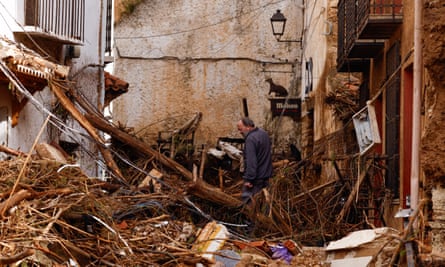
Pedestrians look at piled-up cars in Sedavi, south of Valencia city, after deadly floods. Photograph: José Jordan/AFP/Getty Images

 Residents describe impact of floods and downpours – with some places hit with a year’s worth of rain in just eight hours

The gratitude that greeted Tuesday’s dawn downpours was short-lived in Utiel. When the longed-for rains finally reached the town in the drought-stricken eastern Spanish region of Valencia, they were merciless in their abundance.

“People were very happy at first because they’d been praying for rain as their lands needed water,” said Remedios, who owns a bar in Utiel. “But by 12 o’clock, this storm had really hit and we were all pretty terrified.”

Trapped in the bar, she and a handful of her customers could only sit and watch as Spain’s worst flooding in almost 30 years caused the Magro River to overflow its banks, trapping some residents in their homes and sending cars and rubbish bins surging through the streets on muddy flood waters.

Damaged cars lie amid debris along damaged rail lines in the flood-hit city of Valencia. Photograph: Manuel Bruque/EPA


“The rising waters brought mud and stones with them and they were so strong that they broke the surface of the road,” said Remedios, who gave only her first name.

“The tunnel that leads into the town was half-full of mud, trees were down and there were cars and rubbish containers rolling down the streets. My outside terrace has been destroyed – the chairs and shades were all swept away. It’s just a disaster.”

By Wednesday afternoon, the death toll in Valencia and the neighbouring regions of Castilla-La Mancha and Andalucía stood at 95 . Utiel’s mayor, Ricardo Gabaldón, told Las Provincias newspaper that some of the town’s residents had not survived the floods, but was unable to provide an exact number.

Hours earlier, Gabaldón had told Spain’s national broadcaster, RTVE, that Tuesday had been the worst day of his life. “We were trapped like rats,” he said. “Cars and rubbish containers were flowing down the streets. The water was rising to 3 metres.”

 People in the town fear some of the dead may have been older people who were unable to escape the flood waters. Remedios said: “Anyone who could get to higher ground did, but there were some old people who couldn’t even open their front doors and they were trapped there inside their own houses.”


Residents of La Torre, on the outskirts of Valencia city, were confronted by similar scenes on Wednesday morning.

“The neighbourhood is destroyed, all the cars are on top of each other, it’s literally smashed up,” Christian Viena, a bar-owner in the area, told the Associated Press by phone. “Everything’s a total wreck, everything is ready to be thrown away. The mud is almost 30cm deep.”

A man carries a dog in Letur, Albacete province, after flash floods hit the region. Photograph: Mateo Villalba Sanchez/Getty Images

Spain’s meteorological office, Aemet, said that more than 300 litres of rain per square metre (30cm) had fallen in the area between Utiel and the town of Chiva, 20 miles (50km) away, on Tuesday. In Chiva, it noted, almost an entire year’s worth of rain had fallen in just eight hours.

The ferocious rains have come as Spain continues to experience a punishing drought. Last year, the government approved an unprecedented €2.2bn (£1.9bn) plan to help farmers and consumers cope with the enduring lack of rain amid warnings that the climate would only get worse, and more unpredictable, in the future.

“Spain is a country that is used to periods of drought but there’s no doubt that, as a consequence of the climate change we’re experiencing, we’re seeing far more frequent and intense events and phenomena,” the environment minister, Teresa Ribera, said.

As Wednesday wore on, a distressing picture of the human and economic damage began to emerge. Spain declared three days of national mourning.


The prime minister, Pedro Sánchez, said the entire country felt the pain of those who had lost their loved ones, and urged people to take every possible precaution as the torrential rains moved to the north-east of the country.

The defence minister, Margarita Robles, said 1,000 members of the military emergencies unit had been deployed to help regional emergency services. In a sign that more bodies could be trapped in the mud and in houses, she also offered mobile morgues.

One man used a phone call to RTVE to plead for any news of his son, Leonardo Enrique Rivera, who had gone missing in his Fiat van after going to work as a delivery driver in the Valencian town of Riba-roja on Tuesday.

A man walks among the debris in Letur.

A man picks his way through debris in Letur. Photograph: Susana Vera/Reuters


“I haven’t heard from him since 6.55 yesterday,” said Leonardo Enrique. “It was raining heavily and then I got a message saying the van was flooding and that he’d been hit by another vehicle. That was the last I heard.”

Esther Gómez, a town councillor in Riba-roja, said workers had been stuck overnight in an industrial estate “without a chance of rescuing them” as streams overflowed. “It had been a long time since this happened and we’re scared,” she told Agence France-Presse.

As the search for the dead continued, experts warned that the torrential rains and subsequent floods were further proof of the realities of the climate emergency.

“No doubt about it, these explosive downpours were intensified by climate change,” said Dr Friederike Otto, leader of world weather attribution at the Centre for Environmental Policy, Imperial College London.

“With every fraction of a degree of fossil fuel warming, the atmosphere can hold more moisture, leading to heavier bursts of rainfall. These deadly floods are yet another reminder of how dangerous climate change has already become at just 1.3C of warming. But last week the UN warned that we are on track to experience up to 3.1C of warming by the end of the century.”

There were similar, if differently expressed, sentiments in Utiel on Wednesday. “There was one guy here with me yesterday who’s 73, and he said he’d never seen anything like this in all his years,” said Remedios. “Never.”


Sunday, May 12, 2024

(Artic Melting) - Afghanistan flash floods kill more than 300 as torrents of water and mud crash through villages - theguardian.com


 Afghan men shovel mud from a house following flash floods after heavy rains at a village in the Baghlan-e-Markazi district of northern Afghanistan’s Baghlan province on Saturday. Photograph: Atif Aryan/AFP/Getty Images

More than 300 people were killed in flash floods that ripped through multiple provinces in Afghanistan, the UN’s World Food Programme said, as authorities declared a state of emergency and rushed to rescue the injured.

Many people remained missing after heavy rains on Friday sent roaring rivers of water and mud crashing through villages and across agricultural land in several provinces, causing what one aid group described as a “major humanitarian emergency”.

Survivors picked through muddy, debris-littered streets and damaged buildings on Saturday as authorities and non-governmental groups deployed rescue workers and aid, warning that some areas had been cut off by the flooding.


Northern Baghlan province was one of the hardest hit, with more than 300 people killed there alone, and thousands of houses destroyed or damaged, according to the World Food Programme.

“On current information: in Baghlan province there are 311 fatalities, 2,011 houses destroyed and 2,800 houses damaged,” said Rana Deraz, a communications officer for the UN agency in Afghanistan.

There were disparities between the death tolls provided by the government and humanitarian agencies.

The UN’s International Organisation for Migration said on Saturday that there were 218 deaths in Baghlan. Abdul Mateen Qani, spokesman for the interior ministry, told Agence France-Presse that 131 people had been killed in Baghlan, but that the government toll could rise.

“Many people are still missing,” he said.

Another 20 people were reported dead in northern Takhar province and two in neighbouring Badakhshan, he added.

 Taliban government spokesman Zabihullah Mujahid said on Twitter/X: “Hundreds of our fellow citizens have succumbed to these calamitous floods.”

 He added: “The deluge has wrought extensive devastation upon residential properties, resulting in significant financial losses.”


Torrential rains caused heavy damage in Baghlan, Takhar and Badakhshan, as well as western Ghor and Herat provinces, officials said, in a country racked by poverty and heavily dependent on agriculture.

“My house and my whole life was swept away by the flood,” said Jan Mohammad Din Mohammad, a resident of the Baghlan provincial capital, Pul-e-Khumri.

His family had managed to flee to higher ground but when the weather cleared and they returned home, “there was nothing left, all my belongings and my house had been destroyed”, he said.

“I don’t know where to take my family … I don’t know what to do.”

Emergency personnel were rushing to rescue injured and stranded Afghans. The air force said it had started evacuation operations as skies cleared on Saturday, adding that more than 100 injured people had been transferred to hospital.

“By announcing the state of emergency in [affected] areas, the ministry of national defence has started distributing food, medicine and first aid to the impacted people,” it said.

A vehicle laden with food and water was seen in Baghlan’s Baghlan-i-Markazi district, as well as others carrying the dead to be buried.

  The bodies of Afghans killed in the floods are placed on the ground in Baghlan province, northern Afghanistan, on Saturday. Photograph: Mehrab Ibrahimi/AP


The UN secretary general, António Guterres, “expresses his solidarity with the people of Afghanistan [and] extends his condolences to the families of the victims”, said his spokesperson, Stephane Dujarric, adding that the UN was working with local authorities on providing assistance.

The International Rescue Committee (IRC) was also preparing a rapid response, adding that the floods should act as an “alarm bell” reminding world leaders and donors not to forget a country devastated by decades of conflict and beset by natural calamity.

“These latest floods have caused a major humanitarian emergency in Afghanistan, which is still reeling from a string of earthquakes” this year and severe flooding in March, IRC country director Salma Ben Aissa said.

Since mid-April, flash flooding and other floods had left about 100 people dead in 10 of Afghanistan’s provinces, authorities said.

Farmland has been swamped in a country where 80% of the more than 40 million people depend on agriculture to survive.

Afghanistan – which had a relatively dry winter, making it more difficult for the soil to absorb rainfall – is highly vulnerable to climate change.

The nation, ravaged by four decades of war, is one of the world’s poorest and, according to scientists, one of the worst prepared to face the consequences of global warming.

The UN special rapporteur for human rights in Afghanistan, Richard Bennett, said on Twitter/X that the floods were “a stark reminder of Afghanistan’s vulnerability to the climate crisis”.

“Both immediate aid and long term planning by the Taliban and international actors are needed.”

Tuesday, September 12, 2023

Tempestade deixa 2.000 mortos, 10.000 desaparecidos e cria “cidade fantasma” na Líbia


Número de mortos por tempestade na Líbia sobe para 5.200. 


Tempestade Daniel cruzou o Mediterrâneo e causou enchentes na Líbia Reuters 


Hamdi AlkhshaliMostafa SalemKareem El Damanhouryda CNN


Cerca de 2.000 pessoas morreram e 10.000 estão desaparecidas após as chuvas provocadas pela tempestade Daniel causarem o rompimento de duas barragens no nordeste da Líbia, fazendo com que a água fluísse para áreas já inundadas.

“O número de mortos é enorme e cerca de 10.000 estão desaparecidos”, disse Tamer Ramadan, chefe da delegação da Federação Internacional das Sociedades da Cruz Vermelha e do Crescente Vermelho (FICV) na Líbia, durante uma conferência de imprensa em Genebra, nesta terça-feira (12).

Cerca de 6.000 pessoas estão desaparecidas só na cidade de Derna, disse Othman Abduljalil, ministro da Saúde do governo apoiado pelo parlamento oriental da Líbia, à TV Almasar da Líbia.


Abduljalil, ministro da Saúde do governo apoiado pelo parlamento oriental da Líbia, visitou Derna, a cidade mais atingida do país, na segunda-feira (12), descrevendo partes dela como uma “cidade fantasma”.

“A situação [em Derna] era catastrófica. Os corpos continuam espalhados em muitos lugares”, disse Abduljalil à TV Almasar da Líbia.

“Há famílias ainda presas dentro de suas casas e há vítimas sob os escombros. Presumo que as pessoas tenham sido arrastadas para o mar e amanhã (terça-feira) de manhã encontraremos muitas delas”, disse ele.

Derna é apenas uma área afetada pelas inundações que varreram várias cidades no nordeste do país, na costa do Mar Mediterrâneo.

A chuva é o resultado de um sistema muito forte de baixa pressão que provocou inundações catastróficas na Grécia na semana passada e deslocou-se para o Mediterrâneo antes de se transformar num ciclone tropical conhecido como Medicane (do inglês, furacão do Mediterrâneo). O sistema climático é semelhante às tempestades tropicais e furacões no Atlântico ou aos tufões no Pacífico.

Anteriormente, a Cruz Vermelha da Líbia estimou que mais de 300 pessoas morreram em Derna, de acordo com uma publicação nas redes sociais.

Ahmed Mismari, porta-voz do Exército Nacional da Líbia (LNA), baseado no leste, disse que duas barragens ruíram sob a pressão das inundações.

“Como consequência, três pontes foram destruídas. A água corrente levou bairros inteiros, acabando por depositá-los no mar”, disse ele.

O chefe da autoridade de Emergência e Ambulâncias da Líbia, Osama Aly, disse à CNN que após o rompimento da barragem “toda a água foi direcionada para uma área perto de Derna, que é uma área costeira montanhosa”.

As casas nos vales foram arrastadas por fortes correntes lamacentas que transportavam veículos e detritos, acrescentou. As linhas telefônicas na cidade também caíram, complicando os esforços de resgate, disse Aly, com os trabalhadores impossibilitados de entrar em Derna devido à forte destruição.

Aly disse que as autoridades não previram a escala do desastre.

“As condições meteorológicas não foram bem estudadas, os níveis da água do mar e das chuvas [não foram estudados], as velocidades do vento, não houve evacuação de famílias que poderiam estar no caminho da tempestade e nos vales”, disse Aly.

“A Líbia não estava preparada para uma catástrofe como esta. Nunca testemunhou esse nível de catástrofe antes. Admitimos que houve deficiências, embora esta seja a primeira vez que enfrentamos esse nível de catástrofe”, disse Aly ao canal Al Hurra anteriormente.

Mismari, porta-voz do LNA, disse que as inundações afetaram várias cidades, incluindo Al-Bayda, Al-Marj, Tobruk, Takenis, Al-Bayada e Battah, bem como a costa oriental até Benghazi.


‘Inundações sem precedentes’

A Líbia, um país de seis milhões de habitantes, está dividida entre facções em conflito desde 2014, após a revolta de 2011 apoiada pela Otan contra Muammar Gadhafi.

O chefe do governo apoiado pelo parlamento oriental da Líbia, Osama Hamad, descreveu a situação como “catastrófica e sem precedentes”, de acordo com um relatório da organização de notícias estatal Agência de Notícias da Líbia (LANA).

Imagens compartilhadas nas redes sociais mostraram carros submersos, prédios desabados e torrentes de água correndo pelas ruas.

Hospitais na cidade oriental de Bayda foram evacuados após graves inundações causadas por chuvas causadas por uma forte tempestade, conforme mostraram vídeos compartilhados pelo Centro Médico de Bayda no Facebook.

“As Nações Unidas na Líbia acompanham de perto a emergência causada pelas condições meteorológicas severas na região oriental do país”, disse a Missão de Apoio das Nações Unidas na Líbia numa publicação no X, anteriormente chamado de Twitter.

Vários países enviaram as suas condolências e ofereceram ajuda à Líbia enquanto as equipas de resgate lutam para encontrar sobreviventes sob os escombros e escombros.

Aviões turcos que entregam ajuda humanitária chegaram à Líbia, segundo a Autoridade de Gestão de Emergências da Turquia (AFAD) nesta terça-feira (12).

O presidente turco, Recep Tayyip Erdogan, disse que o país enviaria 168 equipes de busca e resgate e ajuda humanitária para Benghazi, segundo a agência de notícias estatal Anadoulu Agency na terça-feira.

A Embaixada dos EUA na Líbia disse no X, que estava em “contato próximo com as Nações Unidas e com as autoridades na Líbia para determinar a rapidez com que podemos levar a assistência onde é mais necessária”.

O presidente dos Emirados Árabes Unidos, Zayed Al Nahyan, ordenou o envio de ajuda e equipes de busca e resgate, ao mesmo tempo que oferece suas condolências às pessoas afetadas pela catástrofe, informou a agência de notícias estatal.


Thursday, September 7, 2023

Ciclone do RS: nove moradores de Muçum estão desaparecidos, diz governo


Destroços de casas atingidas por enchente após passagem de ciclone extratropical, em Muçum (RS) — Foto: REUTERS/Diego Vara


Sobe para 46 o número de desaparecidos

https://g1.globo.com/rs/rio-grande-do-sul/noticia/2023/09/08/temporal-no-rs-sobe-para-o-numero-de-desaparecidos.ghtml 

Nove moradores de Muçum, na Região Central do estado, estão desaparecidos após a passagem do ciclone extratropical e as intensas chuvas que atingiram o RS no início da semana. O levantamento foi publicado pela Defesa Civil estadual, na noite de quarta-feira (6).

O número de mortes registradas na cidade foi atualizado, após revisão. Dos 15 óbitos registrados inicialmente, o total foi atualizado para 14. A cidade é a que mais registra mortes após a passagem do ciclone.

Nesta quarta-feira (6), os corpos das vítimas de Muçum e das de Roca Sales foram levados ao Departamento Médico Legal de Porto Alegre, para a identificação.


Os nomes dos desaparecidos não foram divulgados pela Defesa Civil. Além da estatística estadual, prefeituras também têm contabilizado relatos de pessoas que não haviam sido encontradas por parentes. Em Estrela, no Vale do Taquari, a prefeitura divulgou nesta quarta uma lista com mais de 30 nomes de pessoas consideradas desaparecidas.

No total, são 37 mortes. Veja abaixo por cidades:

  • Cruzeiro do Sul - 3
  • Encantado - 1
  • Estrela - 2
  • Ibiraiaras - 2
  • Lajeado - 3
  • Mato Castelo - 1
  • Muçum - 14
  • Passo Fundo - 1
  • Roca Sales - 9
  • Santa Tereza - 1


Com pouco mais de 4,6 mil habitantes, Muçum sofreu de forma severa com os impactos da chuva. Vias foram tomadas pela água que inundou o município. De acordo com as autoridades, mais de 85% da cidade foi atingida pela enchente, incluindo residências, escolas, estabelecimentos comerciais, o hospital e o cemitério. 

 As mortes registradas no Rio Grande do Sul já superam a maior tragédia natural das últimas quatro décadas no estado, quando 16 pessoas morreram em junho. 


Wednesday, May 17, 2023

Devastating floods in Italy claim lives and leave thousands homeless

 Angela Giuffrida in Rome
Wed 17 May 2023 20.59 BST

Twenty-one rivers burst their banks after heavy storms across country cause landslides and submerge villages

People call for help as extreme floods engulf houses and roads in Italy 

Nine people have died and thousands have been evacuated from their homes after heavy storms wreaked havoc in the northern Italian region of Emilia-Romagna, causing severe flooding and landslides.

People sought refuge on the rooftops of their homes after 21 rivers broke their banks, submerging entire towns.

Among the victims were an elderly man and a couple who owned a company in the agriculture sector, according to Corriere della Sera. The body of a German woman was found on a beach in Cesenatico, a town by the Adriatic coast, but it is unclear if she was killed in the storms. Others are still reported missing.

The Emilia Romagna F1 Grand Prix scheduled this weekend has been cancelled.

“The only irreparable thing in this emergency are the nine people who lost their lives, and we hope there are no more,” said Stefano Bonaccino, president of Emilia Romagna.

Italy’s civil protection agency said on Wednesday there could be worse to come. “The rainfall is not over, it will continue for several hours,” the agency’s chief, Titti Postiglione, told SkyTG24 news. “We are facing a very, very complicated situation.”


The Savio River in Cesena, central Italy, which burst its banks. Photograph: AP


There has been heavy rain across Italy in recent days but the worst-affected area has been Emilia-Romagna and parts of the central Marche region, where 12 people died in floods last September.

In a video shared on social media, the voices of people trapped in their homes in Faenza, a city in Ravenna province, could be heard shouting for help. Massimo Isola, the mayor of Faenza, said: “We had a night that we will never forget. We’ve never known such flooding in our city, it is something unimaginable.”

Enzo Lattuca, the mayor of Cesena, where citizens swam through the floods to rescue others, said: “The situation is disastrous, it’s a catastrophe, and the rain has not yet finished.”

He said on Wednesday morning the River Savio was starting to swell again.


Emilia-Romagna and parts of Marche have been badly affected by heavy rain, floods and landslides


A bridge that connected Motta-Budrio with San Martino in the area of Bologna collapsed overnight. “Do not go near it,” Italy’s fire service warned. “There is a gas pipeline close by which also seems to be affected.”

Five thousand people were evacuated from their homes in Ravenna. “It’s probably the worst night in the history of Romagna,” Michele de Pascale, the mayor of Ravenna, told Rai radio. “Ravenna is unrecognisable for the damage it has suffered.”

Dario Nardella, the mayor of Florence, said mountain villages on the Romagna side of the Mugello valley had been cut off due to landslides.


UK must stockpile food in readiness for climate shocks or war, expert warns. Prof Tim Lang says country produces far less food than it needs to feed population and is particularly vulnerable

  The UK is one of the least food self-sufficient countries in Europe. Photograph: Major Gilbert/Alamy by   Helena Horton Environment repo...