Showing posts with label Algae. Show all posts

Monday, September 7, 2026

‘Extremely rare event:’ Miles-long microalgae bloom knocks out most of Israel’s desalination plants

A microalgae bloom has spread along Israel's Mediterranean coast. Israel Oceanographic and Limnological Research institute

by  


A miles-long microalgae bloom in the Mediterranean Sea has been blamed for temporarily knocking offline many of Israel’s major desalination plants this week, threatening its main source of drinking water.

Five of the country’s six coastal desalination plants — which convert seawater into drinkable water — shut down on Sunday, according to Mekorot, Israel’s national water company. Since then, some of these facilities, which are privately owned and operated, have partially resumed operations, but only one was operating at full capacity on Thursday.

“An event of this kind has never occurred before in Israel … it was an extremely rare event,” said Lior Gutman, a spokesperson for Mekorot, although he stressed in roughly 99% of cases, there has been no drinking water shortage. 


Still, it’s an alarming situation given the country’s heavy dependence on desalination for drinking water. Israel is arid and has neither big rivers nor abundant rainfall, but its mastery of this technology has made it a water superpower. Desalination now provides at least 65% of its drinking water, with most plants located on the Mediterranean coast.

The problems started at the weekend, as a “sporadic, vast event of contaminates occurred across the Israeli coastline,” said Edo Bar-Zeev, an associate professor in water research at Ben-Gurion University, in Israel. When he and other scientists looked closer, they discovered it was microalgae, tiny organisms that feed on sunlight, carbon dioxide and nutrients in the water — and which can grow rapidly. 

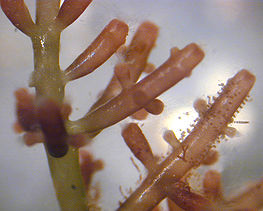
Microscope images of microalgae from the bloom that formed along the Israeli coast. Tali Covas


The microalgae bloom — stretching more than a dozen miles at least, according to Bar-Zeev — is believed to have originated in the Nile Delta and traveled northward with the sea’s currents up Israel’s coast. This is “the first time I saw something in this extent,” said Bar-Zeev, who has been testing the coastal water for 20 years.

The country’s desalination facilities mostly use a technology called “reverse osmosis,” where water is pre-treated to remove larger contaminants, before it’s pushed through membranes which filter out salt, bacteria and other molecules to leave clean drinking water. 

 Algae, and the substances they produce, can foul and damage the membranes, said Michael Christopher Low, director of the Middle East Center at the University of Utah. If there’s too much suspended material in the water, the treatment processes cannot keep up. 


It’s happened before. A severe “red tide” — a harmful algae bloom — in the Gulf of Oman in 2008 and 2009 affected many desalination plants in that region.

In Israel, the government water system has “stepped in to close the gap” caused by the plant closures, Mekorot’s Gutman said. This has included pumping water from the Sea of Galilee, activating groundwater wells and using national water reserves.

Some cities have faced short-term local restrictions, including on garden irrigation and filling swimming pools, but the the main limitations affected farmers who use drinking water-quality water for irrigation, as opposed to those who use recycled water, Gutman said.

The timing compounded the problem. It happened in summer “when water demand in Israel is at its highest,” he said, adding “the situation has been challenging.” 

Israel's Water Authority places drinking water storage tanks near Damascus Gate in Jerusalem, Israel, on August 31, 2026, as part of emergency preparations after five of Israel's six seawater desalination plants were temporarily shut down. Mostafa Alkharouf/Anadolu/Getty Images


A bloom occurs when the right combination of environmental factors in the water come together that allow the algae to grow rapidly, said Tamar Guy-Haim, a marine ecologist at the Israel Oceanographic and Limnological Research Institute. These include nutrients, temperature, light, currents and mixing.

Mekorot said this recent bloom was part of “very unusual combination of factors,” including a sea storm that increased turbidity — the amount of suspended matter in the water — and raised sea temperatures to 86 Fahrenheit (30 degrees Celsius) and above. 


The extent of the disruption is striking. Desalination facilities have been forced to close before due to algae or jellyfish, “but multiple facilities over the large portion of our coast is something that is definitely abnormal,” Ben-Zeev said.

It’s something the country needs to figure out how to deal with — and will, he added. “It’s a fair estimation that this will not be a once-in-a-lifetime kind of event … you can assume that this will occur more and more through climate change.”

As the planet heats up, driven by humans burning fossil fuels, the oceans are changing. Temperatures are at record highs, currents are shifting and stronger storms wash more pollutants into the water, including sewage and fertilizers, which can trigger huge algae blooms. 

The Sorek desalination plant near the Israeli city of Rishon LeZion on November 22, 2021. This plant was one of the five temporarily knocked offline. Gil Cohen Magen/Xinhua/Getty Images


This temporary crisis also exposes a broader concern, experts say.

Desalination is becoming increasingly popular, especially as the climate crisis drives more severe heat and drought, undermining water security. But this growing dependence on a centralized, technical solution carries risks. “This event is causing considerable alarm and even some criticism that the system is too vulnerable to a dramatic disruption,” Low said. 


This could be natural or climate change-driven events, but there’s also the possibility of military and cyber threats. Desalination plants in the Gulf have been targeted and damaged during the US-Iran war, raising significant alarm in a region that depends overwhelmingly on this technology. Hackers have also targeted water facilities, including in the US.

Oil spills are another big concern. “It’s not if, it’s just when an oil spill in the vicinity of desalination facilities will occur,” Ben-Zeev said. A lot of plants are in water-scarce countries that are also big oil producers, such as the Gulf states.

A spill could potentially take plants offline for a much longer time than this microalgae bloom, he added. “That to me is way more worrying.”

Sunday, June 15, 2025

Deadly algal bloom in South Australia’s Coorong an environmental ‘eye opener’, ecologist says


Dead and dying polychaete worms at the southern end of Coorong’s North Lagoon. Photograph: Glen Hill

by 

 Among the dead in the internationally significant wetland are estuarine snails, shore crabs, baby flounder and ‘a thick stew of polychaete worms’


When South Australia’s algal bloom arrived in the Coorong, it stained the water like strong tea before turning it into a slurry of dead worms.

Many had hoped the storm in late May would break up the bloom of Karenia mikimotoi algae, which has killed more than 200 different marine species. Instead, high tides swept the algae into the Coorong, an internationally significant Ramsar wetland at the mouth of the Murray River.

Once there, the algae began “reproducing madly” in the nutrient rich waters of the North Lagoon, according to estuarine ecologist Faith Coleman.

Among the dead were mostly benthic species – estuarine snails, shore crabs, baby flounder and “a thick stew of dead polychaete worms” – a crucial food source for shorebirds and fish.


Levels had declined from their peak but the smell of rotting fish remained, along with algal spores buried in the sediment. “As soon as it warms up again, the likelihood is [the algal bloom will] be back,” Coleman said.

The marine heatwave, a contributing factor to the bloom, persisted off the coast of SA, according to an 11 June update, which showed increases in chlorophyll – an indicator of algae concentrations – along the Coorong coast and western Gulf Saint Vincent.


Fourth generation fisherman Gary Hera-Singh was one of the first to notice the lagoon’s colour turn a “dark, orangey-brown”.

“We had a big storm event, a lot of seawater got pushed around, and this algal bloom found its way into the Coorong and has just created havoc since,” he said, and there were still “massive patches – 100 acres at a time” where the bloom was flourishing.

Hera-Singh has witnessed the health of the Coorong decline in his lifetime, but said in 41 years of fishing the impact of the algal bloom was the worst event he had seen.

The Coorong, a 120km narrow band of water separated by sand dunes from the Southern Ocean, together with lakes Alexandrina and Albert, is considered a wetland of international significance, providing critical habitat for fish, water birds and many threatened species. The North Lagoon – the area affected – is an important nursery for fish such as mulloway and bream.

 Prof Peter Gell, an expert in Ramsar listed wetlands, said the wetlands had degraded over a long period of time, with barrages (structures that control water flow) added in the 1950s, higher nutrient loads and extended periods of reduced flow from the Murray.


Algal blooms were symptoms of broader changes, he said. “Because of this we’re seeing – both offshore and within the Coorong – substantial changes in the food web.”

As a wetland of international significance, the Australian government was obliged to report environmental changes to the Coorong under the Ramsar convention, Gell said, a process that usually triggered restoration efforts.

Federal and state governments were liaising about the situation, including any long-term impacts likely to affect the ecological character of the Coorong, a federal environment department spokesperson said.

“We understand that, given the dynamics of the North Lagoon, it is difficult to dissipate the bloom and it might remain for some time.”

Fresh water may help the situation, Coleman said, given the algae thrived at salinity levels of 18-37 grams per litre. Restoration efforts would help build the resilience of the Coorong and marine areas, she said.

The system was already under pressure, said Dr Nick Whiterod, an ecologist and science program manager at the Coorong Lower Lakes Murray Mouth Research Centre. But the recent drought and unusual algal blooms had been “eye openers” to many people, he said.

Last year, a tropical species of blue-green algal bloomed in Lake Alexandrina for the first time, and had persisted, Whiterod said. Now that karenia mikimotoi had got into the Coorong, there was concern it too would bloom again.

The Coorong was vulnerable to the impacts of climate change, like sea level rise and reduced river flows, he said.

“Ocean temperatures are heating up. It’s creating conditions that are conducive to algal blooms all around the world,” he said. “Our ecosystems are really stressed, we are getting to a period of time where some may not have the capacity to recover.”


Friday, June 12, 2009

European body sees algae fuel industry in 10-15 years


By Svetlana Kovalyova

MILAN (Reuters) - Industrial-scale production of bioenergy from algae, or seaweeds, can be expected in 10 to 15 years, helping Europe to reach its green energy targets, the top official at a newly created bioenergy body said on Wednesday.

Companies around the world are racing to find economic ways to make biofuels from algae, one of the planet's oldest life forms. Such fuels are considered to be net carbon neutral because the algae absorbs greenhouse gases when they grow.

Research into algae-made biofuels has been active in the last 3 to 5 years, but it would take another 10 to 15 years to turn laboratory experiments into industrial-scale production, said Raffaello Garofalo, executive director of the European Algae Biomass Association.

"It will happen in the longer term, 10 to 15 years ... There are still challenges and problems to resolve," Garofalo told Reuters in a telephone interview from Florence, Italy, where the EABA was officially launched on Wednesday.

The new association unites 54 members representing science and industry and aims to be the platform for creating a full algae-based production chain, from biofuels to animal feed and nutrients, Garofalo said.

Making biodiesel from algae costs at least 10 to 30 times more than making traditional biofuels at present, he said.

But extracting value from by-products, which can be used in animal feed or pharmaceutical industries, would help bring down overall price and make algae fuel competitive with traditional fuels faster, he said, adding that he saw a competitive price level at about $500 to $550 per tonne of biodiesel.

Garofalo brushed off concerns that lower oil prices can push development of biofuels, including those made from algae, to the back burner because the world needs new technologies to reduce carbon emissions and fight climate change.

"Algae have a potential to provide answers in this respect: There is no competition food versus energy. There is no impact on land use and algae absorb CO2 as they grow," he said.

Pilot projects to make energy from algae have been operating in Portugal, Italy and other countries, Garofalo said but warned against expectations of quick technological break-though or start of industrial production.

"One of the risks of algae business is the risk of over-enthusiastic announcements ... The potential is enormous but the challenges remain very important too," he said.

Garofalo, also secretary general of the European Biodiesel Board, said Europe's biodiesel output in 2008 was slightly higher than in 2007, but declined to give precise figure.

The European Union's biodiesel output came in at 5.7 million tonnes in 2007, up 17 percent from 2006, according to EBB data on its Web site.

(Editing by Lisa Shumaker) - REUTERS

European body sees algae fuel industry in 10-15 years


By Svetlana Kovalyova

MILAN (Reuters) - Industrial-scale production of bioenergy from algae, or seaweeds, can be expected in 10 to 15 years, helping Europe to reach its green energy targets, the top official at a newly created bioenergy body said on Wednesday.

Companies around the world are racing to find economic ways to make biofuels from algae, one of the planet's oldest life forms. Such fuels are considered to be net carbon neutral because the algae absorbs greenhouse gases when they grow.

Research into algae-made biofuels has been active in the last 3 to 5 years, but it would take another 10 to 15 years to turn laboratory experiments into industrial-scale production, said Raffaello Garofalo, executive director of the European Algae Biomass Association.

"It will happen in the longer term, 10 to 15 years ... There are still challenges and problems to resolve," Garofalo told Reuters in a telephone interview from Florence, Italy, where the EABA was officially launched on Wednesday.

The new association unites 54 members representing science and industry and aims to be the platform for creating a full algae-based production chain, from biofuels to animal feed and nutrients, Garofalo said.

Making biodiesel from algae costs at least 10 to 30 times more than making traditional biofuels at present, he said.

But extracting value from by-products, which can be used in animal feed or pharmaceutical industries, would help bring down overall price and make algae fuel competitive with traditional fuels faster, he said, adding that he saw a competitive price level at about $500 to $550 per tonne of biodiesel.

Garofalo brushed off concerns that lower oil prices can push development of biofuels, including those made from algae, to the back burner because the world needs new technologies to reduce carbon emissions and fight climate change.

"Algae have a potential to provide answers in this respect: There is no competition food versus energy. There is no impact on land use and algae absorb CO2 as they grow," he said.

Pilot projects to make energy from algae have been operating in Portugal, Italy and other countries, Garofalo said but warned against expectations of quick technological break-though or start of industrial production.

"One of the risks of algae business is the risk of over-enthusiastic announcements ... The potential is enormous but the challenges remain very important too," he said.

Garofalo, also secretary general of the European Biodiesel Board, said Europe's biodiesel output in 2008 was slightly higher than in 2007, but declined to give precise figure.

The European Union's biodiesel output came in at 5.7 million tonnes in 2007, up 17 percent from 2006, according to EBB data on its Web site.

(Editing by Lisa Shumaker) - REUTERS

Drone footage shows severe drought hitting river in Brazil – video

  Drone footage from 17 September shows the Araguaia River drying up, as severe drought grips parts of Brazil. The country is preparing for ...