Showing posts with label Greenhouse Effect. Show all posts

Saturday, December 18, 2021

Incêndios, deslizamentos de terra, falta de neve: a indústria de esqui se prepara para batalha. USA


 De tempestades de fogo na região de Tahoe, na Califórnia, ao degelo das geleiras nos Alpes, as áreas de esqui enfrentam uma série assustadora de ameaças ambientais. Aqui está o que alguns resorts estão fazendo.


Do topo de uma pista de esqui intermediária chamada Ridge Run no resort Heavenly do Lake Tahoe, Bryan Hickman sabia o que estava em jogo.


Era final de agosto e nas últimas duas semanas o Fogo Caldor devastou a Floresta Nacional Eldorado na Califórnia. Quase 150.000 hectares de madeira, arbustos e grama preparados para a seca já haviam queimado e mais 72.000 hectares iriam pegar fogo antes da contenção em outubro. Centenas de casas em Grizzly Flats, uma comunidade de cerca de 2.000 pessoas, a sudoeste, foram perdidas.


A mudança climática 'e uma força motriz por trás dos incêndios catastróficos como este, colocou um dos destinos de inverno favoritos do país sob cerco.


Sierra at Tahoe, uma área de esqui de 2.000 acres, já estava envolta em chamas, e teleféricos como Short Stuff e as árvores ao redor de pistas como Dogwood e Clipper agora estao carbonizados. As brasas flutuaram nos padrões de vento da tempestade de fogo para as montanhas do outro lado do Vale do Natal, onde acenderam mais fogueiras que correram em direção às lojas de esqui, restaurantes e casas de South Lake Tahoe e da bacia de Tahoe. Chamas açoitaram um céu cor de fuligem enquanto eles se aproximavam de resorts como Kirkwood, ao sul, e agora Heavenly, que se estende pela linha Nevada-Califórnia.

Uma indústria em perigo

Cerca de 122 áreas de esqui nos Estados Unidos estão localizadas em áreas de floresta nacional - ou cerca de 60% de toda a capacidade de esqui alpino do país -, portanto, ameaças de fogo não são nenhuma novidade para eles. Dois novos resorts mexicanos, Pajarito Mountain Ski Area e Ski Apache, sofreram danos em incêndios florestais separados há cerca de uma década. Mas o esporte, junto com a pesca no gelo, hóquei em lagoas e mergulho autônomo perto de um recife de coral, pode ser uma espécie de indicador para os desafios agudos que as mudanças climáticas representam para a indústria de atividades ao ar livre de US $ 788 bilhões e suas legiões de entusiastas. Com uma estimativa de 15 milhões de pessoas indo para Tahoe anualmente, a região e as turbulências que sofreu no verão passado servem como talvez o outdoor mais visível e claro do que está por vir para as áreas de esqui atingidas por uma crise que não conhece estação.


“Sempre pensei que o clima iria prejudicar a indústria, com certeza, mas devido ao aquecimento, às temporadas mais curtas e ao colapso da primavera”, disse Auden Schendler, vice-presidente sênior de sustentabilidade da Aspen Skiing Company. “Agora acredito que a forma como estamos afundando é através do fogo.”


Os líderes da indústria de esqui e atividades ao ar livre não estão apenas esperando. Embora muitas áreas tenham planos robustos em caso de incêndio, as maiores empresas de esqui do país, incluindo Vail Resorts, Alterra, Powdr e Boyne, se uniram para lutar contra uma mudança climática que está tornando esses planos de incêndio mais relevantes. Áreas de esqui individuais também estão aumentando seus esforços na linha de frente, que agora vão muito além das luzes LED e da reciclagem. Ainda assim, o quão efetivo isso pode ser ainda está para ser visto.


“Até que tenhamos legislação em nível federal que resolva o problema, é realmente sobre adaptação e mitigação”, disse Mike Reitzell, presidente da Ski California, um grupo da indústria que representa 35 resorts na Califórnia e em Nevada. “Felizmente, a adaptação é algo em que somos realmente bons.”


O que exatamente está reservado para a indústria de esqui foi estudado pelo menos 120 vezes em 27 países até agora, mas os resultados pintam em grande parte o mesmo quadro, disse Daniel Scott, professor que pesquisa clima e sociedade na Universidade de Waterloo em Ontário. A duração média de uma temporada de esqui nos Estados Unidos encolheu pela primeira vez em quatro décadas durante a década de 2010, disse ele, e em 2050, a Nova Inglaterra pode esperar uma temporada de 13% a 22% mais curta do que a média. Na Europa, o Centro de Pesquisa de Ecossistemas Alpinos com sede em Chamonix descobriu que a primavera está chegando dois a cinco dias antes de cada década no Monte Branco. No oeste americano, é terrível. A quantidade de neve que ainda cobre as Montanhas Rochosas e Cascades em abril - uma importante fonte de água no verão para muitos - encolheu em média 19% entre 1955 e 2020, de acordo com dados compilados pela Agência de Proteção Ambiental.


“Já estamos pensando em nosso negócio de rafting de verão e o que acontecerá se houver menos água nos rios”, disse John McLeod, presidente e gerente geral da Mount Bachelor de Oregon, que também opera a loja de corredeiras de Bend, Sun Country Tours .


E há deslizamentos de terra, furacões, ventos destrutivos e outras condições meteorológicas estranhas e intensas que as áreas de esqui enfrentam. Em agosto de 2011, a tempestade tropical Irene atingiu Killington, Vermont, com tanta água que uma enchente desalojou o Superstar Pub de sua fundação e o fez desabar. Em fevereiro de 2020, um deslizamento de terra no Sasquatch Mountain Resort, na Colúmbia Britânica, deixou centenas de pessoas presas na colina.


Os impactos econômicos são surpreendentes. Um relatório de 2018 de pesquisadores da University of New Hampshire e da Colorado State University para o grupo de defesa Protect Our Winters mostra que os cinco invernos com menos neve entre 2001 e 2016 custaram à indústria cerca de US $ 1 bilhão e mais de 17.000 empregos por temporada. Scott, o professor de clima, acrescenta que os valores das propriedades de férias podem diminuir e as áreas de esqui que não conseguem produzir neve suficiente podem fechar. No Colorado, os trabalhadores já estenderam a produção de neve até o topo da Aspen Mountain de 11.212 pés de altura para que os gerentes possam administrar a metade superior desse resort de forma independente, prevendo a perda de corridas em altitudes mais baixas. As áreas de esqui que sobrevivem provavelmente ficarão mais lotadas, mesmo com a diminuição da população geral de esquiadores.


“Presumindo que a demanda permaneça próxima aos níveis atuais, o que os análogos dos recentes recordes de invernos quentes demonstraram”, disse o Sr. Scott, “os resorts terão que acomodar mais esquiadores em menos dias de esqui, com menos terreno aberto”.


Protegendo geleiras e "cultivo de neve"


Cientistas estimam que a Suíça pode perder 90 por cento de suas 1.500 geleiras restantes até o final do século, o que levou algumas áreas de esqui, como Engelberg, a cobrir suas geleiras no verão com tecidos que refletem o calor que retardam o derretimento. Essa técnica funciona, mas é muito cara, custando até US $ 8,60 para economizar um metro cúbico de gelo, revelou um estudo de abril de 2021 publicado na revista Cold Regions Science and Technology.


Outros experimentos nos Alpes envolvem geleiras nebulosas para formar camadas protetoras de neve. No Banff Sunshine Village do Canadá, os trabalhadores estão encontrando melhores maneiras de “cultivar neve” instalando 82.000 pés de cerca para reter a queda de neve natural que eles podem distribuir pelo resort em vez de gastar energia para fazer neve.


Aqui nos Estados Unidos, alguns resorts estão adicionando lascas de madeira em suas encostas no verão ou removendo rochas para que precisem de menos neve para esquiar no inverno. Mais de 200 áreas de esqui em todo o país assinaram uma iniciativa da NSAA para reduzir seu impacto ambiental em 10 áreas temáticas, incluindo energia, cadeias de abastecimento e água. Alguns dos projetos que surgiram nos últimos anos são “super legais”, diz a Sra. Isaac, mesmo que o retorno do investimento não seja tão robusto.


Copper Mountain, no Colorado, por exemplo, tem voluntários coletando sementes de flores silvestres nativas e gramíneas em todo o resort, que eles usam para restaurar áreas perturbadas. O plano poderia eventualmente incluir medir o carbono que esse esforço sequestra e empacotá-lo como compensações. Alta, em Utah, trabalhou para restaurar pântanos e florestas, enquanto o plantio de árvores faz parte do compromisso de Powdr “Play Forever” em suas propriedades.


Leia mais em  https://www.nytimes.com/2021/12/14/travel/global-warming-ski-resort.html

Thursday, June 23, 2016

Energia eólica já abastece mais de 30% do Nordeste do Brasil.


Energia eólica: hoje, os parques em operação na região são responsáveis pelo abastecimento de boa parte da população local de 56 milhões de pessoas.

O vento forte que não para de soprar fez da pequena Icaraí de Amontada, na costa oeste do Ceará, uma ilha de usinas eólicas. Elas geram energia elétricausando a força dos ventos.
Ali, para qualquer lado que se olhe, modernas e gigantescas torres de quase 150 metros de altura - do tamanho de um prédio de 42 andares - destoam do cenário rústico da antiga vila de pescadores, com suas dunas, praias e lagoas. Reduto de atletas estrangeiros praticantes de kitesurf e windsurf, a comunidade, de 2,4 mil habitantes, entrou para a lista dos melhores ventos do Brasil e ajudou a elevar a participação da energia eólica para mais de 30% do consumo do Nordeste.
Os parques instalados na região de Amontada estão entre os mais eficientes do planeta. Enquanto no mundo, as usinas eólicas produzem, em média, 25% da capacidade anual, no Complexo de Icaraí esse porcentual é mais que o dobro.
As 31 torres que compõem o parque produzem 56% da capacidade anual. Para ter ideia do que isso significa, nos Estados Unidos, esse indicador é de 32,1%; e na Alemanha, uma das maiores potências eólicas do mundo, de 18,5%. "O vento noNordeste é muito diferenciado", afirma Luciano Freire, diretor de engenharia da Queiroz Galvão Energia, dona do complexo eólico de Icaraí.
É por causa da qualidade desse vento - forte e constante - que o Nordeste despontou como uma das maiores fronteiras eólica do mundo. Hoje, os parques em operação na região são responsáveis pelo abastecimento de boa parte da população local de 56 milhões de pessoas.
Não é difícil entender a rápida expansão das eólicas no Brasil. Em 2008, com a crise internacional, o consumo mundial de energia despencou, paralisou uma série de projetos e deixou as fábricas ociosas. Em busca de demanda, elas desembarcaram no Brasil - onde o uso da energia crescia a taxas de dois dígitos - e derrubou o preço das eólicas, até então caras por aqui. A partir de 2009, com leilões dedicados à essa fonte de energia, os investimentos decolaram. De lá pra cá, o setor recebeu R$ 67 bilhões, segundo dados da Associação Brasileira de Energia Eólica (Abeeólica).
Esse montante colocou o País na 10ª posição entre as nações com maior capacidade instalada do mundo. Foi um grande avanço. Até 2008, a potência do parque eólico brasileiro era de 27 megawatts (MW). No mês passado, alcançou a marca de 9,7 mil MW, volume suficiente para abastecer mais de 45 milhões de habitantes. No total, são 5.141 turbinas instaladas Brasil afora. Cerca de 82% delas estão no Nordeste.
Conta
Os moradores de Icaraí de Amontada ainda se fazem algumas perguntas. Questionam o impacto que as usinas podem causar à região no decorrer dos anos e não entendem por que continuam pagando uma conta de luz tão alta se os parques eólicos estão praticamente no seu quintal. "Deveríamos ter energia elétrica de graça", afirma Raimunda Alves dos Santos, que paga R$ 180 por mês de luz.
Entre os moradores, essa é uma reclamação recorrente. É difícil compreender por que uma energia produzida com o vento - que é de graça - pode ser tão cara. Se eles fizessem essa pergunta às empresas geradoras, teriam como resposta uma explicação complexa, que envolve toda a estrutura do setor. "O Brasil funciona como um sistema único, a precificação é nacional e não regional", diz a presidente da Associação Brasileira de Energia Eólica (Abeeólica), Elbia Gannoum.
Em outras palavras, significa dizer que todos os custos do setor são divididos entre todos os consumidores do País. Para a eólica começar a fazer diferença na conta de luz dos nordestinos, é necessário que ela ganhe participação não só na região, mas em todo o País.
Com alguns raros projetos de Pequenas Centrais Hidrelétricas (PCH) em desenvolvimento no Estado de Pernambuco e sem potencial para grandes hidrelétricas, a vocação do Nordeste tem se inclinado cada vez mais para a energia eólica. Segundo Elbia Gannoum, até 2020, a participação da energia do vento na matriz elétrica brasileira vai saltar dos atuais 6% para 20% da capacidade instalada. No Nordeste, essa participação será ainda maior, de 30%. Em termos de consumo, a fonte será capaz de atender cerca de 70% da carga da região em alguns momentos do dia.
Nos próximos três anos, diz Elbia, o volume de investimentos em novos parques será de R$ 40,8 bilhões. Ela destaca que cada megawatt de eólica instalado cria 15 postos de trabalho em toda cadeia produtiva, desde o canteiro de obras até a fabricação de pás, aerogeradores e torres. Seguindo o cálculo da Abeeólica e considerando que entre 2017 e 2019 estão previstos mais 6,8 mil MW de potência, o setor pode gerar 102 mil postos de trabalho.
As informações são do jornal O Estado de S. Paulo.

Thursday, June 9, 2016

Analysis: Solar beats coal over a whole month in UK for first time


By CarbonBrief.

The UK’s solar panels generated more electricity than coal in May 2016, the first-ever calendar month to pass the milestone, Carbon Brief analysis shows.
Solar generated an estimated 1,336 gigawatt hours (GWh) of electricity in May, 50% more than the 893GWh output from coal. The finding follows on from Carbon Brief’searlier analysis showing solar beating coal for the first full day on 9 April 2016, and for the first week from 3 May 2016.
While these milestones are largely symbolic, they do highlight the major changes going on in the UK electricity system. For further context, analysis and data details see the previous coverage from Carbon Brief.

UK monthly electricity from solar and coal

The chart below shows that solar generated 50% more electricity than coal during May 2016. This was due to a combination of low coal output and the impact of longer days as summer approaches.
Total electricity generation from UK solar and coal during the calendar months April and May 2016, gigawatt hours (GWh). Sources: Sheffield Solar and Gridwatch. Chart by Carbon Brief.

Solar and coal shares of UK total

Solar generated nearly 6% of the UK’s electricity needs during May, against less than 4% for coal (see note below for details of this calculations). In January, the figures were just 1% for solar and 17% for coal.
There has been a huge reduction in coal-fired power generation in the UK since the start of 2016, as the chart below shows. Nearly a quarter of electricity generation in 2015 was from coal but since the, power market economics have shifted in favour of gas and several coal plants have opted to close.
Shares of total UK electricity generation met by solar and coal during January to May 2016 (%). Sources: Sheffield Solar andGridwatch. Chart by Carbon Brief.

UK weekly electricity from solar and coal

Solar has generated more electricity than coal in each of the past five weeks. Note that coal generation increased around the start of June as a result of low wind power output.
Total electricity generation from UK solar and coal during each week between 1 April 2016 and 2 June 2016, gigawatt hours (GWh). Sources: Sheffield Solar and Gridwatch. Chart by Carbon Brief.

UK daily electricity from solar and coal

Although solar has cumulatively outpaced coal in each week since the end of April, coal has topped solar on some days in May, as the chart below shows.
The UK passed a historic milestone in mid-May as coal output hit zero on seven periods across the week commencing Monday 9 May. Total daily coal output was near zero during 12-14 May. The zero-coal periods were reported by the Financial Times, thePress Association, the Telegraph and others, citing Carbon Brief analysis.
Total electricity generation from UK solar and coal on each day between 1 April 2016 and 6 June 2016, gigawatt hours (GWh). Sources: Sheffield Solar and Gridwatch. Chart by Carbon Brief.

Notes: The figures for shares of total UK electricity generation are estimates. They only include solar generation and other forms of generation that are connected to the transmission grid network. Embedded generation from wind or other sources is not centrally metered and data is not available. However, this missing data will not alter the relative positions of solar and coal generation.
Figures for solar output in the UK are estimates produced by Sheffield Solar. The project recently updated its estimates of installed UK solar capacity.
Main image: The solar panel of a parkmeter reflects the sky in a street of Durham, England. Credit: marcoventuriniautieri/Getty Images.


Sunday, June 5, 2016

Chile produz tanta energia solar, que agora é de graça.


Os preços à vista da energia solar chegaram a zero em algumas regiões do Chile durante 113 dias até abril - Mariana Greif / Bloomberg

SANTIAGO — A indústra solar do Chile se expandiu tão rapidamente que está gerando eletricidade gratuitamente. Os preços à vista chegaram a zero em algumas regiões do país durante 113 dias até abril, número que está a caminho de superar o total do ano passado, de 192 dias, segundo a operadora da rede central do país. Embora isto possa ser bom para os consumidores, é uma má notícia para as usinas de energia, em dificuldades para gerar receita, e para as empresas que buscam financiar novos parques.

A pior situação acontece na região norte do país, no deserto do Atacama. A crescente demanda por eletricidade do Chile, impulsionada pela expansão da produção das minas e pelo crescimento econômico, ajudou a estimular o desenvolvimento de 29 parques solares. Outros 15 estão nos planos da rede central. Agora, o Chile enfrenta a queda da demanda por energia devido à desaceleração da produção de cobre em meio a um excedente global, o que provoca um excesso de energia gerada em uma região que não possui linhas de transmissão para distribuir a eletricidade a outras partes.

“Os investidores estão perdendo dinheiro”, disse Rafael Mateo, CEO da unidade de energia da Acciona, que está investindo US$ 343 milhões (mais de R$ 1,2 bilhão) em um projeto de 247 megawatts na região e que será um dos maiores da América Latina. “O crescimento foi desordenado. Não se pode ter tantas empresas no mesmo lugar”.

Um dos principais problemas é que o Chile possui duas redes de energia principais, a central e a do norte, sem conexão entre si. Existem também áreas dentro das redes que não possuem uma capacidade de transmissão adequada.

Com isso, uma região pode ter muita energia, o que derruba os preços, porque o excedente não pode ser entregue a outras partes do país, segundo Carlos Barría, ex-chefe da divisão de energia renovável do governo e professor da Pontifícia Universidade Católica do Chile, em Santiago.

INFRAESTRUTURA INADEQUADA

O governo está trabalhando para corrigir este problema, com planos de construir uma linha de transmissão de 3 mil quilômetros para ligar as duas redes até 2017. Além disso, está desenvolvendo uma linha de 753 quilômetros para resolver o congestionamento nas partes norte da rede central, a região na qual os excedentes de energia estão levando os preços a zero.

“O Chile tem pelo menos sete ou oito pontos nas linhas de transmissão que estão em colapso e bloqueados e tem o enorme desafio de driblar os pontos de estrangulamento”, disse o ministro de Energia, Máximo Pacheco, em entrevista, em Santiago. “Quando você embarca em um caminho de crescimento e desenvolvimento como o que temos tido, obviamente surgem problemas”.


Leia mais sobre esse assunto em http://oglobo.globo.com/economia/chile-produz-tanta-energia-solar-que-agora-de-graca-19439822#ixzz4Ai7laARi
© 1996 - 2016. Todos direitos reservados a Infoglobo Comunicação e Participações S.A. Este material não pode ser publicado, transmitido por broadcast, reescrito ou redistribuído sem autorização. 

Friday, May 27, 2016

G7 se compromete à pronta aplicação do Acordo de Paris - 48°51′24″N 2°21′03″E


O primeiro-ministro do Japão, Shinzo Abe, fala durante a cúpula do G7 em seu país


O ESTADO DE S.PAULO
 - Atualizado: 27 Maio 2016 | 06h 08

Líderes destacaram a importância de diminuir as emissões nocivas no curto prazo e adotar mudanças imediatas em nível nacional

ISE-SHIMA - Os líderes do G7 se comprometeram nesta sexta-feira, 27, a conseguir uma rápida implementação do Acordo de Paris sobre mudança climática e a realizar os passos necessários para conseguir sua ratificação em todos os países signatários em 2016.

Na declaração conjunta adotada pelos líderes de Alemanha, Canadá, Estados Unidos, França, Itália, Japão e Reino Unido ao término da cúpula, todos se mostraram de acordo em participar "ativamente" desta nova empreitada e em suas revisões a cada cinco anos.
Os líderes reiteraram sua intenção de continuar buscando meios de "proporcionar e mobilizar maior financiamento para o clima através de fontes públicas e privadas" e encorajaram outros países a se mobilizarem para potencializar o financiamento para o clima.
O G7 reconheceu que estão ocorrendo "progressos constantes" para se atingir o objetivo de mobilizar conjuntamente US$ 100 bilhões anuais para 2020 no marco das ações para conter a mudança climática, mas pediu à comunidade internacional que continue realizando esforços para ajudar os países emergentes a desenvolver seus próprios planos na matéria.
"Reconhecemos que a inovação é fundamental para conseguir uma resposta global eficaz no longo prazo para nosso objetivo" e mostraram sua intenção de desempenhar um papel-chave neste sentido.
O Acordo de Paris, formulado em dezembro do ano passado, fixou como meta que o aumento da temperatura média mundial ao final do século fique abaixo dos 2 graus centígrados em relação aos níveis pré-industriais.

As 200 nações signatárias, entre elas o G7, também se comprometeram a tentar impedir que a média de temperatura ultrapasse 1,5ºC e o acordo ainda deve ser ratificado em nível nacional pela maioria dos países que o assinaram.
Os líderes dos sete países mais industrializadas do mundo também destacaram a importância de diminuir as emissões nocivas no curto prazo e, nesse sentido, comprometeram-se a adotar medidas em nível nacional.
Os líderes enalteceram a ambição dos países que assinaram o protocolo de Montreal em 1987, que se reuniram recentemente em Dubai, e de sua decisão de trabalhar na luta contra os hidrofluorocarbonetos (HFC), e mostraram sua intenção de proporcionar apoio adicional a sua luta.
O G7 também se mostrou firme em sua determinação de eliminar os subsídios para os combustíveis fósseis ineficientes até 2025 e encorajou todos os países a fazer o mesmo. /EFE


Tuesday, April 1, 2014

Climate inaction catastrophic - US - By BBC


The costs of inaction on climate change will be "catastrophic", according to US Secretary of State John Kerry.
Mr Kerry was responding to a major report by the UN which described the impacts of global warming as "severe, pervasive and irreversible".
He said dramatic and swift action was required to tackle the threats posed by a rapidly changing climate.
Our health, homes, food and safety are all likely to be threatened by rising temperatures, the report says.
Scientists and officials meeting in Japan say the document is the most comprehensive assessment to date of the impacts of climate change on the world.
In a statement, Mr Kerry said: "Unless we act dramatically and quickly, science tells us our climate and our way of life are literally in jeopardy. Denial of the science is malpractice.


"There are those who say we can't afford to act. But waiting is truly unaffordable. The costs of inaction are catastrophic."
Rajendra Pachauri, chair of the Intergovernmental Panel on Climate Change (IPCC), which produced the report, told BBC News: "Even in rich countries, the impacts of climate change could lead to greater incidents of pockets of poverty, even in rich countries could lead to impoverishment of some particular communities.
"However there is an equity issue, because some of the poorest communities in the poorest countries in the world are going to be the worst hit."
Some impacts of climate change include a higher risk of flooding and changes to crop yields and water availability. Humans may be able to adapt to some of these changes, but only within limits.
An example of an adaptation strategy would be the construction of sea walls and levees to protect against flooding. Another might be introducing more efficient irrigation for farmers in areas where water is scarce.
Natural systems are currently bearing the brunt of climatic changes, but a growing impact on humans is feared.
Members of the IPCC say it provides overwhelming evidence of the scale of these effects.
The report was agreed after almost a week of intense discussions here in Yokohama, which included concerns among some authors aboutthe tone of the evolving document.
This is the second of a series from the UN's climate panel due out this year that outlines the causes, effects and solutions to global warming.
This latest Summary for Policymakers document highlights the fact that the amount of scientific evidence on the impacts of warming has almost doubled since the last report in 2007.
Be it the melting of glaciers or warming of permafrost, the summary highlights the fact that on all continents and across the oceans, changes in the climate have caused impacts on natural and human systems in recent decades.
In the words of the report, "increasing magnitudes of warming increase the likelihood of severe, pervasive and irreversible impacts".
"Nobody on this planet is going to be untouched by the impacts of climate change,'' said Mr Pachauri.
Dr Saleemul Huq, a convening lead author on one of the chapters, commented: "Before this we thought we knew this was happening, but now we have overwhelming evidence that it is happening and it is real."
Michel Jarraud, secretary-general of the World Meteorological Organization, said the report was based on more than 12,000 peer-reviewed scientific studies. He said this document was "the most solid evidence you can get in any scientific discipline".
Ed Davey, the UK Energy and Climate Secretary said: "The science has clearly spoken. Left unchecked, climate change will impact on many aspects of our society, with far reaching consequences to human health, global food security and economic development.
"The recent flooding in the UK is a testament to the devastation that climate change could bring to our daily lives."
The report details significant short-term impacts on natural systems in the next 20 to 30 years. It details five reasons for concern that would likely increase as a result of the warming the world is already committed to.
These include threats to unique systems such as Arctic sea ice and coral reefs, where risks are said to increase to "very high" with a 2C rise in temperatures.
The summary document outlines impacts on the seas and on freshwater systems as well. The oceans will become more acidic, threatening coral and the many species that they harbour.
On land, animals, plants and other species will begin to move towards higher ground or towards the poles as the mercury rises.
Humans, though, are also increasingly affected as the century goes on.
Food security is highlighted as an area of significant concern. Crop yields for maize, rice and wheat are all hit in the period up to 2050, with around a tenth of projections showing losses over 25%.
After 2050, the risk of more severe yield impacts increases, as boom-and-bust cycles affect many regions. All the while, the demand for food from a population estimated to be around nine billion will rise.
Many fish species, a critical food source for many, will also move because of warmer waters.
In some parts of the tropics and in Antarctica, potential catches could decline by more than 50%.
"This is a sobering assessment," said Prof Neil Adger from the University of Exeter, another IPCC author.
"Going into the future, the risks only increase, and these are about people, the impacts on crops, on the availability of water and particularly, the extreme events on people's lives and livelihoods."
People will be affected by flooding and heat related mortality. The report warns of new risks including the threat to those who work outside, such as farmers and construction workers. There are concerns raised over migration linked to climate change, as well as conflict and national security.
Report co-author Maggie Opondo of the University of Nairobi said that in places such as Africa, climate change and extreme events mean "people are going to become more vulnerable to sinking deeper into poverty".
While the poorer countries are likely to suffer more in the short term, the rich won't escape.
"The rich are going to have to think about climate change. We're seeing that in the UK, with the floods we had a few months ago, and the storms we had in the US and the drought in California," said Dr Huq.
IPCC Chairman Rajendra Pachauri said the findings in the report were "profound"
"These are multibillion dollar events that the rich are going to have to pay for, and there's a limit to what they can pay."
But it is not all bad news, as the co-chair of the working group that drew up the report points out.
"I think the really big breakthrough in this report is the new idea of thinking about managing climate change as a problem in managing risks," said Dr Chris Field.
"Climate change is really important but we have a lot of the tools for dealing effectively with it - we just need to be smart about it."
There is far greater emphasis to adapting to the impacts of climate in this new summary. The problem, as ever, is who foots the bill?
"It is not up to IPCC to define that," said Dr Jose Marengo, a Brazilian government official who attended the talks.
"It provides the scientific basis to say this is the bill, somebody has to pay, and with the scientific grounds it is relatively easier now to go to the climate negotiations in the UNFCCC (United Nations Framework Convention on Climate Change) and start making deals about who will pay for adaptation."


Thursday, February 27, 2014

House hunting in a hurricane zone


27 February 2014
By Karina Martinez-Carter


It’s been a tough couple of years for homeowners. Extreme weather events over the last 18 months have wreaked havoc on residential property around the world. Bushfires have raged across Australia, huge storms have slammed the United States and UK homes have been flooded.
New Jersey resident Elaine Burns saw her Little Silver home flooded with eight feet of water when October’s superstorm Sandy hit the US east coast. Still, she believes she was lucky. The storm “clobbered” many of their immediate neighbours’ homes, she said. Hers, at least, was still intact.
 “With all of this discussion about the sea level rising long-term, you have to wonder whether this a once-in-a-lifetime event, or something that happens once every so many years,” she said. “That’s the challenge here.”
Burns and her husband, like many others, have had to pour cash into protecting their house in case floodwaters surge again, such as hanging or elevating kitchen appliances. Her neighbours are lifting their home about eight feet off the ground with a new foundation — a lengthy, intense and extensive process that’s necessary both for future safety and more. Such precautions are becoming almost required if an owner in a storm-struck area ever wants to sell.
Yet there is a silver lining to catastrophe. People on all sides of the property fence, including the insurance industry and property agents, say they have become more nimble, experienced and efficient at responding to weather-related disasters. Homeowners, too, can benefit from the many lessons learned by those who have been struck by calamity.
Here’s a look at how real estate professionals, governments, buyers and sellers and insurers have adjusted, and what homeowners should do to protect their properties.
Real estate agents
Real estate agents now say they better understand how to protect vulnerable zones, and they are passing their knowledge on to buyers and homeowners.
For instance, following bushfires in Australia, Sue Swingler, a property agent in the arid state of Victoria, now advises clients to access local authority risk maps of their properties. No matter where homeowners live, reputable insurance companies should provide estimates for the area, as well as regional comparisons.
In many disaster-prone areas, agents are now required by law to say whether the area or property faces risky weather. Stay up-to-date on rules and regulations, which often change following a disaster, Swingler suggested. Consult property or insurance agents, or search online government resources.
Beware bargain hunters who seek to scoop up property after a calamity, agents say. “We worked hard to keep the land prices generally in keeping to the prices pre-fires,” said Swingler. Real estate agents discourage sellers from taking less than their property is worth.
Agents have also begun to take on more of an advisory role. That can be very good news for homeowners, who should seek to find these proactive advisors. “We will talk about the need for a fire plan and refer [prospective buyers] to the respective [local] authority for more information,” Swingler said.
Hands-on agents may urge buyers to consider whether there might be a more resilient property available in their price range and target area. Flood maps might show a home on one street as sitting in a higher danger zone than one for sale a street away.
Agents in fire-prone areas will tell sellers to look at the vegetation and water supply around a property, added Mark Sutherland, another property agent in Victoria. Agents have even begun helping residents in the wake of a crisis, including clearing away brushes and trees, aiding in obtaining new building permits or even relocating displaced owners.
Insurers
Insurance and reinsurance industries have also learned from natural disasters, said Dr Sebastian von Dahlen, economic counsellor for the International Association of Insurance Supervisors (IAIS) in Basel, Switzerland.
For one, insurance companies are taking preventative measures at the sign of an impending storm or disaster. US-based auto insurance company Allstate, for instance, boosted its presence in threatened areas and deployed a number of mobile claim centres and response vehicles even before superstorm Sandy made landfall.
For property owners, insurance and reinsurance for disaster-apt property is still not prohibitively expensive, said Von Dahlen. Still, they should be aware of possible price fluctuations.
Purchasing appropriate insurance — while it sounds obvious — is more crucial than ever because disasters that aren’t covered by basic home insurance are becoming more frequent. The good news is that with the right insurance, you may be paid out for a claim quicker than in the past. The UK’S biggest insurance body, The Association of British Insurers claims the industry has distributed about £14 million($23.5m) in emergency payments since 23 December when severe flooding began in the south of the country.
Governments
Governments around the world are learning from others’ calamities and are better (in some cases) about stepping in with aid earlier.
After Sandy, the New Jersey government offered buyout plans to property owners across a number of affected areas, largely financed by federal disaster funds. It purchased large sections of land to create a natural buffer to protect against future disasters. The Canadian government enacted a similar plan in Alberta.
In many places, law now requires property agents to be transparent about disaster risks. For example, in the UK, property agents have “a legal obligation to inform buyers of anything that would affect their transactional decision,” said Mark Hayward, the UK’s National Association of Estate Agents managing director. In Australia, vendors must declare in the vendor statement if the property up for sale is located in a bushfire zone.
Buyers and Sellers—The Silver Lining
 As owners, buyers and sellers have seen nearby properties slammed by natural disasters, they have become savvier about how to protect their own.
For homes that might face flooding, even slight changes can help, such as raising electrical sockets, landscaping to create barriers to block water and replacing flooring with a water-resistant material. Such adjustments safeguard the property in the present and often lead to more affordable insurance premiums. Once a property is for sale, the measures also make it more appealing to buyers — and can set one house on the block apart from another.
Similarly, buyers are becoming more aware about what to look for in a property, from where appliances are situated, to what type of insurance is required and how close the property lies to a flood plain.
While Burns and her family have stayed in their home on a peninsula that juts into the Shrewsbury River, some of her neighbours have opted to sell. And the truth is, come hell or high water, many buyers will continue to covet those waterfront properties

Sunday, February 23, 2014

Nível de reservas da Cantareira é o menor desde o início de suas operações - Brazil


FERNANDA GUIMARÃES - Agência Estado
O índice que mede o volume de água armazenado no Sistema Cantareira apresentou nova queda neste sábado, caindo para 17,5% da capacidade total dos reservatórios ante o nível de 17,7% registrado na sexta. Este é o índice mais baixo apresentado desde o início de operação do sistema, em 1974. 


De acordo com dados da Sabesp, a pluviometria ds região acumulada em fevereiro permanece em 48,7 milímetros (mm), o que representa somente 24% da média histórica de chuvas para o mês. A pluviometria de hoje, ainda de acordo com a Sabesp, foi de 0,1 mm, apesar de ter chovido forte em algumas regiões de São Paulo na tarde de hoje.
Conforme os meteorologistas do Centro de Gerenciamento de Emergências (CGE), as próximas horas ainda devem seguir com registro de chuvas na Capital, entretanto de maneira fraca e com eventuais pontos moderados. Para amanhã são aguardadas pancadas de chuvas a partir do meio da tarde. Na segunda-feira a partir da tarde estão previstas pancadas de chuva com intensidade de moderada a forte.

Friday, February 21, 2014

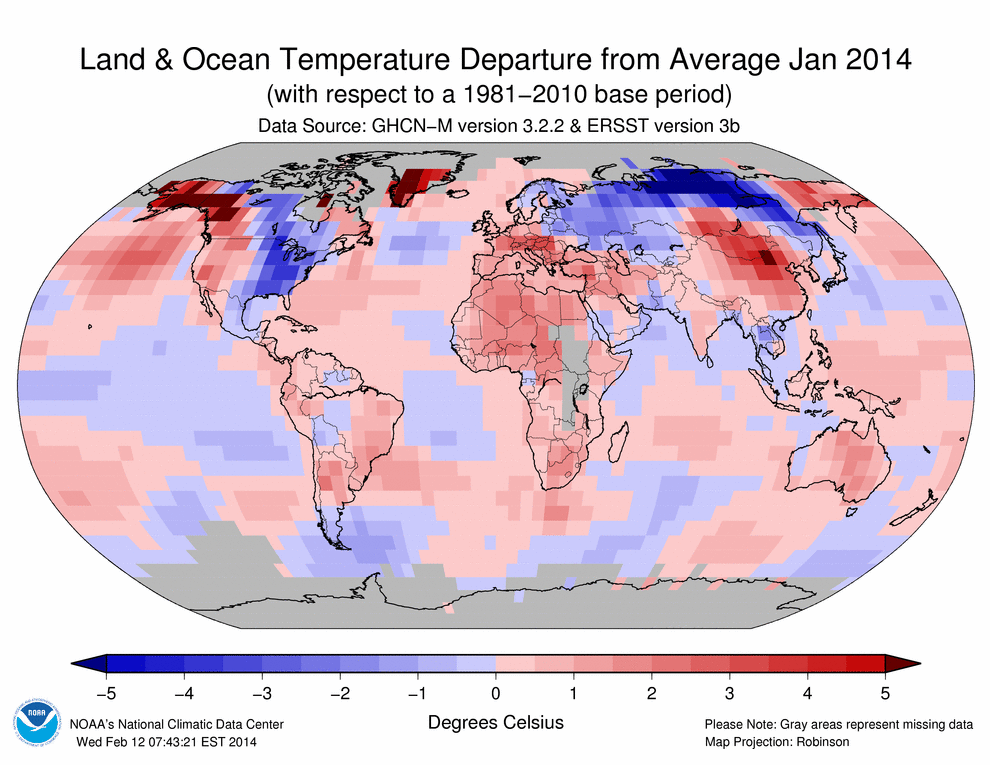
Freezing January for Easterners Was Not Felt Round the World


An abandoned farmhouse near Bakersfield, Calif., in February. California is struggling with a severe drought. David McNew/Getty Images


For people throughout the Eastern United States who spent January slipping, sliding 

and shivering, here is a counterintuitive fact: For the earth as a whole, it was the

fourth-warmest January on record.

It was, in fact, the 347th consecutive month with temperatures above the 20th-century average, the government reported Thursday.
That may feel plausible to Californians, whose state experienced temperatures 10 or 15 degrees above normal in some places last month, and especially to Alaskans, where the average temperature was almost 15 degrees above normal.
But on a map of January temperatures released Thursday by government weather analysts, the Eastern United States stood out as one of the coldest areas on the planet, compared with seasonal norms.

That is no surprise to anybody living east of the Mississippi River, of course — certainly not to the Atlantans who were caught up in two memorable ice storms that shut down the city, or the New Yorkers who are still picking their way through mounds of dirty snow.

But this might be another surprise: Despite all the weather drama, it was not a January for the record books.
By the time analysts averaged the heat in the West and the cold in the East, the national temperature for the month fell only one-tenth of a degree below the 20th-century average for January. January 2011 was colder.
No state set a monthly record for January cold. Alabama, also walloped by the ice storms, came closest, with the fourth-coldest January on its record books.
The United States covers only 2 percent of the surface of the globe, so what happens in this country does not have much influence on overall global temperatures.
Brazil, much of southern Africa, most of Europe, large parts of China and most of Australia were unseasonably warm in January, the National Oceanic and Atmospheric Administration reported Thursday. That continues a pattern of unusual global warming that is believed to be a consequence of human-caused emissions of greenhouse gases.
Even in the United States, more than a third of the country is in drought of varying intensity. Mountain snowpack in many parts of the West is only half of normal, portending a parched summer and a likelihood of severe wildfires.
“Today’s snowpack is tomorrow’s water in the West,” said Deke Arndt, chief of climate monitoring for the National Climatic Data Center in Asheville, N.C., in a briefing on Thursday. “If it does not recover, this will have consequences for months down the road.”
The Arctic blasts of this winter do stand out in the weather records of this young century, even if they are pretty humdrum when compared with the 1970s and 1980s. Winters have been so mild over the past couple of decades — probably as a result of global warming, scientists say — that some young adults have never experienced cold waves quite so intense.


And the pain may not be over. Forecasters say the northern tier of the United States

may face still more cold blasts, storms and heavy winds right up to the doorstep of 

spring, albeit interspersed with bursts of warmth in some areas.

Over just the next few days, the Southeast may be hit by severe thunderstorms, high winds and even hail. The Midwest may have wind gusts up to 60 miles an hour. And the Northeast could see rain, snow or a mix of the two.
Temperatures across the eastern Great Plains, the Great Lakes and the Mississippi Valley are expected to be below normal for the next month and into the spring.
But the cold weather in the East is being balanced, in a sense, by the bizarrely warm temperatures in the West. And that trend, too, is likely to continue.
The outlook over the next month is for continued above-normal temperatures in the West, the Southwest and parts of Alaska, as well as a continuation of the California drought, despite recent rains that have eased the situation slightly.
The extremes in January were directly related, experts said, with the two regions falling on opposite sides of a big loop in the jet stream, a belt of high winds in the upper atmosphere that helps to regulate the climate.
A dip of the jet stream into the Eastern United States allowed cold air to descend from the Arctic, while a corresponding ridge in the West allowed warm air to hover over California and to penetrate normally frigid regions to the north.
For those ready for the warmth to dip in their direction, mark a calendar: March 20, at 12:57 p.m. Eastern Daylight Time.
That is when the tilt of the Earth causes the sun to pass over the Equator and re-enter the Northern Hemisphere, bringing spring with it.


Drone footage shows severe drought hitting river in Brazil – video

  Drone footage from 17 September shows the Araguaia River drying up, as severe drought grips parts of Brazil. The country is preparing for ...