Showing posts with label FRANCE. Show all posts

Sunday, August 10, 2025

Wildfires close Mount Vesuvius trails while fierce blazes continue in France. French officials says heatwave in southern Europe complicates efforts to contain biggest wildfire since 1949


Tackling the Vesuvius wildfire

by  in Rome


Tourist trails have been closed on Mount Vesuvius in southern Italy as firefighters tackle a huge blaze on the volcano’s slopes, while officials warned of another “challenging day” for those working to contain France’s biggest wildfire since 1949.

The wildfire on Mount Vesuvius, close to Naples, broke out a few days ago and by Saturday afternoon had stretched to about 3km (1.9 miles) wide, destroying hundreds of hectares of woodland and killing wild animals. Thick smoke could be seen from Pompeii and Naples.

Six Canadair firefighting planes have been dispatched from the state fleet and teams made up of firefighters, soldiers, forestry corps, police and civil protection volunteers from across Italy are working on the ground.

Flames and smoke rise from a wildfire at the Vesuvius national park in Terzigno on Saturday. Photograph: Anadolu/Getty Images

Drones were being used to monitor the spread of the fire, the national fire service said. The operation has been complicated by the latest heatwave.

Vesuvius national park authorities said the volcano’s trail network had been closed for safety reasons and to facilitate firefighting and clean-up operations in the areas affected. Pompeii’s archaeological park remains open to the public.

The fire has mainly affected the Terzigno pine forest as well as woodlands close to the small towns of Trecase, Ercolano and Ottaviano at the foot of the volcano.

Francesco Ranieri, the mayor of Terzigno, told Italian media the situation on Saturday night was “very critical” although the efforts of firefighters ensured the flames did not reach any homes.

The cause of the fire has not been identified although there are strong suspicions that it was arson, with Ranieri suggesting there may be “a criminal hand” behind it.

The fires have charred and destroyed the landscape in Jonquières, France. Photograph: Getty Images

Firefighters in France’s southern Aude region, meanwhile, have managed to contain a massive wildfire, which killed one person and injured several others, although authorities warned that work on Sunday would be complicated by intense heat and a hot, dry wind.

“It’s a challenging day, given that we are likely to be on red alert for heatwave from 6pm, which will not make things any easier,” said Christian Pouget, the prefect of the Aude department.

Europe is far from alone in suffering frequent wildfires. The weather conditions in which they flourish, marked by heat, drought and strong winds, is increasing in some parts of all continents.

A vintage Citreon car burnt by a wildfire in Saint-Laurent-de-la-Cabrerisse, France. Photograph: Kiran Ridley/Getty Images

Human-caused climate breakdown is responsible for a higher likelihood of fire and bigger burned areas in southern Europe, northern Eurasia, the US and Australia, with some scientific evidence of increases in southern China.

Climate breakdown has increased the wildfire season by about two weeks on average across the globe.

Wednesday, August 6, 2025

‘Unprecedented’ wildfire burns area size of Paris in southern France. Advancing blaze scorches 16,000 hectares near Spanish border, destroying homes and forcing people to flee


Wednesday, May 14, 2025

How the humble chestnut traced the rise and fall of the Roman Empire. The chestnut trees of Europe tell a hidden story charting the fortunes of ancient Rome and the legacy it left in the continent's forests.

(Credit: Getty Images)

Sophie Hardach


The ancient Romans left an indelible imprint on the world they enveloped into their empire. The straight, long-distance roads they built can still be followed beneath the asphalt of some modern highways. They spread aqueducts, sewers, public baths and the Latin language across much of Europe, North Africa and the Middle East. But what's perhaps less well known is the surprising way they transformed Europe's forests.

According to researchers in Switzerland, the Romans had something of a penchant for sweet chestnut trees, spreading them across Europe. But it wasn't so much the delicate, earthy chestnuts they craved – instead, it was the fast-regrowing timber they prized most, as raw material for their empire's expansion. And this led to them exporting tree cultivation techniques such as coppicing too, which have helped the chestnut flourish across the continent.

"The Romans' imprint on Europe was making it into a connected, economical space," says Patrik Krebs, a geographer at the Swiss Federal Institute for Forest, Snow and Landscape Research (WSL). "They built a single system of governance all over Europe, they improved the road system, the trade system, the military system, the connection between all the different people all over Europe."

As a result of that connection, "specific skills in arboriculture [the cultivation of trees] were shared by all the different civilisations", he says.

 The arboreal legacy of the Romans can still be found today in many parts of Europe – more than 2.5 million hectares (6 million acres) of land are covered by sweet chestnut trees, an area equivalent in size to the island of Sardinia. The trees have become an important part of the landscape in many parts of the continent and remain part of the traditional cuisine of many countries including France and Portugal.

Chestnuts have become a popular part of the cuisine in many parts of Europe – an indirect legacy of the Romans, who planted chestnut trees for timber (Credit: Getty Images)

Krebs works at a branch of the WSL in Switzerland's Ticino canton on the southern slope of the Alps, an area that is home to giant chestnut trees, where many specimens have girths greater than seven metres (23ft). By the time of the Middle Ages, sweet chestnuts were a staple food in the area. But it was the Romans who brought the trees there – before their arrival in Ticino, sweet chestnuts did not exist there, having been locally wiped out in the last ice age, which ended more than 10,000 years ago

Using a wide range of evidence, including paleoecological pollen records and ancient Roman texts, Krebs' research team analysed the distribution of both sweet chestnut (Castanea sativa) and walnut (Juglans regia) trees in Europe before, during and after the Roman empire. Sweet chestnut and walnut trees are considered useful indicators of the human impact on a landscape, as they generally benefit from human management – such as pruning and supressing competing trees. Their fruits and timber are also highly desirable. 

In countries such as Switzerland, France and parts of Germany, sweet chestnut pollen was near-absent from the wider pollen record – such as, for example, fossil pollen found in sediment and soil samples – before the Romans arrived, according to the study and previous research. But as the Roman Empire expanded, the presence of sweet chestnut pollen grew. Specifically, the percentage of sweet chestnut pollen relative to other pollen across Europe "shows a pattern of a sudden increase around year zero [0AD], when the power of the Roman empire was at its maximum" in Europe, Krebs says.

The ancient chestnut trees in Ticino, Switzerland, have grown to be true giants over the centuries (Credit: Swiss Federal Institute for Forest, Snow and Landscape)
 

After the Barbarian sacks of Rome around 400-500 AD, which signalled the beginning of the end of the Roman Empire amid widespread upheaval, the chestnut pollen percentage then drops temporarily. This decrease suggests that many of the Roman-era orchards were abandoned, Krebs says, probably not only due to the fall of the Roman Empire, but also, because a wider population decline in many areas at the time. 

"Juglans [walnut] has a different pattern," says Krebs. The spread of pollen from these trees is less clearly associated with the rise and fall of the Roman empire, he and his colleagues found. Its distribution around Europe had already increased before the arrival of the Romans, perhaps pointing to the ancient Greeks and other pre-Roman communities as playing a role.

But while the Romans can perhaps take credit for spreading the sweet chestnut around mainland Europe, some separate research suggests they were not behind the arrival of these trees in Britain. Although the Romans have previously been credited with bringing sweet chestnuts to the British isles – where they are still a key part of modern woodlands – research by scientists at the University of Gloucestershire in the UK found the trees were probably introduced to the island later.

This speedy regrowth came in handy given the Romans' constant need for raw materials for their military expansion


Sweet chestnut trees can be striking features of the landscape. They can grow up to 35m (115ft) tall and can live for up to 1,000 years in some locations. Most of those alive today will not have been planted by the Romans, but many will be descendants or even cuttings taken from those that ancient Roman legionnaires and foresters brought with them to the far-flung corners of the empire. The oldest known sweet chestnut tree in the world is found in Sicily, Italy, and is thought to be up to 4,000 years old.

Wood for fortresses

Why did the Romans so favour the sweet chestnut tree? According to Krebs, they did not tend to value the fruit much – in Roman culture, it was portrayed as a rustic food of poor, rural people in Roman society, such as shepherds. But the Roman elites did appreciate sweet chestnut's ability to quickly sprout new poles when cut back, a practice known as coppicing. This speedy regrowth came in handy given the Romans' constant need for raw materials for their military expansion.

"Ancient texts show that the Romans were very interested in Castanea, especially for its resprouting capacity," he says. "When you cut it, it resprouts very fast and produces a lot of poles that are naturally very high in tannins, which makes the wood resistant and long-lasting. You can cut this wood and use it for building fortresses, for any kind of construction, and it quickly sprouts again."

Coppicing can also have a rejuvenating effect on the chestnut tree, even after decades of neglect.

As the Roman Empire rapidly expanded, they needed fast growing timber so they could build fortifications (Credit: Getty Images)

In Ticino, chestnut trees became more and more dominant under the Romans, according to the pollen record. They remained popular even after the Roman Empire fell, Krebs says.

One explanation for this is that locals had learned to plant and care for the tree from the Romans, and then came to appreciate chestnuts as a nourishing, easy-to-grow food – by the Middle Ages, they had become a staple food in many parts of Europe. The chestnuts, for example, could be dried and ground into flour. Mountain communities would also have welcomed the fact that the trees thrived even on rocky slopes, where many other fruit trees and crops struggled, Krebs adds.

"The Romans' achievement was to bring these skills from far away, to enable communication between people and spread knowledge," he says. "But the real work of planting the chestnut tree orchards was probably done by local populations."

When they are cultivated in an orchard for their fruit, sweet chestnut trees benefits from management such as pruning dead or diseased wood, as well as the lack of competition, all of which prolong their life, Krebs says: "In an orchard, there's just the chestnut tree and the meadow below, it's like a luxury residence for the tree. Whereas when the orchard is abandoned, competitor trees arrive and take over."

 Research on abandoned chestnut orchards has shown that when left alone, chestnut trees are crowded out by other species. In wild forests, "Castanea reaches a maximum age of about 200 years, then it dies," Krebs says. "But here in Ticino, where chestnuts have been cultivated, they can reach up to almost 1,000 years, because of their symbiosis with humans."

Europe's landscape was altered by the Romans' forestry approach, reintroducing the sweet Italian chestnut to areas it hadn't existed since the last ice age (Credit: Getty Images)

By the end of the Roman era, the sweet chestnut had become the dominant tree species in Ticino, displacing a previous forest-scape of alders and other trees, the pollen record shows: "This was done by humans. It was a complete reorganisation of the vegetal landscape," Krebs explains.

In fact, pollen evidence from a site in Ticino at some 800m (2,625ft) above sea level shows that during the Roman period there was a huge increase in Castanea pollen, as well as cereal and walnut-tree pollen, suggesting an orchard was kept there, Krebs says. (Read more about the traces left by passing Romans and other ancient civilisations in the Alps.)

By the Middle Ages, long after the Romans were gone, many historical texts document the dominance of sweet chestnut production and the importance of foods such as chestnut flour in Ticino, says Krebs. "In our valleys, chestnuts were the most important pillar of subsistence during the Middle Ages."


People in Ticino continued to look after the trees, planting them, coppicing them, pruning them and keeping out the competition, over centuries, Krebs says: "That's the nature of this symbiosis: humans get the fruit [and wood] of the chestnut tree – and the chestnut gets longevity", as well as the opportunity to hugely extend its natural area of distribution, he explains. 

A similar transfer of chestnut-related knowledge to locals may have happened elsewhere in the Roman Empire, he suggests – and possibly left linguistic traces. As a separate study shows, across Europe, the word for "chestnut" is similar to the Latin "castanea" in many languages. 

Today, Europe's sweet chestnut trees are facing threats including disease, climate change and the abandonment of traditional orchards as part of the decline in rural life. But chestnut trails and chestnut festivals in Ticino and other parts of the southern Alps still celebrate the history of sweet chestnuts as a past staple food – reminding us of the long legacy of both Roman and local ideas and skills in tree-care.

Sunday, August 14, 2022

Martianization - Europe’s rivers run dry as scientists warn drought could be worst in 500 years. The Guardian


Crops, power plants, barge traffic, industry and fish populations devastated by parched waterways


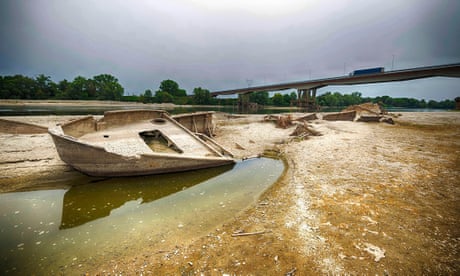
In places, the Loire can now be crossed on foot; France’s longest river has never flowed so slowly. The Rhine is fast becoming impassable to barge traffic. In Italy, the Po is 2 metres lower than normal, crippling crops. Serbia is dredging the Danube.

Across Europe, drought is reducing once-mighty rivers to trickles, with potentially dramatic consequences for industry, freight, energy and food production – just as supply shortages and price rises due to Russia’s invasion of Ukraine bite.

Driven by climate breakdown, an unusually dry winter and spring followed by record-breaking summer temperatures and repeated heatwaves have left Europe’s essential waterways under-replenished and, increasingly, overheated.

With no significant rainfall recorded for almost two months across western, central and southern Europe and none forecast in the near future, meteorologists say the drought could become the continent’s worst in more than 500 years.

“We haven’t analysed fully this year’s event because it is still ongoing,” said Andrea Toreti of the European Commission’s Joint Research Centre. “There were no other events in the past 500 [years] similar to the drought of 2018. But this year, I think, is worse.”

Germany’s Federal Institute of Hydrology (BfG) said the level of the Rhine, whose waters are used for freight transport, irrigation, manufacturing, power generation and drinking, will continue dropping until at least the beginning of next week.

On Friday the water at the critical Kaub marker 50km downstream from Mainz – which measures navigability, rather than the water depth – fell below 40cm, the level at which many shipping firms consider it is no longer economical for barges to operate. It could fall to nearer 30cm over the next few days, the BfG has said.

Many barges, which carry coal for power plants and vital raw materials for industrial giants such as steelmaker Thyssen and chemical giant BASF, are already operating at about 25% capacity to reduce their draft, raising shipping costs up to fivefold.

A vital part of northwest Europe’s economy for centuries, the 760 miles (1,233km) of the Rhine flow from Switzerland through Germany’s industrial heartland before reaching the North Sea at the megaport of Rotterdam.

A total halt in Rhine barge traffic would hit Germany’s – and Europe’s – economy hard: experts have calculated that a six-month suspension in 2018 cost around €5bn (£4.2bn), with low water levels forecast to cost Germany 0.2 points of economic growth this year.

While the EU has said boosting waterborne freight by 25% is one of the bloc’s green transition priorities, Germany is now working to divert it to rail and road – although between 40 and 100 trucks are needed to replace a standard barge load.

France’s rivers might not be such key freight arteries, but they do serve to cool the nuclear plants that produce 70% of the country’s electricity. As prices hit all-time highs, power giant EDF has been forced to reduce output because of the drought.

Strict rules regulate how far nuclear plants can raise river temperatures when they discharge cooling water – and if record low water levels and high air temperatures mean the river is already overheated, they have no option but to cut output. With Europe’s looming energy crisis mounting and the Garonne, Rhône and Loire rivers already too warm to allow cooling water to be discharged, the French nuclear regulator last week allowed five plants to temporarily break the rules.

In Italy, the flow of the parched Po, Italy’s longest river, has fallen to one-tenth of its usual rate, and water levels are 2 metres below normal. With no sustained rainfall in the region since November, corn and risotto rice production have been hard hit.

The Po valley accounts for between 30% and 40% of Italy’s agricultural production, but rice growers in particular have warned that up to 60% of their crop may be lost as paddy fields dry out and are spoiled by seawater sucked in by the low river level.

In the protected wetlands of the river’s delta, near Venice, its high temperature and sluggish flow have reduced the water’s oxygen content to the extent that an estimated 30% of clams growing in the lagoon have already been killed off.

Low river levels and high water temperatures can prove fatal to many species. In Bavaria, the Danube reached 25C last week and could hit 26.5C by mid-month, meaning its oxygen content would fall below six parts per million – fatal for trout.

Freight on the 2,850km of the Danube has also been heavily disrupted, prompting authorities in Serbia, Romania and Bulgaria to start dredging deeper channels while barges carrying mainly fuel for the power generators wait to advance.

Even Norway, which relies on hydropower for about 90% of its electricity generation, has said the unusually low levels of its reservoirs may ultimately oblige it to limit power exports.

Saturday, August 13, 2022

Martianization - EU countries rush to help France tackle ‘monstrous’ wildfires


Firefighters from Romania, Poland, Austria, Greece and Italy fight blazes in show of ‘European solidarity’


Hundreds of firefighters from across the EU have been rushed to France to help battle wildfires in an unprecedented show of international solidarity.

Most are stationed along a 26 mile (40km) active fire-front in the south-west, where a blaze described as “monstrous” continued to devastate pine forests.

German firefighters and their vehicles arrived in the early hours of Friday morning to help tackle the massive Landiras fire in the Gironde and the Landes, south of Bordeaux, which had sparked up again this week after destroying swathes of forest in July.


Romanian firefighters and teams from Poland, Austria, Greece and Italy were also deployed to help more than 1,100 French firefighters try to contain the blaze. President Emmanuel Macron tweeted of the more than 360 firefighters arriving with vehicles and planes: “Our partners are coming to France’s aid against the fires. Thank you to them. European solidarity is at work!”

In a summer of extreme heat and drought, France has faced its most serious forest fires in years. One local firefighter described the Landiras blaze in south-west France as “a sleeping monster which can wake at any gust of wind”.

The French state broadcaster reported that since the start of the year, 56,000 hectares of forest had burned in France – three times the annual average this decade. There have also been forest fires in northern regions not usually hit by summer blazes, including in Brittany, where firefighting planes arrived from Sweden to help.

Authorities in the Gironde said in a statement that more than 7,400 hectares of forest had burned in the Landiras fire, France’s biggest blaze. They said that although the fire had not developed further overnight, high temperatures and dry conditions expected on Friday meant there was a “severe risk” of the fire spreading, and it would be a “complicated” day for fire teams.

The fire had already destroyed 14,000 hectares in July – the driest month in France since 1961 – before being contained, but it had never been fully extinguished and had continued to smoulder in the region’s peat-rich soil before erupting again this week in the tinder-dry pine forests.

Since flaring up again on Tuesday, the fire, which officials suspect may have been caused by arson, has burned through 7,400 hectares, destroyed or damaged 17 homes, and forced 10,000 people to flee, Lieut-Col Arnaud Mendousse of the Gironde fire and rescue service told AFP.

There can be no more hiding, and no more denying. Global heating is supercharging extreme weather at an astonishing speed, and it’s visible in Brazil and beyond. Guardian analysis recently revealed how human-caused climate breakdown is accelerating the toll of extreme weather across the planet. People across the world are losing their lives and livelihoods due to more deadly and more frequent heatwaves, floods, wildfires and droughts triggered by the climate crisis. At the Guardian, we will not stop giving this life-altering issue the urgency and attention it demands. We have a huge global team of climate writers around the world and have recently appointed an extreme weather correspondent. 


Our editorial independence means we are free to write and publish journalism which prioritises the crisis. We can highlight the climate policy successes and failings of those who lead us in these challenging times. We have no shareholders and no billionaire owner, just the determination and passion to deliver high-impact global reporting, free from commercial or political influence.


And we provide all this for free, for everyone to read. We do this because we believe in information equality. Greater numbers of people can keep track of the global events shaping our world, understand their impact on people and communities, and become inspired to take meaningful action. Millions can benefit from open access to quality, truthful news, regardless of their ability to pay for it. 


Every contribution, however big or small, powers our journalism and sustains our future. Support the Guardian from as little as $1 – it only takes a minute. If you can, please consider supporting us with a regular amount each month. Thank you.


Martianization - Onda de calor na Europa provoca incêndio gigante na França - Países da Europa ajudam no combate francês


A França enfrenta pelo terceiro dia consecutivo nesta quinta-feira (11) as chamas de um imenso incêndio florestal perto da cidade de Bordéus, no sudoeste do país. Mais de 10 mil pessoas foram forçadas a deixar suas casas e 6.800 hectares de floresta viraram cinzas. Devido às proporções do fogo, ele vem sendo chamado de "monstro".


O serviço de meteorologia local previu que as temperaturas na região chegariam a 40ºC e permaneceriam altas até sábado (13). Nesta quinta (11), a luta contra o incêndio ganhou o reforço de bombeiros enviados por diversos países da Europa.


O governo francês disse ter recebido dois aviões-tanque gregos, duas aeronaves suecas, mais de 100 bombeiros da Polônia, dezenas da Alemanha, Áustria e Romênia. Só na operação desta quinta-feira, mais de 1.000 homens tentavam conter as chamas, apoiados por aviões.


Em 2022, mais de 57 mil hectares de florestas já foram incendiados na França. O número é quase seis vezes a média anual registrada no período entre 2006 e 2021 no país, segundo dados do Sistema Europeu de Informações sobre Incêndios Florestais.


A ocorrência de incêndios nas florestas explodiu em parte da Europa em 2022, em meio a sucessivas ondas de calor que atingem o continente, com países registrando temperaturas recordes. O problema desafia os gestores e coloca no centro do debate público os riscos das mudanças climáticas para a indústria e para os meios de subsistência. Em visita ao local atingido pelo incêndio, a primeira-ministra francesa Élisabeth Borne disse que o país deve lutar “mais do que nunca” contra o colapso climático, mas também se adaptar a ele. A autoridade afirmou que trabalhará em um “planejamento ambiental” para ajudar o país na tarefa.


(Com informações da Reuters)


Tensions are rising between states that rely on the Colorado River. A prolonged drought means the nation’s largest reservoirs are dwindling, and litigation over access to water could lie ahead.

  (Nina Riggio | The New York Times) The Upper Colorado River in Grand Canyon National Park in Colorado on May 16, 2026. About 40 million ...