
This article was produced in partnership with the Pulitzer Center’s Ocean Reporting Network.
They call it “the Blob.”
A decade ago, sea surface temperatures in the Pacific shot up to 11 degrees Fahrenheit hotter than normal. A high pressure system parked over the ocean, and winds that churn cold, nutrient-rich water from the depths to the surface died down. Stagnant, warm water spread across the Northeast Pacific, in a marine heat wave that lasted for three years.
Under the surface, the food web broke down and ecosystems convulsed, at first unseen to humans on shore. But soon, clues washed up.
Dead Cassin’s auklets — small, dark gray seabirds — piled up on West Coast beaches. The auklets were followed by common murres, a slightly bigger black-and-white seabird. The carcasses were knee-deep in places, impossible to miss.
Researchers are still untangling the threads of what happened, and they caution against drawing universal conclusions from a single regional event. But the Blob fundamentally changed many scientists’ understanding of what climate change could do to life in the ocean; 10 years later, the disaster is one of our richest sources of information on what happens to marine life as the temperature rises.
And it is more relevant than ever. Last year, multiple “super-marine heat waves” blanketed parts of the ocean. Averaged together, global sea surface temperatures broke records, often by wide margins, for months in 2023 and 2024. As the climate warms, scientists expect extreme marine heat waves to become more frequent.
The Blob “was a window into what we might see in the future,” said Julia Parrish, a marine ecologist at the University of Washington who runs the Coastal Observation and Seabird Survey Team, a network of volunteers who survey beaches from Northern California to Alaska.


In a study published last year, Dr. Parrish and her colleagues estimate that the Blob eventually killed millions of seabirds, in waves of starvation.
More recently, researchers undertook a thorough post-mortem of the Blob in the Greater Farallones National Marine Sanctuary, off the California coast.
The sanctuary is one of 17 pockets of U.S. waters protected to varying degrees from development and industry. They are becoming test beds for ways people can try and help marine life — and the human livelihoods that depend on the ocean — adapt to climate change.
This summer, the National Oceanic and Atmospheric Administration published a “condition report” for the Greater Farallones, along with an accompanying climate vulnerability assessment that reveals just how shocking the Blob was for scientists.

The foundation species that creates habitat for everything else in the Greater Farallones is bull kelp, a seaweed that grows from the seafloor to the surface in dense forests. Before the Blob, Ms. Lipski and her colleagues hadn’t thought bull kelp would be particularly vulnerable to climate change.
By the time the Blob dissipated, more than 90 percent of Northern California’s kelp forests were gone.
Historically, kelp has had booms and busts, Ms. Lipski said. “We just thought that’s the pattern for kelp — it’ll recover,” she said. “And it hasn’t.”
Kelp is eaten by sea urchins, which are eaten by sea stars. During the Blob, a deadly disease spread among sea stars, causing urchin populations to explode. Urchins devoured the kelp, leaving behind a much more barren seascape to this day.
“Back in 2014, I think there was this feeling amongst our experts that relative to land ecosystems, the ocean is really resilient,” said Sara Hutto, the climate change coordinator for the Greater Farallones and Cordell Bank sanctuaries.
Ms. Hutto oversaw the new climate vulnerability assessment, in which scientists revised their scores for 17 species and six types of habitat to reflect more vulnerability than previously thought.
“We have no precedent for the rate of change that we’re seeing,” she said.

Life in the Greater Farallones, named for a group of forbidding rocky islands 30 miles off the coast of San Francisco, is ruled by upwelling. Wind mixes layers of the ocean and brings nutrients to the surface, feeding phytoplankton, which in turn feed a rich food web around them. The Greater Farallones are part of a much larger upwelling zone along the West Coast called the California Current Ecosystem.
This ecosystem is so productive that whales, turtles and seabirds migrate thousands of miles to eat there, Ms. Lipski said, from Central America, Hawaii, Indonesia and as far away as New Zealand.
When the Blob struck, far fewer nutrients reached the sea surface where phytoplankton live, and the bottom fell out of the food web. Krill and forage fish populations — the small fish that bigger animals eat — dwindled. Sea stars wasted away. Harmful algae bloomed, spreading toxic domoic acid through the valuable Dungeness crab fishery. Like the auklets and murres, seals and gray whales also starved.
During the Blob, the Greater Farallones actually fared better than other parts of the ocean in a way — some upwelling persisted, in a narrow band close to shore. But that meant animals that couldn’t find food elsewhere flocked to this small area, in a phenomenon called habitat compression. This proved deadly for whales, which found themselves crossing busy shipping lanes, where they were struck by vessels, and fishing grounds where they got tangled in gear.
Although the immediate catastrophe of the Blob ended, hints of chronic change are everywhere.
On a Sunday at the beginning of October, the temperature in San Francisco surpassed 90 degrees Fahrenheit. Hundreds of people crowded the city’s beaches, either enjoying or trying to find relief from the unseasonable heat.
Just beyond the Golden Gate Bridge, the normally choppy waters in the Gulf of the Farallones were still. Common murres — the survivors of the Blob — bobbed on the surface in groups of two and three.
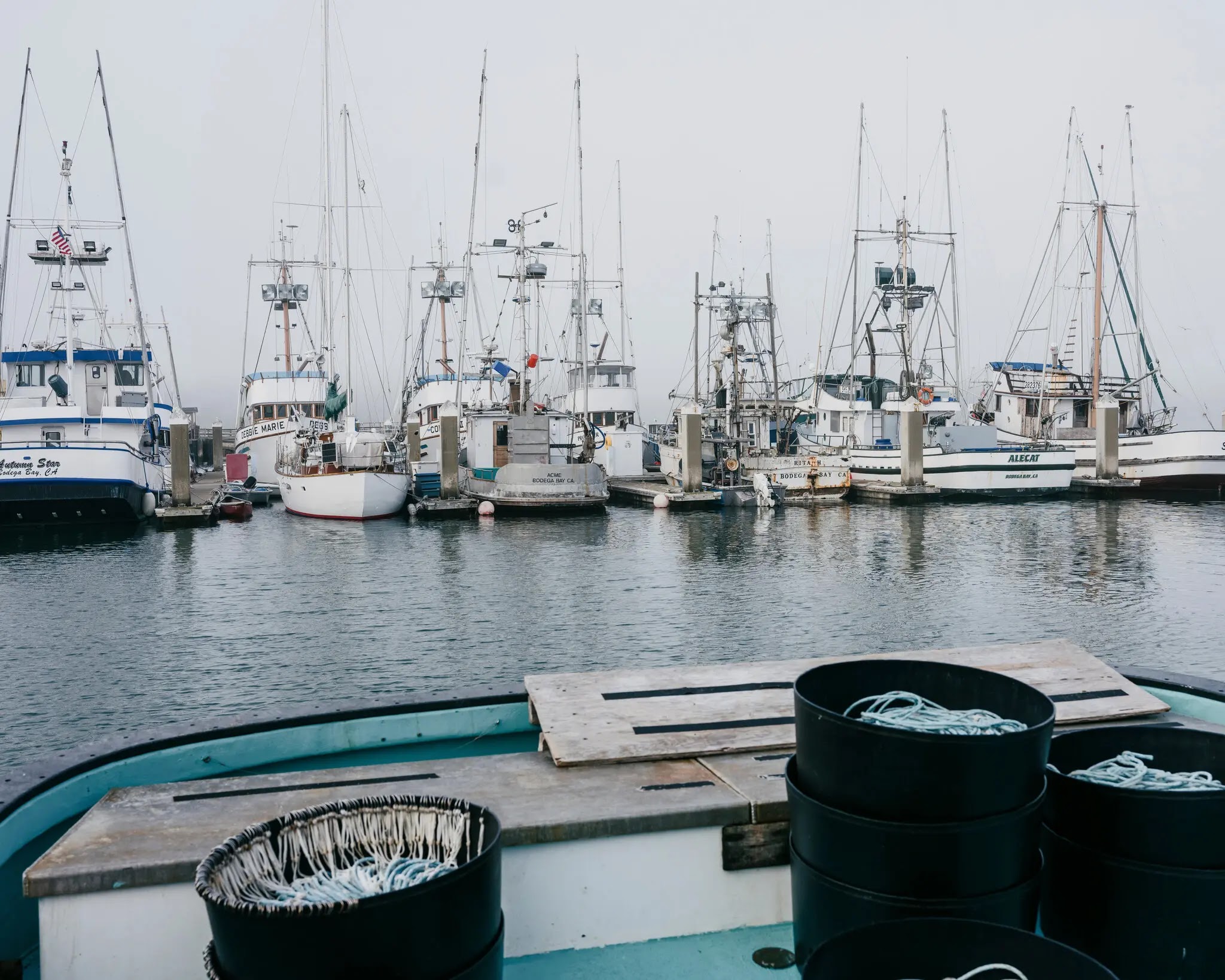
Conspicuously absent from the water were fishing boats.
October is normally the tail end of salmon season, and a busy time on the waterfront. But the next morning, Monday, Fisherman’s Wharf in San Francisco was quiet.
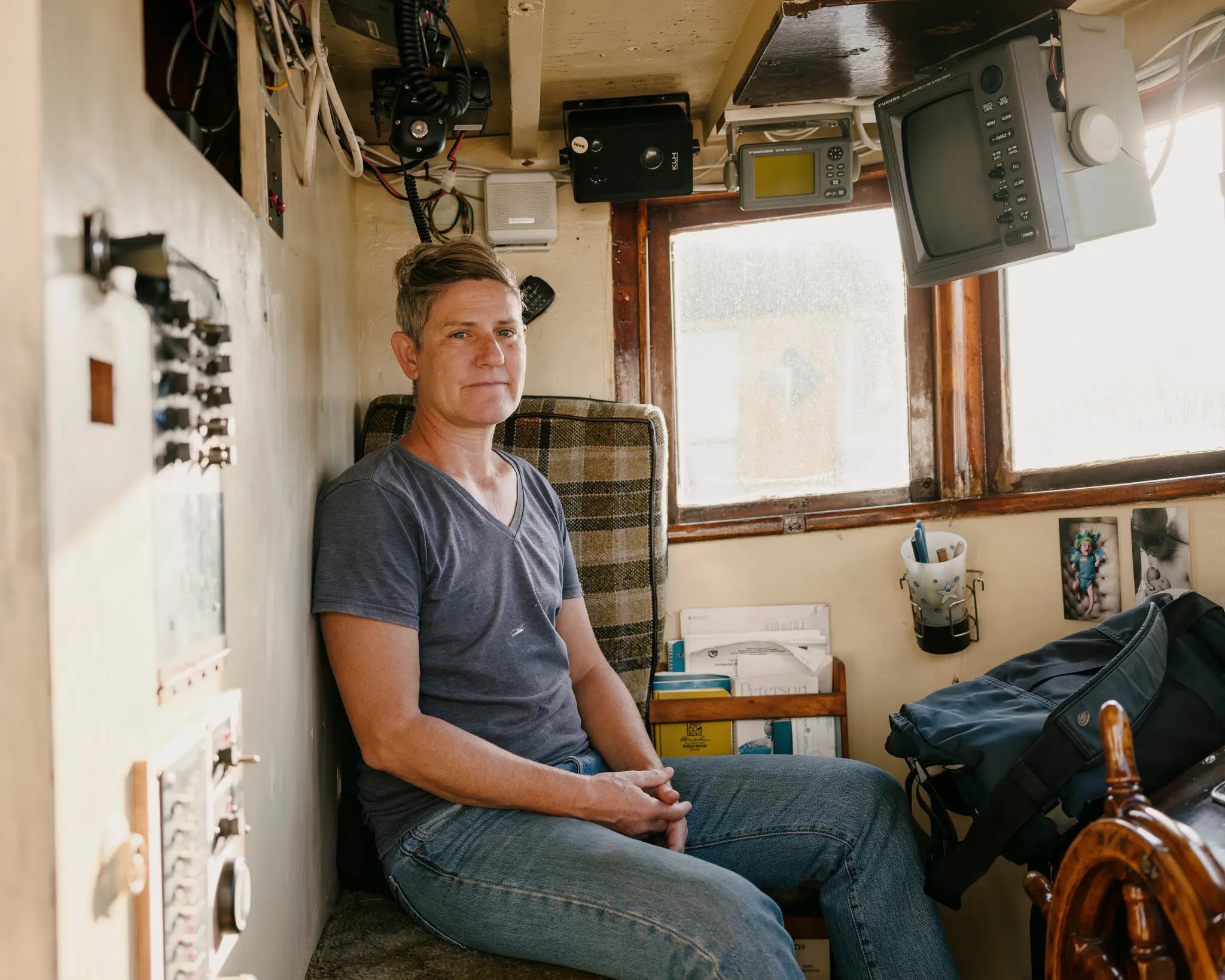
“It’s kind of a ghost town,” said Sarah Bates, a local salmon boat captain, who has seen the past two seasons canceled because of drought.
Ms. Bates holds one of two spots for commercial fishermen on the Greater Farallones National Marine Sanctuary’s advisory council, and appreciates the scientific research done in the sanctuary.
Marine sanctuaries are rare slices of ocean where people carefully watch what’s happening underneath the surface, and as a result scientists can catch the signal of climate change sooner, said Zachary Cannizzo, NOAA’s climate coordinator for marine protected areas nationwide.
In hindsight, Ms. Bates views the Blob differently.
At the time, she said, “it didn’t feel like it was the new normal, it just felt like it was an anomaly.”
But now, she continued, “it’s becoming clear that was just sort of the leading edge of changing ocean patterns.”
This change affects multiple fisheries. California’s crab fishing season has been delayed year after year, first to avoid toxic domoic acid from harmful algal blooms and now to avoid entanglements with whales.
Richard Ogg, a crab boat captain based in the small town of Bodega Bay, holds the other spot on the Greater Farallones council.
“We see current changes, we see color changes, we know temperatures are different, we see species shift,” Mr. Ogg said.


He wants fishermen to be able to convey these observations from the water to scientists, to help model and predict the future of the marine ecosystem. (One early example is the Habitat Compression Index, a tool recently developed by NOAA scientists to predict humpback whale movements months in advance based on sea surface temperatures.)
Everyone who studies and works in this region of the ocean — the scientists, the volunteers, the whale watch crews, the fishermen — is grappling in their own ways with the upheaval of the recent past and the uncertain future.
Rebecca Johnson, who directs the Center for Biodiversity and Community Science at the California Academy of Sciences, explained the value of getting as many people as possible to pool their observations of the changing environment.
Dr. Johnson helped create Snapshot Cal Coast, a program that recruits hundreds of Californians each June to document the species they see along the coast. This year, the effort yielded a rare sighting of a sunflower sea star — a critically endangered species that all but disappeared during the Blob.
More data from more people and places means better-informed decisions on conservation measures and fisheries management, Dr. Johnson said. And the people contributing this data become better connected to their environment.
Like Anne Kelley, a retired French lecturer and longtime bird watcher recruited to join Beach Watch, a sister program to the University of Washington’s that is run by NOAA.
Ms. Kelley walks her assigned beaches each month, tallying every living and dead thing.
It’s normal to come across occasional carcasses, she said. What wasn’t normal was finding scores of dead seabirds at once — as she did during the Blob. In her dozen years of meticulously bearing witness to changes along the coast, Ms. Kelley said, “the die-offs are the things that you really remember.”


For the past decade, restoration efforts in the Greater Farallones have focused on controlling the purple urchin population. Some bull kelp has come back, but slowly. Scientists are now trying to speed up recovery by planting lab-grown kelp within the sanctuary, in hopes that these individuals will reseed larger forests.
The caretakers of this pioneering kelp showed off their handiwork recently at the Bodega Marine Laboratory, an isolated facility perched on a cliff over the ocean, an hour and a half north of San Francisco. About 30 long, brownish-green strands of seaweed tumbled in concrete tanks of water outside, glinting in the sun.
Julieta Gómez and Rachael Karm entered graduate school in 2020 at Sonoma State University. During school, they harvested bull kelp on body boards from the few remnant patches in the region, and began painstaking experiments to coax the kelp to grow under artificial conditions. Today, Ms. Gómez is a kelp restoration specialist at the Greater Farallones Association, and Ms. Karm works for her former adviser at Sonoma State.
They have a clear affection for their charges, which represent so much loss — and now hope — for the region’s changing ecosystem.
This year was a turning point for their project, with the first successful out-planting taking place in July. They hope to get the sanctuary’s bull kelp population back to a stable point where minimal intervention is needed. But the two young scientists, who began their careers in a post-Blob world, recognize there will be challenges ahead.
“Together we can just continue chipping away at these different questions and hopefully build something that is successful, is resilient to further climate change,” Ms. Karm said. “Because that’s something that’s huge. If temperatures are just going to continue warming, what are we going to do?”


