Showing posts with label Italy. Show all posts

Friday, July 31, 2026

Dead trees and searing-hot benches: Rome’s multimillion-dollar cooling piazza shows the challenges of brutal heat

Tourists shield themselves from the sun near the Pantheon in Rome on July 10, 2026. Xinhua News Agency/Getty Images

by  


Rome — 

The new trees meant to provide much-needed shade in Rome’s Piazza Risorgimento were burnt to a crisp. Benches in dark plastic and wood were searingly hot. Several of the large flower pots had been gutted of their foliage entirely. The bushes lining the entrance were a burnt orange color.

This park, under the shadow of St. Peter’s Basilica, was supposed to be a green oasis for tourists and locals alike, but when CNN visited earlier this week it looked parched.

The central square was revamped in 2024 with a 14 million euro ($16 million) budget as part of the preparations for the Vatican’s Holy Jubilee — 4 million euros ($4.6 million) of which went toward the plan’s lush green trees, fountains, ample seating around the square and removal of pavement. But extreme heat, coupled with insufficient irrigation, has led to dead trees, no shade, and seating too hot to sit on.

The city of Rome says it will replace the trees and upgrade the irrigation system. Some of the dead foliage has been cut down in preparation for the new trees’ arrival.

“We are constantly learning how to deal with the changing weather,” Edoardo Zanchini, director of the city of Rome’s Climate Office, told CNN, admitting that the revamped piazza should have been planted with different trees. “We have to constantly think about who is in the city at the hottest time of the year — the elderly and young, the tourists and residents.” 

Withered trees in Piazza Risorgimento, Rome, Italy on June 27, 2026. Barbie Latza Nadeau/CNN

Dried-up plants in the piazza's planters, June 27, 2026. Barbie Latza Nadeau/CNN

 On Wednesday, the day after CNN published its video story about the square, Rome’s Councillor for Agriculture, Environment and Waste Management, Sabrina Alfonsi, posted a video of herself in the piazza, wielding a yellow garden hose and watering recently planted flowers.


“In the last few weeks there has been a lot of talk about the plants that were put here, and it’s true, some of them have struggled during an exceptionally intense heatwave,” she said. “Today, as you can see, they’re being looked after and are healthy.”

She referred to criticism of the condition of the square from right-wing opposition politicians, and said it was ironic given many of them have denied climate change for years.

Combating climate change-driven extreme heat has become a top priority facing European cities this summer as parts of the continent have been roiled by a succession of heat waves. Providing adequate shade, building cooling centers, removing asphalt and adding more trees are among the solutions advocated for by climate activists and urban planners. But, as Rome’s piazza shows, it is hugely challenging to build for brutal heat, which arrives earlier, lingers longer and is more intense. 

 In southern Europe, where summers are always hot, heat plans have become necessary — and expensive. Rome has committed to spending around 50 million euros ($58 million) over the next five years to create spaces where everyone from homeless people to tourists to kids in day care can find relief.


Only 56% of Italian homes have some form of cooling system, so the city is trying to give people access to air-conditioned venues. Last week, Rome introduced an initiative opening movie theaters for free during the hottest time of the day to give people a chance to cool off.

Over the past few years, Rome has installed hundreds of “water houses” — green kiosks with waterspouts and phone charging stations — to provide free cold water, both still and sparkling, to make sure people stay hydrated. They are a modern take on the roughly 2,500 cast iron “nasoni” water fountains put in place in the 1800s to provide free water across the city. 

People line up to refill their water bottles at a public water dispenser near the Colosseum in Rome on July 4. Andrea Ronchini/NurPhoto/Shutterstock


Joanne Waverly, a tourist from New York City, told CNN she didn’t realize Rome would be so hot at night. “I envisioned the afternoon siesta sleeping in my air-conditioned hotel room and going out at night, but it almost feels hotter than during the day,” she told CNN as she filled her bottle at a water house next to Piazza Navona. “The cement and cobblestones radiate heat, and the temperatures don’t even go down. I have no idea how people live here!”

Waverly has taken to early-morning sightseeing; others are seeing the city late into the evening. Venues including the Pantheon and Colosseum are offering new nighttime opening hours, from 7 p.m. to 11 p.m., to allow people to visit when the sun isn’t blazing. 


Rome mayor Roberto Gualtieri says trees and green space are key to his government’s heat plan. “The intensity of heatwaves is no longer an exception but the rule,” he said when announcing the city’s heat plan earlier this month. The plan will see thousands of trees planted, with a focus on the hottest districts, where many people don’t have, or can’t afford, air conditioning.

“Rome cannot stand still in the face of impacts that risk overwhelming key infrastructure, undermining urban livability and hitting the most vulnerable residents the hardest,” Gualtieri said.

Rome, like many other cities, has de-paved asphalt streets, replacing surfaces with solar reflective coverings and porous materials, and has introduced more “climate shelters,” like the free movie initiative and other up air-conditioned venues where people can gather.

Construction workers carry air conditioning units in Rome on July 10. Xinhua News Agency/Getty Images


But there have been false starts beyond just Piazza Risorgimento. Plans to trial a giant bioclimatic “tree” at the city’s main train station — a huge steel structure intended to bring down temperatures by evaporating water and releasing cooler air — have fizzled out after coming under scrutiny for cost and aesthetic reasons.

Still, the city says it’s committed to figuring out how to adapt to unprecedented heat. 


“It’s a challenge that we have no choice but to combat,” Zanchini, the city’s climate chief, says. “The city is changing, but we learn from the ancient Romans who knew how to combat the heat with shade and water and use common sense.”

This story has been updated with additional information. After this story was published, the Mayor of Rome’s office told CNN that of the 14 million euro budget for Piazza Risorgimento, 4 million euros was spent on the trees, plants, benches and removal of pavement.

Tuesday, December 3, 2024

Italy plans mandatory insurance for climate risks


By Gautam Naik

Starting Jan. 1, every company in Italy must buy insurance to protect its assets from floods, landslides and other natural hazards that have become more common thanks to global warming. It’s the latest sign of Europe’s rising anxiety about climate change.

As the fastest-warming continent, its climate losses have increased by 2.9% a year from 2009 to 2023, according to the European Environment Agency. This year alone saw epic wildfires in Greece, a crippling drought in Sicily and costly floods in the UK, central Europe and Spain. And there’s still a month left.

The biggest danger in Italy is flooding. Companies affected by such events face a 7% higher probability of going bust, and those that survive typically suffer a 5% average decline in revenue within three years, according to a 2024 study published by the country’s central bank.

Most Italian businesses — especially small and mid-sized ones — have no protection at all. The new law will require companies to buy coverage and insurers to write policies or face fines. The plan is backed by a €5 billion ($5.3 billion) reinsurance fund, set up by a state-controlled financial institution.

But there are rumblings the plan’s rollout may be delayed. One concern is that one big catastrophe could overwhelm the new fund. Another is that insurers will abandon the country’s riskiest areas, as is happening in the US. 

Insurers in Italy have to accept all clients under the law, and that means there’s no limit to their loss exposure, said Petra Hielkema, chair of the European Insurance and Occupational Pensions Authority (EIOPA). As a result, the industry is “wondering: How much am I up for and how do I price this?”

Across Europe, the financial risk is captured in one number: 75%.

That’s the insurance-protection gap—the difference between insured and uninsured losses from climate-related catastrophes, according to EIOPA data compiled from 1980 through 2021. The gap in Italy for all natural catastrophes is roughly 80%, based on Swiss Re research for the past decade. In the US, where insurers have fled states like California and Florida, the gap is a less onerous 42%.


European insurers are feeling the pinch. For the first nine months of 2024, Italy’s Assicurazioni Generali SpA reported a “significant” €930 million hit from “adverse weather conditions” across the continent. Deadly floods in central and eastern Europe have generated some of the worst regional losses for insurers this year.

“It’s a critical concern for insurers and policymakers, and if no countermeasures are taken, the insurance-protection gap is expected to widen,” Hielkema said in an interview. Generali has said that new law “will serve to fill the protection gap not only for companies, but also for citizens.”

Read More: European Floods Threaten Insurers With Worst Losses in Decades

Unless weather patterns change, higher premiums will make insurance less affordable just when it’s needed most. A bigger gap threatens to increase “financial stability risks and reduce credit provisions” in countries with large exposures to catastrophe-risk events, according to a report by the European Central Bank and EIOPA. 

The two organizations are calling on insurers to expand programs such as “impact underwriting.” It means providing discounted premiums for people and companies that have taken steps to reduce risk, like flood-proofing a home or using a real-time weather warning system for crops.

“You can’t prevent the damage, but you can lower it,” Hielkema said.

The ECB and EIOPA also want a wider adoption of catastrophe bonds, instruments that allow insurers to pass on natural disaster risk to hedge funds and other private investors. While the US market for such bonds has grown strongly in the past two years, Europe is lagging behind.

“European perils still represent a relatively small portion of bonds currently outstanding,” the ECB and EIOPA wrote in their report. “Part of the reason for this lies in the high-transaction costs involved in executing a cat-bond transaction.”

Disaster insurance varies across the continent. In Spain, a state-managed group acts as a catastrophe insurer. In France, a state-backed program provides affordable coverage to all citizens. The UK has teamed up with private insurers to offer policies for flood risk. In Switzerland, most buildings are covered under a mandatory system.

Germany doesn’t offer state support. Even after ruinous floods caused about €11 billion of insured damage in 2021, “there’s still no prospect of such a scheme” in that country, Fitch Ratings said in a recent report. “This leaves German insurers more vulnerable.”

Annual climate losses in Europe soared to €50 billion in the 2021-2023 period from less than €16 billion during the 2010-2019 period, Hielkema said. And the European Environment Agency recently pointed out that, while extreme weather events are intensifying, the pace of adaptation is trailing. 

The agency said while there is uncertainty, it’s unlikely the European Union will mitigate climate impact enough to reduce associated economic losses by 2030.

Sunday, September 29, 2024

Melting glaciers force Switzerland and Italy to redraw part of Alpine border. Two countries agree to modifications beneath Matterhorn peak, one of Europe’s highest summits

The Matterhorn straddles Switzerland’s Zermatt region and Italy’s Aosta valley. Photograph: Ascent/PKS Media Inc/Getty Images


Switzerland and Italy have redrawn a border that traverses an Alpine peak as melting glaciers shift the historically defined frontier.

The two countries agreed to the modifications beneath the Matterhorn, one of the highest mountains in Europe, which straddles Switzerland’s Zermatt region and Italy’s Aosta valley.

Glaciers in Europe, the world’s fastest-warming continent, are retreating at an accelerated pace because of human-caused climate breakdown.

“Significant sections of the border are defined by the watershed or ridge lines of glaciers, firn or perpetual snow,” the Swiss government said in a statement cited by Bloomberg. “These formations are changing due to the melting of glaciers.”


 The famed Zermatt ski resort is affected by the change, with the two countries agreeing to modify the border around the landmarks of Testa Grigia, Plateau Rosa, Rifugio Carrel and Gobba di Rollin based on their economic interests, Bloomberg reported.

A joint Italian-Swiss commission agreed to the changes in May 2023. Switzerland officially approved the treaty on Friday, but Italy still needs to sign.

The changes come after a disagreement between the two countries over the peak’s territory that lasted for years.

Swiss glaciers lost 4% of their volume in 2023, the second-biggest annual decline on record, according to the Swiss Academy of Sciences. The largest decline was 6% in 2022.

Experts have stopped measuring the ice on some Swiss glaciers because there is none left.

The remains of a German mountain climber who disappeared while crossing a glacier near the Matterhorn nearly 40 years ago were discovered in melting ice in July last year.


Experts in Italy said this month that the Marmolada glacier, which is the largest and most symbolic of the Dolomites, could melt completely by 2040 as a result of rising average temperatures.

The collapse of part of the Marmolada killed 11 people in 2022.

The glacier has been measured every year since 1902 and is considered a “natural thermometer” of climate change.


Thursday, August 31, 2023

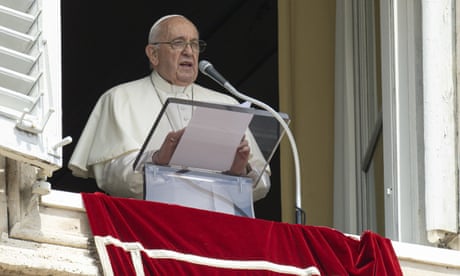
Pope Francis to lay bare ‘terrible world war’ on nature in papal letter - “sacred gift from the creator”


Follow-up to 2015 encyclical on climate crisis urges people to take side of ‘victims of environmental injustice’ - Theguardian.com


Pope Francis attends a World Youth Day gathering of young Catholics in Lisbon on 3 August where he urged people to focus on caring for the planet. Photograph: Miguel Riopa/AFP/Getty

Pope Francis has said he will issue a follow-up document on the protection of nature because a “terrible world war” against the environment was taking place.

The pontiff said the papal statement – a follow-up to his 2015 encyclical on the climate crisis – would be issued on 4 October, the feast day of Francis of Assisi, the patron saint of the environment.

Describing nature as a “sacred gift from the creator”, Francis urged people to take the side of the “victims of environmental and climatic injustice” and called for an end to “the senseless war on our common home, it is a terrible world war”.

John Kerry, the US climate envoy and former secretary of state, told Reuters in an interview in June after meeting the pope that the 2015 encyclical had a profound impact on the climate conference that year which set goals to limit global heating.

In the eight years since Laudato Si was published, there has been an increase in extreme weather events such as more intense and prolonged heatwaves, more frequent wildfires and more severe hurricanes.

Francis said last month such events showed urgent action was needed to tackle the climate crisis and appealed to world leaders “to do something more concrete to limit polluting emissions”.

He said the new document would be an apostolic exhortation, another form of papal writing.

After Laudato Si was issued, some Catholics allied with conservative political movements and corporate interests, particularly in the United States, fiercely criticised the pope for backing the opinion of a majority of scientists who say global heating is at least partly due to human activity.

Wednesday, May 17, 2023

Devastating floods in Italy claim lives and leave thousands homeless

 Angela Giuffrida in Rome
Wed 17 May 2023 20.59 BST

Twenty-one rivers burst their banks after heavy storms across country cause landslides and submerge villages

People call for help as extreme floods engulf houses and roads in Italy 

Nine people have died and thousands have been evacuated from their homes after heavy storms wreaked havoc in the northern Italian region of Emilia-Romagna, causing severe flooding and landslides.

People sought refuge on the rooftops of their homes after 21 rivers broke their banks, submerging entire towns.

Among the victims were an elderly man and a couple who owned a company in the agriculture sector, according to Corriere della Sera. The body of a German woman was found on a beach in Cesenatico, a town by the Adriatic coast, but it is unclear if she was killed in the storms. Others are still reported missing.

The Emilia Romagna F1 Grand Prix scheduled this weekend has been cancelled.

“The only irreparable thing in this emergency are the nine people who lost their lives, and we hope there are no more,” said Stefano Bonaccino, president of Emilia Romagna.

Italy’s civil protection agency said on Wednesday there could be worse to come. “The rainfall is not over, it will continue for several hours,” the agency’s chief, Titti Postiglione, told SkyTG24 news. “We are facing a very, very complicated situation.”


The Savio River in Cesena, central Italy, which burst its banks. Photograph: AP


There has been heavy rain across Italy in recent days but the worst-affected area has been Emilia-Romagna and parts of the central Marche region, where 12 people died in floods last September.

In a video shared on social media, the voices of people trapped in their homes in Faenza, a city in Ravenna province, could be heard shouting for help. Massimo Isola, the mayor of Faenza, said: “We had a night that we will never forget. We’ve never known such flooding in our city, it is something unimaginable.”

Enzo Lattuca, the mayor of Cesena, where citizens swam through the floods to rescue others, said: “The situation is disastrous, it’s a catastrophe, and the rain has not yet finished.”

He said on Wednesday morning the River Savio was starting to swell again.


Emilia-Romagna and parts of Marche have been badly affected by heavy rain, floods and landslides


A bridge that connected Motta-Budrio with San Martino in the area of Bologna collapsed overnight. “Do not go near it,” Italy’s fire service warned. “There is a gas pipeline close by which also seems to be affected.”

Five thousand people were evacuated from their homes in Ravenna. “It’s probably the worst night in the history of Romagna,” Michele de Pascale, the mayor of Ravenna, told Rai radio. “Ravenna is unrecognisable for the damage it has suffered.”

Dario Nardella, the mayor of Florence, said mountain villages on the Romagna side of the Mugello valley had been cut off due to landslides.


Sunday, August 14, 2022

Martianization - Europe’s rivers run dry as scientists warn drought could be worst in 500 years. The Guardian


Crops, power plants, barge traffic, industry and fish populations devastated by parched waterways


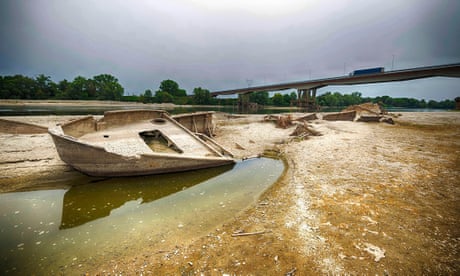
In places, the Loire can now be crossed on foot; France’s longest river has never flowed so slowly. The Rhine is fast becoming impassable to barge traffic. In Italy, the Po is 2 metres lower than normal, crippling crops. Serbia is dredging the Danube.

Across Europe, drought is reducing once-mighty rivers to trickles, with potentially dramatic consequences for industry, freight, energy and food production – just as supply shortages and price rises due to Russia’s invasion of Ukraine bite.

Driven by climate breakdown, an unusually dry winter and spring followed by record-breaking summer temperatures and repeated heatwaves have left Europe’s essential waterways under-replenished and, increasingly, overheated.

With no significant rainfall recorded for almost two months across western, central and southern Europe and none forecast in the near future, meteorologists say the drought could become the continent’s worst in more than 500 years.

“We haven’t analysed fully this year’s event because it is still ongoing,” said Andrea Toreti of the European Commission’s Joint Research Centre. “There were no other events in the past 500 [years] similar to the drought of 2018. But this year, I think, is worse.”

Germany’s Federal Institute of Hydrology (BfG) said the level of the Rhine, whose waters are used for freight transport, irrigation, manufacturing, power generation and drinking, will continue dropping until at least the beginning of next week.

On Friday the water at the critical Kaub marker 50km downstream from Mainz – which measures navigability, rather than the water depth – fell below 40cm, the level at which many shipping firms consider it is no longer economical for barges to operate. It could fall to nearer 30cm over the next few days, the BfG has said.

Many barges, which carry coal for power plants and vital raw materials for industrial giants such as steelmaker Thyssen and chemical giant BASF, are already operating at about 25% capacity to reduce their draft, raising shipping costs up to fivefold.

A vital part of northwest Europe’s economy for centuries, the 760 miles (1,233km) of the Rhine flow from Switzerland through Germany’s industrial heartland before reaching the North Sea at the megaport of Rotterdam.

A total halt in Rhine barge traffic would hit Germany’s – and Europe’s – economy hard: experts have calculated that a six-month suspension in 2018 cost around €5bn (£4.2bn), with low water levels forecast to cost Germany 0.2 points of economic growth this year.

While the EU has said boosting waterborne freight by 25% is one of the bloc’s green transition priorities, Germany is now working to divert it to rail and road – although between 40 and 100 trucks are needed to replace a standard barge load.

France’s rivers might not be such key freight arteries, but they do serve to cool the nuclear plants that produce 70% of the country’s electricity. As prices hit all-time highs, power giant EDF has been forced to reduce output because of the drought.

Strict rules regulate how far nuclear plants can raise river temperatures when they discharge cooling water – and if record low water levels and high air temperatures mean the river is already overheated, they have no option but to cut output. With Europe’s looming energy crisis mounting and the Garonne, Rhône and Loire rivers already too warm to allow cooling water to be discharged, the French nuclear regulator last week allowed five plants to temporarily break the rules.

In Italy, the flow of the parched Po, Italy’s longest river, has fallen to one-tenth of its usual rate, and water levels are 2 metres below normal. With no sustained rainfall in the region since November, corn and risotto rice production have been hard hit.

The Po valley accounts for between 30% and 40% of Italy’s agricultural production, but rice growers in particular have warned that up to 60% of their crop may be lost as paddy fields dry out and are spoiled by seawater sucked in by the low river level.

In the protected wetlands of the river’s delta, near Venice, its high temperature and sluggish flow have reduced the water’s oxygen content to the extent that an estimated 30% of clams growing in the lagoon have already been killed off.

Low river levels and high water temperatures can prove fatal to many species. In Bavaria, the Danube reached 25C last week and could hit 26.5C by mid-month, meaning its oxygen content would fall below six parts per million – fatal for trout.

Freight on the 2,850km of the Danube has also been heavily disrupted, prompting authorities in Serbia, Romania and Bulgaria to start dredging deeper channels while barges carrying mainly fuel for the power generators wait to advance.

Even Norway, which relies on hydropower for about 90% of its electricity generation, has said the unusually low levels of its reservoirs may ultimately oblige it to limit power exports.

Drone footage shows severe drought hitting river in Brazil – video

  Drone footage from 17 September shows the Araguaia River drying up, as severe drought grips parts of Brazil. The country is preparing for ...