Showing posts with label Spain. Show all posts

Tuesday, June 23, 2026

France restricts public drinking as Europe swelters under a ‘heat-dome driven furnace’ for the second time in two months


A woman on the Trocadero square near the Eiffel Tower as temperatures rise in Paris during a second heatwave affecting a large part of France, on June 20, 2026. Sarah Meyssonnier/Reuters

Homem mergulha em fonte perto da Torre Eiffel, em Paris, na França, em meio a onda de calor histórica no país europeu, en 22 de junho de 2026. — Foto: Abdul Saboor/ Reuters 


Franceses às margens do Canal Saint-Martin, em Paris, onde o banho foi liberado — Foto: REUTERS/Alice Sacco


by  Laura Paddison 


Europe is sweltering under its second heat dome in two months, with temperatures spiking above 104 degrees Fahrenheit, bringing dangerous conditions across swaths of the planet’s fastest-warming continent. France banned public alcohol consumption, Spain closed a World Cup fan zone and the UK is bracing for an annihilation of its all-time June temperature record.

Heat alerts were posted Monday by 26 countries, from Ireland to Greece, as soaring temperatures deliver one of Western Europe’s worst June heat waves on record.

The punishing temperatures are the result of a heat dome parked over the continent for the second time in two months. Heat domes are persistent high-pressure systems which act like a lid on a pot, trapping hot air and pushing it downward. The heat waves also come as a strengthening El Niño takes shape in the tropical Pacific. This natural climate pattern is known to increase the frequency and severity of heat extremes worldwide.

Scientists say these kinds of heat waves are becoming more severe and more frequent as humans continue to burn fossil fuels and heat the planet. 

 Extreme heat can quickly become dangerous and even deadly, especially on a continent where very few people have air conditioning. Only about 20% of European homes have AC, compared to around 90% in the United States. 


In France, the blistering heat has been unrelenting. More than half of its 96 regions were under red heat wave alerts Sunday, the most severe level. Temperatures reached above 104 degrees Fahrenheit in some parts of the country.

The heat was so intense Sunday, the government banned public alcohol drinking at Fête de la musique, an annual music festival which takes place across the country and brings millions onto the streets. The ban applied to regions under red heat wave alerts.

“For ‌all ⁠events organized by the state and its agencies, instructions have been given not to offer alcohol,” the Prime Minister’s office said in a statement. 

 Monday is set to be even hotter, with temperatures rising to more than 107 degrees Fahrenheit in some places. The government has ordered the closure of more than 800 schools, according to a report in the Associated Press.


Monday could be France’s hottest day on record for any month, and there is little chance of respite; temperatures are expected to reach “a very high plateau” until at least Thursday, Météo-France said. On Monday, at least four locations in France set all-time high temperature records for any month of the year, while other locations broke June records.

“This heatwave will be quite comparable in severity to the one in August 2003. It is expected to surpass it in terms of maximum intensity,” Météo France said Monday, referring to a deadly 16-day heat wave that killed nearly 15,000 people.

Other parts of Europe are also set to endure unprecedented heat. In the United Kingdom, temperatures are forecast to reach at least 102.2 degrees Fahrenheit Wednesday, according to the country’s Met Office, which would smash the UK’s all-time heat record for June of 96.08 degrees Fahrenheit, last recorded in 1976. Humidity levels will be high, making the heat even more oppressive.

The Met Office issued a rare “Red Extreme Heat Warning” for Wednesday and Thursday. 

 The country will also endure tropical nights, where temperatures don’t dip below 68 degrees Fahrenheit. Nighttime heat is particularly pernicious as it gives people little chance to rest and recover. 


Scientists have sounded the alarm on the extent of the UK’s heat wave. It means two consecutive months “in which the UK temperature records have been annihilated by well over 2 degrees Celsius (3.6 Fahrenheit),” said Liz Bentley, chief executive at the Royal Meteorological Society.

“This is not just a heatwave, it is a heat-dome driven furnace that will grip most of southern UK and push temperatures into truly exceptional territory,” said Akshay Deoras, a meteorologist at the University of Reading. 


Termômetro em Rennes, no oeste da França, em 22 de junho de 2026. — Foto: Jeremias González/ AP

Parts of Spain are sweltering under triple digit temperatures and tropical nights. On the Almería coast in southeastern Spain, nighttime temperatures Sunday into Monday didn’t drop below 86 degrees Fahrenheit, according to the country’s weather service AEMET.

In Madrid, a fan zone set up with big screens for people to watch the World Cup was closed Sunday due to the heat, according to Reuters.

Monday is set to be extremely hot again, AEMET posted on X, adding “the danger is significant in much of the country.” 

A woman seen reading in the Ciutadella Park sheltered from the sun in a comfortable area in Barcelona, Spain, on June 2. SOPA Images/LightRocket/Getty Images


Heat is often called a silent killer. It lacks the visible destruction of a hurricane, flood or wildfire, yet it’s the deadliest type of extreme weather. Extreme temperatures, especially when combined with high humidity, make sweating and other mechanisms people rely on to cool down become less effective.

Heat and humidity are increasingly reaching levels the human body struggles to cope with. Extreme temperatures have killed more than 200,000 people over the past four years, according to the World Health Organization

 Scientists warn these types of extreme heat waves will only become more common as the planet heats up. “Human-driven climate change has provided the springboard for this event, loading the atmosphere with extra heat and making extreme temperatures far more intense than they would have been in the past,” Deoras said. 

 Andrew Freedman contributed to this report.

Monday, August 18, 2025

Wildfires rage in Spain and Portugal amid searing heat


Firefighting efforts continue in Ourense, Spain. Photograph: Anadolu/Getty Images

by   and

Extreme temperatures exacerbated by carbon pollution fuel fires in southern Europe as green policies are rolled back 


Relentless heat and raging wildfires continue to ravage southern Europe, with one-quarter of weather stations in Spain recording 40C temperatures, as the prime minister urged people to “leave the climate emergency outside of partisan struggles”.

The Spanish weather agency Aemet recorded a high of 45.8C in Cádiz on Sunday, while one in eight weather stations nationwide hit peaks of at least 42C (108F) . The agency warned of “very high or extreme fire danger” in most of the country in a post on social media on Monday.

“Although the heatwave is starting to subside, very high temperatures will still be reached today in the east and south of the peninsula,” it said. “Be cautious.”

A pyrocumulus cloud swells over Vilarmel village during a fire in the Galicia region of Spain. Photograph: Mikel Konate/Reuters

Deadly fires have burned 348,000 hectares in Spain this year, according to preliminary data published by Copernicus on Monday, charring even more land than when the previous record was set in 2022.

A fourth person was killed by the fires in Spain when a firefighting truck overturned on a steep forest road, while in neighbouring Portugal, which has also had extreme heat, another firefighter died, bringing the national death toll to two. Civil protection authorities said 31,130 people have been evacuated from their homes in the last week.

The Spanish government said on Sunday that an extra 500 soldiers would join the 1,400 troops trying to bring deadly wildfires under control. The prime minister, Pedro Sánchez, announced a “state pact” to tackle the climate emergency as he visited Ourense and León, one of the regions engulfed by flames.


“We need a strategy that anticipates a better, more secure and more equitable response for our fellow citizens in the face of the worsening and accelerating effects of the climate emergency in our country,” Sánchez said. “And that requires a great state pact that leaves the climate emergency outside of partisan struggles and ideological issues, where we focus on scientific evidence and act accordingly.”

Sánchez’s proposed pact received a dismissive response from the opposition conservative People’s party (PP), which has called for more troop deployments and accused the prime minister of absenting himself from the crisis.


“State pacts don’t put out the flames, nor do they restore what’s been lost,” said Ester Muñoz, a PP spokesperson. “People were expecting a lot more than a smokescreen designed to save his reputation after he’d gone missing for a week.”

Extreme heat, made hotter by carbon pollution, has fuelled devastating wildfires across southern Europe this month, the latest in a series of disasters exacerbated by climate breakdown amid a continental rollback of green policies.

Data from last week shows the blazes have burned at least 530,000 hectares this year, more than double the average over the past two decades, forcing several overwhelmed governments from Spain to Bulgaria to seek firefighting help from the EU. Portugal activated the EU’s civil protection mechanism on Friday with a request for four Canadair water-bombing planes.


 The prolonged heatwave has broken temperature records across the continent. It is expected to die down in Spain after Monday and subsided in some countries over the weekend.


Météo France, the French national weather agency, said temperatures had fallen on Sunday but the wildfire risk remained high or very high in several southern regions.

“The Mediterranean and south-western departments of the country are experiencing significant drought, which means that vegetation is highly sensitive to fire,” the agency said on Monday. It added that the rise in daytime temperatures had been limited by smoke from the Spanish and Portuguese wildfires, as well as plumes of Saharan sand.

In Portugal, which has been under a state of alert since the start of the month, large rural fires have killed two people and caused several injuries.

The head of a dead fish lies in the almost-dry Aume riverbed in Saint-Fraigne, France. Photograph: Yohan Bonnet/AP

The minister for internal affairs, Maria Lúcia Amaral, extended the wildfire alert on Sunday until Tuesday night but left a press conference when journalists tried to ask questions, Portuguese media reported. André Ventura, the head of the far-right Chega party, called for her resignation. “We are reaching the limit of what is acceptable,” he said on Sunday.

In a radio interview on Monday morning, Spain’s defence minister, Margarita Robles, said the fires were unlikely to be brought under control until the heatwave ended later on Monday. “We’re not going to be able to end this situation until the heatwave dies down,” Robles told Cadena Ser. “We’re seeing fires with different characteristics because of climate change.”

A woman flees as a forest fire gathers pace in Pampilhosa da Serra, Portugal. Photograph: Paulo Cunha/EPA
 

 She said the Military Emergencies Unit (UME), founded to help deal with disasters, had never faced such challenging conditions. “We’re seeing a fire situation that’s never been seen before. The UME hasn’t seen anything like this since it was established 20 years ago.”

Wednesday, August 13, 2025

Spain wildfires are ‘clear warning’ of climate emergency, minister says. Environment minister says blazes, in which two people have died, are proof of country’s vulnerability to global heating

A firefighter battles a wildfire in the village of Parafita, Galicia region, Spain, on Tuesday. Photograph: Violeta Santos Moura/Reuters

by   in Madrid, in Athens and agencies

 The heatwave-fuelled wildfires that have killed two people in Spain over recent days, devouring thousands of hectares of land and forcing thousands of people from their homes, are a “clear warning” of the impact of the climate emergency, the country’s environment minister has said.


Speaking on Wednesday morning, as firefighters in Spain, Greece and other Mediterranean countries continued to battle dozens of blazes, Sara Aagesen said the 14 wildfires still burning across seven Spanish regions were further proof of the country’s particular vulnerability to global heating.

Aagesen said that while some of the fires appeared to have been started deliberately, the deadly blazes were a clear indicator of the climate emergency and of the need for better preparation and prevention.

“The fires are one of the parts of the impact of that climate change, which is why we have to do all we can when it comes to prevention,” she told Cadena Ser radio.

“Our country is especially vulnerable to climate change. We have resources now but, given that the scientific evidence and the general expectation point to it having an ever greater impact, we need to work to reinforce and professionalise those resources.”

Firefighters on the outskirts of Abejera de Tábara, Zamora, Spain. Photograph: Susana Vera/Reuters

Aagesen’s comments came a day after temperatures in parts of southern Spain surged past 45C (113F). The state meteorological office, Aemet, said there were no recorded precedents for the temperatures experienced between 1 August and 20 August.

A 35-year-old volunteer firefighter died on Tuesday in the north-western Spanish region of Castilla y León, where fires have prompted the evacuation of more than 8,000 residents, and where seven people are being treated in hospital for serious burns. Four are in a critical condition.

The firefighter’s death came hours after that of a 50-year-old man who suffered 98% burns while trying to save horses from a burning stable near Madrid on Monday night.

By Wednesday morning, the Madrid fire had been brought under control, but blazes in the far north-western region Galicia had consumed 11,500 hectares (30,000 acres) of land by the end of the day.

“Emergency teams are continuing to fight fires across our country,” the prime minister, Pedro Sánchez, said in a post on X on Wednesday. “The fire situation remains serious and extreme caution is essential. My thanks, once again, to all of you who are working tirelessly to fight the flames.”

A helicopter flies over the town of Vilar near Chandrexa de Queixa in Galicia, Spain, on Tuesday. Photograph: Brais Lorenzo/EPA

Neighbouring Portugal deployed more than 2,100 firefighters and 20 aircraft against five big blazes, with efforts focused on a fire in the central municipality of Trancoso that has raged since Saturday.

Strong gusts of wind had rekindled flames overnight and threatened nearby villages, where television images showed local people volunteering to help firefighters under a thick cloud of smoke.

In Greece, which requested EU aerial assistance on Tuesday, close to 5,000 firefighters were battling blazes fanned by gale-force winds nationwide. Authorities said emergency workers were waging a “a titanic battle” to douse flames still raging through the western Peloponnese, in Epirus farther north, and on the islands of Zakynthos, Kefalonia and Chios, where thousands of residents and tourists have been evacuated from homes and hotels.

Local media reported the wildfires had decimated houses, farms and factories and forced people to flee. Fifteen firefighters and two volunteers had suffered burns and other injuries including “symptoms of heatstroke”, the fire service said.

A man moves goats during a wildfire in Vounteni, on the outskirts of Patras, Greece, on Wednesday. Photograph: Thanassis Stavrakis/AP

Around midnight a huge blaze erupted on Chios, devouring land that had only begun to recover from devastating wildfires in June. As the flames reached the shores, the coastguard rushed to remove people on boats to safety.

On the other side of Greece, outside the western city of Patras, volunteers with the Hellenic Red Cross struggled to contain infernos barrelling towards villages and towns. By lunchtime on Wednesday, media footage showed flames on the outskirts of Patras, Greece’s third-largest city. Municipal authorities announced a shelter had been set up to provide refuge, food and water for those in need.

Officials evacuated a children’s hospital and a retirement home in the city as a precaution, and local media footage showed the roof of a 17th-century monastery outside the city on fire.

Seventeen settlements around Preveza, where fires broke out Tuesday, were reported to be without electricity or water.

“Today is also expected to be very difficult as in most areas of the country a very high risk of fire is forecast,” a fire service spokesperson, Vassilis Vathrakoyiannis, said in a televised address. “By order of the head of the fire brigade, all services nationwide, including civil protection forces, will be in a state of alert.”

Firefighters take a quick rest in Izmir, Turkey, on Wednesday. Photograph: Anadolu/Getty Images

At first light, 33 water-dumping planes and helicopters scrambled to extinguish fires, he said.

Temperatures exceeding 35C (95F) are predicted, according to some meteorologists, to rise further later this week, the height of the summer for Greeks. Record heat and prolonged drought have already turned much of the country tinder-dry, producing conditions ripe for forest fires.

A forestry worker was killed on Wednesday while responding to a wildfire in southern Turkey, officials said. The forestry ministry said the worker died in an accident involving a fire truck that left four others injured.

Turkey has been battling severe wildfires since late June. A total of 18 people have been killed, including 10 rescue volunteers and forestry workers who died in July.

In southern Albania a wildfire caused explosions after detonating buried second world war-era artillery shells. Officials said on Wednesday an 80-year-old man had died in one blaze south of the capital, Tirana.

The Associated Press and Agence France-Presse contributed to this report

Tuesday, August 12, 2025

Thousands evacuated in Spain as deadly heatwave fans Mediterranean wildfires. Boy, four, dies of heatstroke in Rome as scientists say high temperatures and fires are reminder of climate emergency


 by  in Madrid and in Athens


The deadly heatwave fanning wildfires across the Mediterranean region has claimed at least three lives and forced thousands of people from their homes.

Firefighters continued to battle blazes on Tuesday and authorities braced for further damage as temperatures in some areas surged well past 40C. In Spain, a Romanian man in his 50s died after suffering 98% burns while trying to rescue horses from a burning stable near Madrid on Monday night.

A four-year-old boy who was found unconscious in his family’s car in Sardinia died in Rome on Monday after suffering irreversible brain damage caused by heatstroke. And in Montenegro, one soldier died and another was seriously injured when their water tanker overturned while fighting wildfires in the hills north of the capital, Podgorica, on Tuesday.

Scientist have warned that the heat currently affecting large parts of Europe is creating perfect conditions for wildfires and serving as another reminder of the climate emergency.


“Thanks to climate change, we now live in a significantly warmer world,” Akshay Deoras, a research scientist at the University of Reading’s meteorology department told Agence France-Presse, adding that “many still underestimate the danger”.

The fire in Tres Cantos, near Madrid – which had been fuelled by winds of 70km/h (45mph) and which has devoured 1,000 hectares of land – was still not under control on Tuesday evening, when further strong gusts were expected. The regional government said it had recovered 150 dead sheep and 18 dead horses from the area.

More than 3,700 people were evacuated from 16 municipalities amid dozens of reported blazes in the north-western region of Castilla y León, including one that damaged the Unesco world heritage-listed Roman-era mining site at Les Médulas.

Authorities in neighbouring Galicia said the largest wildfire of the year had burned through 3,000 hectares of land in Ourense province. In the southern town of Tarifa, firefighters on the ground and in planes battled a fire that broke out on Monday, with 2,000 people evacuated.

The blazes have led the interior ministry to declare a “pre-emergency phase” to help coordinate emergency resources.

Firefighters work to extinguish a forest fire in Lamas de Olo, in the Alvao natural park, Portugal. Photograph: Pedro Sarmento Costa/EPA

The prime minister, Pedro Sánchez, offered his condolences to the family of the man who died after the Tres Cantos fire, and thanked the emergency services for their “tireless efforts”.

He urged people to recognise the seriousness of the situation. “We’re at extreme risk of forest fires,” he said in a message on X on Tuesday. “Let’s be very careful.”

In neighbouring Portugal, firefighters were battling three large wildfires in the centre and north of the country.

Authorities in Greece requested EU help as fires, fuelled by gale force winds, ripped across vast swathes of the western Peloponnese and emergency services ordered the evacuation of thousands of residents.

Firefighters were also trying to contain blazes on the popular Ionian tourist islands of Zakynthos and Kefalonia. With gusts hampering firefighting efforts, emergency services ordered all hotels in the region of Agala and Keri on Zakynthos to temporarily close, forcing suitcase-wielding holidaymakers to flee and relocate to other areas.

A house burning during a wildfire that erupted in a forest near the village of Agalas on Zakynthos. Photograph: Costas Synetos/EPA


By late Tuesday, dozens of firefighters, supported by 15 fire trucks and eight water-bombing planes and helicopters, were still trying to douse the fast-moving flames.

“Everything that civil protection can offer is here but there are very strong winds and the fires are out of control,” said the island’s mayor, Giorgos Stasinopoulos. “We need a lot more air support, it’s vital.”

The fire service said it was also dealing with blazes farther north in Epirus, around Preveza and in the central region of Aetolia-Acarnania.

Despite temperatures nudging 43C in some parts of the Peloponnese region of southern Greece on Tuesday – and the prolonged drought, which has produced highly flammable conditions on tinder-dry soil – officials described the outbreak of so many fires as “suspiciously high”.

Faced with an estimated 63 blazes erupting and firefighters confronting flames on 106 fronts, fire officers dispatched specialist teams to several of the stricken regions to investigate possible arson.

In Albania, hundreds of firefighters and troops had subdued most of the nearly 40 fires that flared up in the past 24 hours, the defence ministry said, but more than a dozen were still active.

Since the start of July, nearly 34,000 hectares have been scorched nationwide, according to the European Forest Fire Information System. Police say many of the blazes were deliberate, with more than 20 people arrested.

The aftermath of the blaze in Çanakkale, Turkey, on Tuesday. Photograph: Anadolu/Getty Images

In Croatia, about 150 firefighters spent Monday night defending homes near the port city of Split.

In the north-western Turkish province of Çanakkale, more than 2,000 people were evacuated and 77 people treated in hospital for smoke inhalation after fires broke out near the tourist village of Güzelyalı, authorities said.

Images on Turkish media showed homes and cars ablaze, while more than 760 firefighters, 10 planes, nine helicopters and more than 200 vehicles were deployed to battle the flames. Turkey this year experienced its hottest July since records began 55 years ago.

In southern France, where temperature records were broken in at least four weather stations, the government called for vigilance.

The south-western city of Bordeaux hit a record 41.6C on Monday, while all-time records were broken at meteorological stations in Bergerac, Cognac and Saint Girons, according to the national weather service, Météo France.

Agence France-Presse contributed to this report

Wednesday, October 30, 2024

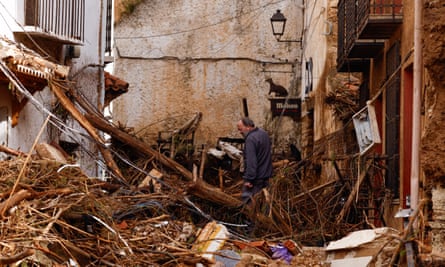
‘We were trapped like rats’: Spain’s floods bring devastation and despair


Pedestrians look at piled-up cars in Sedavi, south of Valencia city, after deadly floods. Photograph: José Jordan/AFP/Getty Images

 Residents describe impact of floods and downpours – with some places hit with a year’s worth of rain in just eight hours

The gratitude that greeted Tuesday’s dawn downpours was short-lived in Utiel. When the longed-for rains finally reached the town in the drought-stricken eastern Spanish region of Valencia, they were merciless in their abundance.

“People were very happy at first because they’d been praying for rain as their lands needed water,” said Remedios, who owns a bar in Utiel. “But by 12 o’clock, this storm had really hit and we were all pretty terrified.”

Trapped in the bar, she and a handful of her customers could only sit and watch as Spain’s worst flooding in almost 30 years caused the Magro River to overflow its banks, trapping some residents in their homes and sending cars and rubbish bins surging through the streets on muddy flood waters.

Damaged cars lie amid debris along damaged rail lines in the flood-hit city of Valencia. Photograph: Manuel Bruque/EPA


“The rising waters brought mud and stones with them and they were so strong that they broke the surface of the road,” said Remedios, who gave only her first name.

“The tunnel that leads into the town was half-full of mud, trees were down and there were cars and rubbish containers rolling down the streets. My outside terrace has been destroyed – the chairs and shades were all swept away. It’s just a disaster.”

By Wednesday afternoon, the death toll in Valencia and the neighbouring regions of Castilla-La Mancha and Andalucía stood at 95 . Utiel’s mayor, Ricardo Gabaldón, told Las Provincias newspaper that some of the town’s residents had not survived the floods, but was unable to provide an exact number.

Hours earlier, Gabaldón had told Spain’s national broadcaster, RTVE, that Tuesday had been the worst day of his life. “We were trapped like rats,” he said. “Cars and rubbish containers were flowing down the streets. The water was rising to 3 metres.”

 People in the town fear some of the dead may have been older people who were unable to escape the flood waters. Remedios said: “Anyone who could get to higher ground did, but there were some old people who couldn’t even open their front doors and they were trapped there inside their own houses.”


Residents of La Torre, on the outskirts of Valencia city, were confronted by similar scenes on Wednesday morning.

“The neighbourhood is destroyed, all the cars are on top of each other, it’s literally smashed up,” Christian Viena, a bar-owner in the area, told the Associated Press by phone. “Everything’s a total wreck, everything is ready to be thrown away. The mud is almost 30cm deep.”

A man carries a dog in Letur, Albacete province, after flash floods hit the region. Photograph: Mateo Villalba Sanchez/Getty Images

Spain’s meteorological office, Aemet, said that more than 300 litres of rain per square metre (30cm) had fallen in the area between Utiel and the town of Chiva, 20 miles (50km) away, on Tuesday. In Chiva, it noted, almost an entire year’s worth of rain had fallen in just eight hours.

The ferocious rains have come as Spain continues to experience a punishing drought. Last year, the government approved an unprecedented €2.2bn (£1.9bn) plan to help farmers and consumers cope with the enduring lack of rain amid warnings that the climate would only get worse, and more unpredictable, in the future.

“Spain is a country that is used to periods of drought but there’s no doubt that, as a consequence of the climate change we’re experiencing, we’re seeing far more frequent and intense events and phenomena,” the environment minister, Teresa Ribera, said.

As Wednesday wore on, a distressing picture of the human and economic damage began to emerge. Spain declared three days of national mourning.


The prime minister, Pedro Sánchez, said the entire country felt the pain of those who had lost their loved ones, and urged people to take every possible precaution as the torrential rains moved to the north-east of the country.

The defence minister, Margarita Robles, said 1,000 members of the military emergencies unit had been deployed to help regional emergency services. In a sign that more bodies could be trapped in the mud and in houses, she also offered mobile morgues.

One man used a phone call to RTVE to plead for any news of his son, Leonardo Enrique Rivera, who had gone missing in his Fiat van after going to work as a delivery driver in the Valencian town of Riba-roja on Tuesday.

A man walks among the debris in Letur.

A man picks his way through debris in Letur. Photograph: Susana Vera/Reuters


“I haven’t heard from him since 6.55 yesterday,” said Leonardo Enrique. “It was raining heavily and then I got a message saying the van was flooding and that he’d been hit by another vehicle. That was the last I heard.”

Esther Gómez, a town councillor in Riba-roja, said workers had been stuck overnight in an industrial estate “without a chance of rescuing them” as streams overflowed. “It had been a long time since this happened and we’re scared,” she told Agence France-Presse.

As the search for the dead continued, experts warned that the torrential rains and subsequent floods were further proof of the realities of the climate emergency.

“No doubt about it, these explosive downpours were intensified by climate change,” said Dr Friederike Otto, leader of world weather attribution at the Centre for Environmental Policy, Imperial College London.

“With every fraction of a degree of fossil fuel warming, the atmosphere can hold more moisture, leading to heavier bursts of rainfall. These deadly floods are yet another reminder of how dangerous climate change has already become at just 1.3C of warming. But last week the UN warned that we are on track to experience up to 3.1C of warming by the end of the century.”

There were similar, if differently expressed, sentiments in Utiel on Wednesday. “There was one guy here with me yesterday who’s 73, and he said he’d never seen anything like this in all his years,” said Remedios. “Never.”


Tempestades na Espanha deixam mais de 62 mortos


Região de Málaga também foi atingida


Autoridades da Espanha confirmaram nesta quarta-feira (30/01) que ao menos 62 pessoas morreram e várias estão desaparecidas após as enchentes  que atingiram a província de Valência. As inundações arrastaram carros, transformaram ruas de vilarejos em rios e interromperam o tráfego em linhas ferroviárias e rodovias.

Nesta terça-feira, chuvas torrenciais e inundações causaram estragos em várias partes do país, principalmente em uma ampla área do sul e do leste. Os maiores impactos foram registrados nas regiões costeiras mediterrâneas da Andaluzia, Múrcia e Valência.

Além das fortes chuvas, houve também queda de granizo e fortes rajadas de vento, segundo com o serviço meteorológico nacional Aemet. A agência previu que as tempestades devem continuar até esta quinta-feira

A força da água arrastou veículos e destroços pelas ruas de várias localidades. A polícia e os serviços de resgate usaram helicópteros para retirar pessoas de casas e carros. O governo da região de Valência pediu aos moradores que se desloquem para terrenos mais altos.

Inundações na Espanha transformaram ruas de vilarejos em rios e interromperam o tráfego em linhas ferroviárias e rodoviasFoto: JOSE JORDAN/AFP/Getty Images

 
 O transporte aéreo e ferroviário também foi afetado. Um trem de alta velocidade com quase 291 pessoas a bordo descarrilou perto de Málaga devido a um deslizamento de terra. A empresa ferroviária estatal Renfe informou que o acidente, porém, não deixou feridos.


Governo cria comitê de crise

O serviço de trens de alta velocidade e outras linhas de passageiros entre Valência e Madri foi interrompido. Aulas tiveram de ser canceladas em várias escolas e universidades. Mais de mil membros dos serviços de emergências da Espanha foram enviados para as áreas atingidas.

A tempestade já havia atingido Mallorca e outras Ilhas Baleares na segunda-feira, onde um alerta amarelo de tempestade ainda está em vigor para algumas áreas.

O governo da Espanha criou um comitê de crise para coordenar os esforços de resgate, que será presidido pelo primeiro-ministro, Pedro Sánchez.

Carros foram arrastados pela força das águas


A tempestade deve se mover para nordeste do país nesta quarta-feira, enquanto um alerta de clima severo permanece em vigor para uma grande parte da Espanha.

Tempestades após fortes secas

As tempestades que atingem a Espanha ocorrem após uma seca severa. Cientistas afirmam que o aumento dos episódios de clima extremo provavelmente está associado às mudanças climáticas. À medida que as temperaturas globais aumentam, o ar mais quente retém mais umidade, o que intensifica os níveis de precipitação.

Atividades humanas, como desenvolvimento urbano, desmatamento e infraestruturas inadequadas, também contribuem significativamente para os riscos de inundações.

rc/cn (AP, DPA, EFE)


Monday, July 18, 2022

Onda de calor mata mais de 1.000 em Portugal e Espanha, e incêndios se alastram pela Europa


França, Reino Unido e Itália também sofrem com recordes de temperaturas


MADRI | REUTERS e AFP
A onda de calor que atinge há quase uma semana o sul da Europa já deixou mais de 1.000 mortos apenas em Portugal e Espanha, além de uma série de incêndios florestais, que se alastram pelo continente.

Dados da Direção-Geral de Saúde de Portugal compilados na noite de sábado (16) apontavam a morte de 659 pessoas em meio à onda de calor nos sete dias anteriores, a maioria deles idosos. O pico de mortes ocorreu na quinta-feira (14), segundo o órgão, quando as temperaturas passaram dos 40ºC na maior parte do país —com recorde de 47ºC no distrito de Viseu, 300 km ao norte de Lisboa.

No mesmo dia, o Instituto de Saúde Carlos 3º, na Espanha, apontou 360 mortes relacionadas ao calor no país. Neste domingo (17), autoridades espanholas lutavam contra 20 incêndios ainda ativos e fora de controle em diferentes pontos do país. Na Galícia, na região noroeste, o fogo destruiu cerca de 4.500 hectares durante a semana.

Em Málaga, no sul, os bombeiros conseguiram estabilizar um incêndio na serra de Mijas que destruiu pelo menos 2.000 hectares. As chamas forçaram cerca de 3.000 pessoas a sair de casa, mas a maior parte delas já conseguiu retornar. Os britânicos William e Ellen McCurdy buscaram abrigo em um centro esportivo no sábado, quando o incêndio se aproximou. "Foi muito rápido, não levei muito a sério. Achei que eles tinham tudo sob controle e fiquei bastante surpreso quando o fogo parecia estar se movendo em nossa direção", disse William, 68.

A agência meteorológica da Espanha emitiu alertas para temperaturas máximas de 42ºC neste domingo nas regiões de Aragão, Navarra e La Rioja, no norte. Segundo a entidade, a onda de calor extremo deve terminar nesta segunda-feira (18), mas as temperaturas permanecerão "anormalmente altas".

Em Portugal, cerca de 1.000 bombeiros tentavam controlar 13 incêndios florestais e rurais no centro e no norte do país, o maior deles perto da cidade de Chaves. Quase todo o território apresentava um risco "máximo", "muito alto", ou "elevado" de incêndios neste domingo. Na última semana, o fogo destruiu entre 12 mil e 15 mil hectares, segundo cálculos oficiais.

Na França, a situação é crítica. No sudoeste do país, os bombeiros continuam lutando contra dois incêndios que já devastaram em torno de 11 mil hectares desde terça-feira (12) na região de Bordeaux, uma área equivalente à da cidade de Paris, disse à AFP o engenheiro Guillaume Rozier.

Segundo a agência meteorológica Météo-France, as temperaturas podem chegar a 40ºC nessa área. No domingo, 51 departamentos estavam sob alerta laranja, e 15, sob alerta vermelho, o mais alto, devido à escalada dos termômetros. "O calor está aumentando, a onda de calor está se espalhando pelo país", advertiu a agência.

As autoridades preveem que segunda-feira (18) será o dia mais quente no oeste do país, com temperaturas que podem ultrapassar os 40ºC nas regiões da Bretanha, Baixa Normandia, Aquitânia e Occitânia ocidental.

As temperaturas também continuam altas no Reino Unido, onde as autoridades decretaram a primeira emergência nacional por calor extremo. No sul da Inglaterra, as temperaturas podem passar dos 40°C pela primeira vez na segunda ou na terça-feira (19). ​Passageiros de trens foram aconselhados a viajar apenas se for absolutamente necessário e pode haver atrasos e cancelamentos generalizados.

Diante da onda de calor, Dominic Raab, adjunto do primeiro-ministro Boris Johnson, pediu que se respeite alguns "conselhos de senso comum". "Mantenha-se hidratado, evite sol nas horas mais quentes e passe protetor solar, esse tipo de coisa", disse ele à Sky News. Ao mesmo tempo, afirmou que é preciso "aproveitar o sol", que o país é resistente o suficiente para aguentar o calor e que não há razão para fechar as escolas.

As declarações foram criticadas por profissionais de saúde e meteorologistas. "Não é um dia bonito de sol, em que você pode passar protetor solar, ir nadar, ou comer fora", disse Tracy Nicholls, diretora-executiva do College of Paramedics. "Trata-se de um calor severo que pode, de fato, provocar mortes, porque é forte demais", acrescentou. "Não estamos preparados para esse tipo de calor neste país", insistiu.

Na Itália, onde incêndios menores ocorreram nos últimos dias, os meteorologistas esperam temperaturas acima de 40°C em várias regiões nos próximos dias.


Monday, May 25, 2009

Future of Biofuels Expected to Remain Bright


SALAMANCA, SPAIN — Only a year ago, biofuels were blamed for soaring prices of vital food commodities like corn, wheat, sugar and vegetable oils. Riots in more than 30 countries and warnings from environmental groups, governments, the United Nations and the World Bank triggered a global debate over public support for the expanding biofuel industry.
Then, as credit dried up and the global recession took hold, the burgeoning industry imploded — which at least silenced the outcry. Commodity prices tumbled even faster than crude oil as global fuel demand evaporated. The bursting of the biofuel bubble left dozens of plants idle and forced some of the biggest names in the industry to file for bankruptcy.
Among the casualties, the biggest ethanol plant in Spain halted production in September 2007, barely a year after starting operations. Jointly owned by a unit of Abengoa, a Spanish company that is one of the top biofuel producers in the world, and Ebro Puleva, a food-processing company, the €150 million, or $200 million, distillery, with an annual capacity of 200 million liters, or 50 million gallons, stood idle for 11 months amid cereal fields in the flatlands near Salamanca, about 220 kilometers, or 140 miles, northwest of Madrid.
Production resumed only in August 2008, as cereal prices dropped from their record highs and the Spanish government mandated compulsory blending requirements for transport fuel — a law that took effect at the start of the year.
Despite last year’s setback, Javier Salgado, chairman of the plant’s operator, Abengoa Energia, is optimistic for the future.
“We have the fortune of working in a European regulated market,” Mr. Salgado said. “We are living a crisis; it’s hard; we are under cost control; but the horizon is one of growth. I can envision in 10 years that Europe’s ethanol market will multiply by five, by four in Brazil, and triple in the U.S.”
Abengoa, the biggest ethanol producer in Europe — and a recent entrant to the biodiesel business — has a global annual fuel production capacity of 1.9 billion liters, with another 1.15 billion liters under construction. It is currently building the biggest ethanol plant in continental Europe, in the Netherlands. The European Union has set a 2020 target of supplying 10 percent of its transportation needs with renewable sources, which includes biofuels.
Industry analysts and producer companies say they expect government policies to continue to underpin biofuels expansion. Despite that, commodity prices should stay low for much of this year, depressed by the economic crisis; but next year, if global energy demand recovers along with the economy, there could be a repeat of last year’s spike in global food prices.
Less than 5 percent of world cereal production will go to biofuels this season, according to the Food and Agriculture Organization of the United Nations. But that share is expected to rise steadily, at least until technology to process alternative raw materials is deployed on a global scale, a distant prospect.
Rising biofuel use, together with surging human and animal consumption, will continue to put pressure on global food supplies, mostly because cereal production is not keeping up with demand. “There is not enough money being devoted to agriculture. Long-term trends are pretty dire,” said Francisco Blanch, head commodity analyst for Bank of America-Merrill Lynch, in London. “We are setting ourselves up for another big rally.
“Prices are set by marginal changes in supply; biofuels are still biting into overall agricultural production, and there is a risk of another price spike in as little as a year. All we need is a bad crop.”
The ratio of world grain stocks to consumption — a measure of spare food capacity — is likely to remain historically low through 2010 and beyond, at around half its level at the start of the century, according to data from the U.S. Department of Agriculture and the United Nations.

Future of Biofuels Expected to Remain Bright


SALAMANCA, SPAIN — Only a year ago, biofuels were blamed for soaring prices of vital food commodities like corn, wheat, sugar and vegetable oils. Riots in more than 30 countries and warnings from environmental groups, governments, the United Nations and the World Bank triggered a global debate over public support for the expanding biofuel industry.
Then, as credit dried up and the global recession took hold, the burgeoning industry imploded — which at least silenced the outcry. Commodity prices tumbled even faster than crude oil as global fuel demand evaporated. The bursting of the biofuel bubble left dozens of plants idle and forced some of the biggest names in the industry to file for bankruptcy.
Among the casualties, the biggest ethanol plant in Spain halted production in September 2007, barely a year after starting operations. Jointly owned by a unit of Abengoa, a Spanish company that is one of the top biofuel producers in the world, and Ebro Puleva, a food-processing company, the €150 million, or $200 million, distillery, with an annual capacity of 200 million liters, or 50 million gallons, stood idle for 11 months amid cereal fields in the flatlands near Salamanca, about 220 kilometers, or 140 miles, northwest of Madrid.
Production resumed only in August 2008, as cereal prices dropped from their record highs and the Spanish government mandated compulsory blending requirements for transport fuel — a law that took effect at the start of the year.
Despite last year’s setback, Javier Salgado, chairman of the plant’s operator, Abengoa Energia, is optimistic for the future.
“We have the fortune of working in a European regulated market,” Mr. Salgado said. “We are living a crisis; it’s hard; we are under cost control; but the horizon is one of growth. I can envision in 10 years that Europe’s ethanol market will multiply by five, by four in Brazil, and triple in the U.S.”
Abengoa, the biggest ethanol producer in Europe — and a recent entrant to the biodiesel business — has a global annual fuel production capacity of 1.9 billion liters, with another 1.15 billion liters under construction. It is currently building the biggest ethanol plant in continental Europe, in the Netherlands. The European Union has set a 2020 target of supplying 10 percent of its transportation needs with renewable sources, which includes biofuels.
Industry analysts and producer companies say they expect government policies to continue to underpin biofuels expansion. Despite that, commodity prices should stay low for much of this year, depressed by the economic crisis; but next year, if global energy demand recovers along with the economy, there could be a repeat of last year’s spike in global food prices.
Less than 5 percent of world cereal production will go to biofuels this season, according to the Food and Agriculture Organization of the United Nations. But that share is expected to rise steadily, at least until technology to process alternative raw materials is deployed on a global scale, a distant prospect.
Rising biofuel use, together with surging human and animal consumption, will continue to put pressure on global food supplies, mostly because cereal production is not keeping up with demand. “There is not enough money being devoted to agriculture. Long-term trends are pretty dire,” said Francisco Blanch, head commodity analyst for Bank of America-Merrill Lynch, in London. “We are setting ourselves up for another big rally.
“Prices are set by marginal changes in supply; biofuels are still biting into overall agricultural production, and there is a risk of another price spike in as little as a year. All we need is a bad crop.”
The ratio of world grain stocks to consumption — a measure of spare food capacity — is likely to remain historically low through 2010 and beyond, at around half its level at the start of the century, according to data from the U.S. Department of Agriculture and the United Nations.

‘Extremely rare event:’ Miles-long microalgae bloom knocks out most of Israel’s desalination plants

A microalgae bloom has spread along Israel's Mediterranean coast.  Israel Oceanographic and Limnological Research institute by   By Laur...