Small island countries press for guarantees as rising sea levels risk leaving their citizens stateless
https://www.theguardian.com/world/2023/jun/27/tuvalu-climate-crisis-rising-sea-levels-pacific-island-nation-country-digital-clone
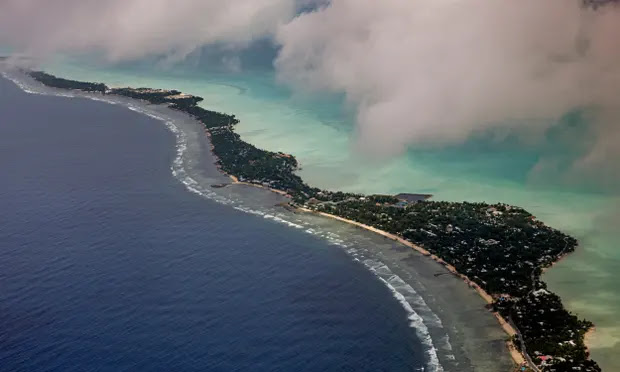
Within decades,
archipelagos could lose outlying atolls that define national borders as
coastlines are increasingly threatened by storm surges. Photograph: Jonas Gratzer/LightRocket/Getty Images
Small island nations would rather fight than flee,
but rising sea levels have prompted apocalyptic legal discussions about
whether a state is still a state if its land disappears below the
waves.
The Pacific Islands Forum,
which represents many of the most vulnerable countries, has invited
international legal experts to consider this question and begun a
diplomatic campaign to ensure that political statehood continues even
after a nation’s physical fabric is submerged.
At the heart of this discussion is the scientific
certainty that oceans will continue to rise for at least another century
and a sense of injustice that those worst affected are among the least
responsible for the climate crisis. The Alliance of Small Island States
represents more than a quarter of the world’s countries, but is
responsible for less than 1% of global carbon emissions, most of which
come from big industrialised countries in the global north.
This
has locked in an expansion of the world’s oceans that is already under
way and will accelerate in the second half of this century. Island maps
are already being slowly redrawn and coastlines are increasingly
threatened by storm surges. Within decades, archipelagos could lose
outlying atolls that define national borders. A century from now – if
not sooner – entire states could become uninhabitable, raising doubts
about what will happen to their citizens, governments and resources.
The World Bank
had said current regulations on these matters were drawn up in a period
of climate stability and may need to be reassessed to account for an
“unprecedented situation for international law”.
At a conference on this topic in Fiji this year, the prime minister of the Cook Islands, Mark Brown,
framed this debate in a series of existential questions: “As our
shorelines are eaten away by sea level rise, what will become of our
sovereignty, of our lands, our titles, our homes? What will become of
our fundamental rights and freedoms guaranteed by our constitutions and
the Universal Declaration of Human Rights? How can we realise our shared
vision when our very status as ‘states’ is being questioned? How can we
fulfil our responsibility to our peoples if their homes and livelihoods
are taken away from them? These questions are difficult but real. They
require solutions.”
Simon Kofe, the foreign minister of Tuvalu,
one of the most vulnerable nations, stressed the need for a
redefinition of global rules and a recognition of what is due to
citizens of the worst-affected countries. “The threats of sea level rise
and the erosion of our statehood are not mere hypotheticals, but very
real and present dangers that we must face head on,” he said. “Our
discourse is not limited to legal instruments and policies, but
encompasses the survival of our people and nations. We have the power to
make a significant impact by acting urgently and decisively.”
The priorities for action are largely determined
by the timing of expected impacts. The science of sea level rise is well
established, but there are several uncertainties related to future
levels of greenhouse gas emissions and the speed at which the Greenland
and Antarctic ice sheets melt.
Robert E. Kopp, an earth sciences professor at Rutgers University in New Jersey and one of the lead authors for the IPCC report on global sea level rise,
said that a country like Tuvalu – which has an average elevation of 2
metres – was unlikely to be completely flooded until the 22nd century.
The possible collapse of the giant Thwaites glacier in Antaractica could
bring that forward as it would add 1.5 metres to ocean heights, but
this would take decades. The more immediate risk, he said, was from
storm surges: “It’s not just sea level rise, but when a place gets
flooded multiple times a year.” This view was echoed by Peter Girard of
Climate Central, who said floods would hit long before total inundation:
“It could become impossible to live along the coast without
protection.”
Tuvalu
and other island states have recently begun reinforcing some of their
coastlines with concrete flood barriers, but these are only a partial
defence that will diminish over time and always be vulnerable to
tsunamis or other big flooding events, as well as to upsurges of
groundwater.
Faced by these threats to the integrity of the nation, protection of legal rights is a priority. In 2020, the Pacific Islands Forum
called for international guarantees of existing maritime zones – and
the resources within them – even if land territory is eroded.
More recently, Tuvalu has launched a diplomatic
push for other nations to recognise its statehood regardless of the
physical impacts of climate change.
Kofe noted
that the definition of statehood under international law was reflected
in the Montevideo convention, which sets out four criteria: a physical
territory, population, government, and the capacity to enter into
relations with other countries. “If we were to take that definition,
Tuvalu could possibly lose its status as a state if we lose our physical
territory or we are forced to relocate to a different location,” he
said. “So we are just imagining this worst-case scenario – if it does
come to that, we would want the world to continue to recognise our
statehood as being permanent.”
So far, seven
governments have made this commitment: Venezuela, the Bahamas, Saint
Kitts, St Lucia, Vanuatu, Niue, Palau, Gabon and Taiwan. Tuvalu is also
discussing the matter with bigger neighbours such as New Zealand and
Australia.
Tuvalu is also digitising its government to make
it easier to relocate, while legal scholars have considered whether
statehood could be continued by leasing land in another country.
Patricia
Galvão Teles, a member of the International Law Commission who
participated in the conference in Fiji, noted the historical precedents
of governments in exile during wartime, or the historical relocations of
the Holy See and the Sovereign Order of Malta.
However, in those cases, the moves were temporary
and away from a homeland that remained physically intact. A state that
evacuates because of climate pressure may find it harder to prove its
long-term viability if its land is under ever more water. The loss of
productive land and other economic resources might also make it
difficult to meet international obligations to protect the assets of its
citizens, maintain embassies or pay for membership of global
organisations.
Another challenge is whether a
population could maintain its legal rights and cultural cohesion as a
permanent diaspora. Galvão Teles noted that international law does not
have a special legal category for climate refugees or people affected by
sea level rise, so it is necessary to rely on existing agreements on
human rights and refugees. If states can continue as political entities
regardless of the physical loss of land, she said, the question of
statelessness would probably not arise until “much further down the
road”. However, there could be complications if people evacuate to
another nation that does not allow dual citizenship or the registration
of births of foreign nationals.
One solution, raised by the World Bank, would be to merge with another state, as Zanzibar and Tanganyika did in 1964 to form Tanzania.
Delegates at the conference said speculation about
a landless state and stateless citizens should not distract from the
more pressing task of persuading big emitters, such as the United
States, Europe, China and India, to cut greenhouse gases, which was the
most effective way of reducing pressure on the oceans.
Galvão
Teles said the delegates at the Fiji conference wanted to counter the
narrative of climate refugees and disappearing nations. “The new
initiative is one of ‘rising nations’ and the message is, ‘We are not
drowning, we are fighting,’” she said. That meant more emphasis on
making industrial nations take responsibility for the problem and reduce
emissions. “If you concede you will disappear, there will be less
engagement on mitigation and adaptation measures,” she said.
Henry
Puna, secretary general of the Pacific Islands Forum, stressed that
climate action was the best chance for small island nations to guarantee
their rights and their survival. “We must not lose sight of the bigger
picture,” he said. “Ensuring that we keep [rises in] global temperatures
below 1.5 degrees Celsius must always remain a top priority for us.”