
Monday, July 31, 2023
Heat Is Costing the U.S. Economy Billions in Lost Productivity
From meatpackers to home health aides, workers are struggling in sweltering temperatures and productivity is taking a hit.
 By Coral Davenport
July 31, 2023, 3:00 a.m. ET
As much of the United States swelters under record heat, Amazon drivers and warehouse workers have gone on strike in part to protest working conditions that can exceed 100 degrees Fahrenheit.
On triple-digit days in Orlando, utility crews are postponing checks for gas leaks, since digging outdoors dressed in heavy safety gear could endanger their lives. Even in Michigan, on the nation’s northern border, construction crews are working shortened days because of heat
Link to Nytimes -
By Coral Davenport
July 31, 2023, 3:00 a.m. ET
As much of the United States swelters under record heat, Amazon drivers and warehouse workers have gone on strike in part to protest working conditions that can exceed 100 degrees Fahrenheit.
On triple-digit days in Orlando, utility crews are postponing checks for gas leaks, since digging outdoors dressed in heavy safety gear could endanger their lives. Even in Michigan, on the nation’s northern border, construction crews are working shortened days because of heat
Link to Nytimes -
Saturday, July 15, 2023
Drought leaves millions in Uruguay without tap water fit for drinking


After years of underinvestment, reservoir has had to be topped up from estuary, raising health concerns

A dried-up reservoir in Uruguay in March. Photograph: Pablo Porciuncula/AFP/Getty Images
More than half of Uruguay’s 3.5 million citizens are without access to tap water fit for drinking, and experts say the situation could continue for months.
Some had predicted the crisis years ago when pointing out the vulnerability of the single reservoir supplying water to the metropolitan area around the capital, Montevideo.
By Latin American standards, Uruguay is a high-income country and it has historically thought of itself as having abundant water resources. Those who warned of diminishing supplies were considered catastrophists and investment was postponed.
Three consecutive years of drought have almost emptied the reservoir of fresh water, and to avoid shortages the state-run water supplier, OSE, has since the beginning of the year been gradually adding brackish water from the Rio de la Plata estuary.
By early May the mix had reached the maximum levels of sodium and chlorides recommended by the World Health Organization (WHO), and now it has double those levels, giving the water a repulsive taste and raising questions about potential effects on health.
Authorities maintain that the chemicals only affect the taste and smell of the water and do not necessarily pose a risk to most people’s health.
Some vulnerable groups such as babies, pregnant women and people with health conditions have been warned against drinking the water but there have been conflicting claims about its safety for the broader population.

A protester holds a sign that reads ‘For water, for life’ in Montevideo in May. Photograph: Santiago Mazzarovich/AP
Álvaro Mombrú, the dean of the chemistry faculty at the Universidad de la República, said he would not recommend its consumption at present, while his colleague Arturo Briva, the dean of the medicine faculty, said the water was still considered safe but warned that “as levels rise and time of exposure increases, some repercussions may appear”.
Experts have advised taking shorter showers, and there have been increased reports of damage to water heaters.
A poll in May found that roughly half of people in the area affected had reduced their consumption of tap water and 35% had stopped drinking it completely.
The government has exempted bottled water from taxes and announced it would provide free bottled water to more than 500,000 people.
Mario Bidegain, a meteorologist, said calculating the amount of rain needed to bring the situation back to normal was a difficult task. If there are heavy rains as expected by early September, authorities will still have to decide whether to reduce the sodium and chloride levels back to normal or keep some kind of mix to preserve supplies in case the drought continues. “We will probably come out of this slowly,” Bidegain said.
Tuesday, July 11, 2023
Mais de 61 mil pessoas morreram de calor na Europa no verão de 2022, diz estudo...
.svg.png)

Mais de 61 mil pessoas morreram de calor na Europa durante o verão de 2022 no Hemisfério Norte, de acordo com um estudo publicado nesta segunda-feira (10) pela revista científica Nature Medicine.
Sem medidas adequadas, o continente poderá enfrentar mais de 94 mil mortes por ondas de calor em 2040, segundo o estudo, elaborado por cientistas de um instituto de saúde francês e do Instituto de Saúde Global de Barcelona (ISGlobal).
O verão de 2022 foi o mais quente registrado até hoje na Europa, com sucessivas ondas de calor que causaram recordes de temperatura, seca e incêndios florestais.
Os cientistas analisaram dados de temperatura e mortalidade para o período 2015-2022 em 823 regiões de 35 países europeus, com uma população total de mais de 543 milhões de pessoas.
Com base nesses dados, construíram modelos epidemiológicos que permitem prever a mortalidade atribuível às temperaturas para cada região e semana do período de verão do ano passado, que no Hemisfério Norte é entre fim de junho e fim de setembro.
No total, a análise revela que, entre 30 de maio e 4 de setembro de 2022, ocorreram 61.672 mortes atribuíveis ao calor na Europa.
Só uma onda de calor particularmente intensa, entre 18 e 24 de julho, causou 11.637 mortes.
"É um número de mortes muito alto", disse à AFP Hicham Achebak, pesquisador do Inserm e participante do estudo.
"Já sabíamos dos efeitos do calor na mortalidade desde o precedente de 2003, mas com esta análise fica claro que ainda há muito trabalho a ser feito para proteger a população", acrescentou.
O índice de mortalidade no verão de 2003, quando a Europa sofreu uma das piores ondas de calor de sua história, ultrapassou a cifra de 70.000 mortes.


Sunday, July 9, 2023
The planet heats, the world economy cools – the real global recession is ecological
Larry Elliott Theguardian.com
Governments focus on the climate when they have few other economic worries. That can no longer be the case

The recent Canadian forest fires led to the economic powerhouse of New York City being choked in a noxious orange smog. Photograph: Noah Berger/AP
First it was the pandemic. Then it was the war in Ukraine. Next it could be the climate crisis.
On Monday last week the world registered its hottest-ever day but the record lasted only 24 hours before it was beaten by an even more sizzling Tuesday. And while the temperature continues to warm up the global economy continues to cool down.
Germany is already in recession and plenty of other developed countries – including the UK – seem to be heading in that direction. China’s post-lockdown recovery has petered out, the US jobs market seems to be cooling in response to higher interest rates.
The combination of weak activity and the increasing number of extreme weather events is worrying. Normally, pressure on the environment intensifies during booms, which is why there were big surges in support for the green movement in the early 1970s, the late 1980s and the period immediately before the global financial crisis of 2008.
If, as seems likely, there will be no letup in global heating despite slower growth, that’s a real concern. The US economy may technically avoid falling into recession, but the fact that the recent Canadian forest fires led to New York City being choked in a noxious orange smog speaks of a planet heading for a catastrophic slump. In a sense, the real recession is the ecological one.
Generally, governments focus on the future of the planet when they feel they have nothing much else to worry about. That, at least, has been the record until now. Recessions – and even the threat of recessions – have the effect of making policymakers focus on the short term. Stretched public finances coupled with the desire to remain popular engenders a growth at all costs mentality. Fears are now surfacing about the costs of the transition to a cleaner, less carbon-intensive economy, particularly on those least able to bear them.
Make no mistake, some of these concerns are legitimate. Heat pumps are expensive. Electric cars are only seen in the driveways of the better off. Fossil fuels now make up three-quarters of the UK’s energy mix and ending that dependency will be neither quick nor easy.
In the current circumstances, politicians think they have more pressing matters to deal with than hitting net zero goals. Action to tackle the climate emergency can be put off to another day when, fingers crossed, science and market forces will come up with a solution that will allow us all to consume as much as we like without destroying the planet.
This may be shortsighted. It may be dumb thinking. It no doubt infuriates the Just Stop Oil protesters who have made their presence felt at Lord’s and Wimbledon in recent days. But for those in positions of power, the temptation to delay action remains strong. Rishi Sunak’s plan to renege on the government’s £11.6bn pledge to help poor countries deal with climate change is a case in point. It would be an act of betrayal but one sadly in keeping with the prime minister’s lack of interest in the net zero agenda.
It would be wrong to assume it is only the politicians who are at fault. Our political masters respond to the signals they get from voters, and the message is by no means as clear-cut as those urging more drastic action on the climate emergency would hope. In part, that’s due to the cost-of-living crisis, but it goes deeper than that.
Many support football teams sponsored by fossil fuel interests and the fans really don’t care if the new star striker is being bought with dirty Middle East oil money so long as he scores plenty of goals. People worry more about the future of the planet than they did when Fritz Schumacher wrote Small is Beautiful half a century ago, but what they really want is a painless transition that doesn’t force them to stop doing the things they like, such as driving to see friends and relatives or jetting off for a holiday abroad.
There is still time to step back from the edge of the abyss. For a start, the green movement needs to heal the divide between those backing no growth and those favouring sustainable growth, and focus on the real enemy: a form of capitalism that is eating itself.
Friday, July 7, 2023
Heat Records Are Broken Around the Globe as Earth Warms, Fast
From north to south, temperatures are surging as greenhouse gases trap heat in the atmosphere and combine with effects from El Niño.

A woman tried to shield herself from the sun in Beijing, where temperatures reached 104 degrees Fahrenheit on Thursday.Credit...Andy Wong/Associated Press
Brad Plumer and
Nytimes.com
The past three days were quite likely the hottest in Earth’s modern history, scientists said on Thursday, as an astonishing surge of heat across the globe continued to shatter temperature records from North America to Antarctica.
The spike comes as forecasters warn that the Earth could be entering a multiyear period of exceptional warmth driven by two main factors: continued emissions of heat-trapping gases, mainly caused by humans burning oil, gas and coal; and the return of El Niño, a cyclical weather pattern.
Earth’s Hottest Days on Record Were July 3-5

Link to Nytimes https://www.nytimes.com/2023/07/06/climate/climate-change-record-heat.html

Wednesday, June 28, 2023
‘We could lose our status as a state’: what happens to a people when their land disappears
Small island countries press for guarantees as rising sea levels risk leaving their citizens stateless
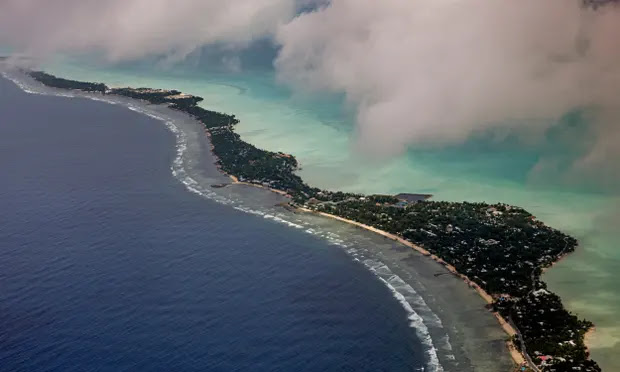
Within decades, archipelagos could lose outlying atolls that define national borders as coastlines are increasingly threatened by storm surges. Photograph: Jonas Gratzer/LightRocket/Getty Images
Small island nations would rather fight than flee, but rising sea levels have prompted apocalyptic legal discussions about whether a state is still a state if its land disappears below the waves.
The Pacific Islands Forum, which represents many of the most vulnerable countries, has invited international legal experts to consider this question and begun a diplomatic campaign to ensure that political statehood continues even after a nation’s physical fabric is submerged.
At the heart of this discussion is the scientific certainty that oceans will continue to rise for at least another century and a sense of injustice that those worst affected are among the least responsible for the climate crisis. The Alliance of Small Island States represents more than a quarter of the world’s countries, but is responsible for less than 1% of global carbon emissions, most of which come from big industrialised countries in the global north.
This has locked in an expansion of the world’s oceans that is already under way and will accelerate in the second half of this century. Island maps are already being slowly redrawn and coastlines are increasingly threatened by storm surges. Within decades, archipelagos could lose outlying atolls that define national borders. A century from now – if not sooner – entire states could become uninhabitable, raising doubts about what will happen to their citizens, governments and resources.

The World Bank had said current regulations on these matters were drawn up in a period of climate stability and may need to be reassessed to account for an “unprecedented situation for international law”.
At a conference on this topic in Fiji this year, the prime minister of the Cook Islands, Mark Brown, framed this debate in a series of existential questions: “As our shorelines are eaten away by sea level rise, what will become of our sovereignty, of our lands, our titles, our homes? What will become of our fundamental rights and freedoms guaranteed by our constitutions and the Universal Declaration of Human Rights? How can we realise our shared vision when our very status as ‘states’ is being questioned? How can we fulfil our responsibility to our peoples if their homes and livelihoods are taken away from them? These questions are difficult but real. They require solutions.”
Simon Kofe, the foreign minister of Tuvalu, one of the most vulnerable nations, stressed the need for a redefinition of global rules and a recognition of what is due to citizens of the worst-affected countries. “The threats of sea level rise and the erosion of our statehood are not mere hypotheticals, but very real and present dangers that we must face head on,” he said. “Our discourse is not limited to legal instruments and policies, but encompasses the survival of our people and nations. We have the power to make a significant impact by acting urgently and decisively.”
The priorities for action are largely determined by the timing of expected impacts. The science of sea level rise is well established, but there are several uncertainties related to future levels of greenhouse gas emissions and the speed at which the Greenland and Antarctic ice sheets melt.
Robert E. Kopp, an earth sciences professor at Rutgers University in New Jersey and one of the lead authors for the IPCC report on global sea level rise, said that a country like Tuvalu – which has an average elevation of 2 metres – was unlikely to be completely flooded until the 22nd century. The possible collapse of the giant Thwaites glacier in Antaractica could bring that forward as it would add 1.5 metres to ocean heights, but this would take decades. The more immediate risk, he said, was from storm surges: “It’s not just sea level rise, but when a place gets flooded multiple times a year.” This view was echoed by Peter Girard of Climate Central, who said floods would hit long before total inundation: “It could become impossible to live along the coast without protection.”
Tuvalu and other island states have recently begun reinforcing some of their coastlines with concrete flood barriers, but these are only a partial defence that will diminish over time and always be vulnerable to tsunamis or other big flooding events, as well as to upsurges of groundwater.
Faced by these threats to the integrity of the nation, protection of legal rights is a priority. In 2020, the Pacific Islands Forum called for international guarantees of existing maritime zones – and the resources within them – even if land territory is eroded.

More recently, Tuvalu has launched a diplomatic push for other nations to recognise its statehood regardless of the physical impacts of climate change.
Kofe noted that the definition of statehood under international law was reflected in the Montevideo convention, which sets out four criteria: a physical territory, population, government, and the capacity to enter into relations with other countries. “If we were to take that definition, Tuvalu could possibly lose its status as a state if we lose our physical territory or we are forced to relocate to a different location,” he said. “So we are just imagining this worst-case scenario – if it does come to that, we would want the world to continue to recognise our statehood as being permanent.”
So far, seven governments have made this commitment: Venezuela, the Bahamas, Saint Kitts, St Lucia, Vanuatu, Niue, Palau, Gabon and Taiwan. Tuvalu is also discussing the matter with bigger neighbours such as New Zealand and Australia.
Tuvalu is also digitising its government to make it easier to relocate, while legal scholars have considered whether statehood could be continued by leasing land in another country.
Patricia Galvão Teles, a member of the International Law Commission who participated in the conference in Fiji, noted the historical precedents of governments in exile during wartime, or the historical relocations of the Holy See and the Sovereign Order of Malta.
However, in those cases, the moves were temporary and away from a homeland that remained physically intact. A state that evacuates because of climate pressure may find it harder to prove its long-term viability if its land is under ever more water. The loss of productive land and other economic resources might also make it difficult to meet international obligations to protect the assets of its citizens, maintain embassies or pay for membership of global organisations.
Another challenge is whether a population could maintain its legal rights and cultural cohesion as a permanent diaspora. Galvão Teles noted that international law does not have a special legal category for climate refugees or people affected by sea level rise, so it is necessary to rely on existing agreements on human rights and refugees. If states can continue as political entities regardless of the physical loss of land, she said, the question of statelessness would probably not arise until “much further down the road”. However, there could be complications if people evacuate to another nation that does not allow dual citizenship or the registration of births of foreign nationals.
One solution, raised by the World Bank, would be to merge with another state, as Zanzibar and Tanganyika did in 1964 to form Tanzania.
Delegates at the conference said speculation about a landless state and stateless citizens should not distract from the more pressing task of persuading big emitters, such as the United States, Europe, China and India, to cut greenhouse gases, which was the most effective way of reducing pressure on the oceans.
Galvão Teles said the delegates at the Fiji conference wanted to counter the narrative of climate refugees and disappearing nations. “The new initiative is one of ‘rising nations’ and the message is, ‘We are not drowning, we are fighting,’” she said. That meant more emphasis on making industrial nations take responsibility for the problem and reduce emissions. “If you concede you will disappear, there will be less engagement on mitigation and adaptation measures,” she said.
Henry Puna, secretary general of the Pacific Islands Forum, stressed that climate action was the best chance for small island nations to guarantee their rights and their survival. “We must not lose sight of the bigger picture,” he said. “Ensuring that we keep [rises in] global temperatures below 1.5 degrees Celsius must always remain a top priority for us.”

Friday, June 23, 2023
Martianization - Ecological tipping points could occur much sooner than expected, study finds
Amazon rainforest and other ecosystems could collapse ‘very soon’, researchers warn

Deforestation of the Amazon, near Santarém, Brazil. Photograph: Brazil Photos/LightRocket/Getty Images
Ecological collapse is likely to start sooner than previously believed, according to a new study that models how tipping points can amplify and accelerate one another.
Based on these findings, the authors warn that more than a fifth of ecosystems worldwide, including the Amazon rainforest, are at risk of a catastrophic breakdown within a human lifetime.
“It could happen very soon,” said Prof Simon Willcock of Rothamsted Research, who co-led the study. “We could realistically be the last generation to see the Amazon.”
The research, which was published on Thursday in Nature Sustainability, is likely to generate a heated debate. Compared with the long-established and conclusively proven link between fossil fuels and global heating, the science of tipping points and their interactions is relatively undeveloped.
The United Nations’ top science advisory body, the Intergovernmental Panel on Climate Change, has been more cautious. In its latest report, it said there was a chance of a tipping point in the Amazon by the year 2100.
However, several prominent Brazil-based scientists, including Carlos Nobre, have warned that this may come much sooner. The new study underlines that alarming prospect. It observes that most studies until now have focused on one driver of destruction, such as climate change or deforestation. But when you combine this with other threats, such as water stress, degradation and river pollution from mining, the breakdown comes much quicker.
Lake Erhai in China collapsed sooner than most observers expected. According to Willcock, this was because projections had been based on one factor – agricultural runoff that was loading the water system with excess nutrients – but other stresses compounded and accelerated this degradation. When climate variation, water management and other forms of pollution were added into the mix, the lake system quickly lost its resilience.
Overall, the team, comprising scientists from Southampton, Sheffield and Bangor universities, as well as Rothamsted Research, looked at two lake ecosystems and two forests, using computer models with 70,000 adjustments of variables. They found that up to 15% of collapses occurred as a result of new stresses or extreme events, even while the primary stress was maintained at a constant level. The lesson they learned was that even if one part of an ecosystem is managed sustainably, new stresses such as global warming and extreme weather events could tip the balance towards a collapse.
While the scope of the study was limited, the authors said the results showed the need for policymakers to act with more urgency.
“Previous studies of ecological tipping points suggest significant social and economic costs from the second half of the 21st century onwards. Our findings suggest the potential for these costs to occur much sooner,” the co-author Prof John Dearing noted.
Subscribe to:
Posts (Atom)
Drone footage shows severe drought hitting river in Brazil – video
Drone footage from 17 September shows the Araguaia River drying up, as severe drought grips parts of Brazil. The country is preparing for ...

-
 Chocolate being added to cups of coffee. The prices for cocoa and coffee rose 163% and 103% respectively in the year to January. Photogra...
 -
 This aerial view shows icebergs and ice sheets floating in the water off Nuuk, Greenland, on 07 March 2025. Photograph: Odd Andersen/AFP/...
 -
 The Bellingshausen Sea is 650,000 sq kms of sea ice compared with the 1991 – 2010 average. Photograph: Alex Ingle/Schmidt Ocean Institute...