Monday, November 11, 2024

Por que o nível do mar está subindo cada vez mais rápido? Aumento vem causando o desaparecimento de praias e a destruição de casas principalmente durante tempestades


Água invade a faixa de areia na Praia de Copacabana, no Rio; nível do mar está subindo cada vez mais rápido. Foto: PEDRO KIRILOS/ESTADÃO - 14/06/2023

 Por Fernando Reinach

 Em 2024 comemoramos 30 anos em que altímetros instalados em satélites medem continuamente o nível dos oceanos ao redor do planeta. Uma análise cuidadosa dos dados coletados nessas três décadas mostra que o nível do oceano está subindo e que o ritmo do aumento dobrou nos últimos anos.


Qualquer pessoa olhando o mar pode imaginar quão difícil é medir seu nível. A cada segundo, ondas sobem e descem, a cada dia as marés sobem e descem e os grandes sistemas climáticos cíclicos como o El Niño provocam mudanças que duram anos. Além disso, a água dilata e contrai com mudanças da temperatura dos oceanos. Tudo isso combinado torna uma tarefa hercúlea medir o aumento do nível médio do mar com uma precisão de milímetros.

PUBLICIDADE

Foi somente com a colocação de altímetros precisos em satélites 30 anos atrás, capazes de medir a distância entre a superfície do oceano e o satélite, que isso se tornou possível. A cada segundo a distância de milhares de pontos em todos os oceanos e o satélite são determinadas. E, depois de corrigir para todas as flutuações, os computadores calculam o nível médio global do oceano.

O gráfico obtido ao longo dos 30 anos e as projeções para o futuro podem ser vistos na figura abaixo.


 Nesses últimos 30 anos, o nível do mar subiu 111 milímetros, subindo em média 3,5 milímetros por ano. Esse é um número pequeno, mas o preocupante é que a velocidade da subida vem aumentando. No início do período de 30 anos, em 1993, o mar subia 2,5 milímetros por ano, mas em 2023 ele subiu 4,5 milímetros em um ano. Extrapolando esse aumento até o ano de 2050, é provável que o nível do mar subirá mais 169 milímetros.


Esse aumento se deve principalmente ao derretimento das geleiras e a dilatação da água devido ao aquecimento da atmosfera e a transferência desse calor para os oceanos. Esse número é relativamente pequeno, mas, por não ser distribuído igualmente ao longo das costas de todos os continentes, vem causando o desaparecimento de praias e a destruição de casas principalmente durante tempestades.


Nas próximas décadas não vai ser o aumento do nível do mar que vai afetar a vida das cidades costeiras, mas o aumento da intensidade das tempestades causadas pelo aumento da temperatura. A importância desse resultado é que ele confirma uma das premissas mais importantes dos modelos climáticos: a velocidade da subida do nível dos oceanos. As outras duas medidas globais são a temperatura média da atmosfera e o nível de gás carbônico na atmosfera.

Essas medidas experimentais são extremamente importantes pois são elas que ancoram os modelos preditivos do IPCC.

Mais informações: The rate of global sea level rise doubled during the past three decades. Communications Earth & Environmental. https://doi.org/10.1038/s43247-024-01761-5 2024


Saturday, November 9, 2024

Climate breakdown will hit global growth by a third, say central banks New modelling finds risk to global economies much worse than previously thought, but group of central banks says even this may be an underestimate


The business losses alone from the devastating floods in Valencia have been calculated at well over €10bn. Photograph: Ana Beltran/Reuters


The physical shocks caused by climate breakdown will hit global economic growth by a third, according to a risk assessment by a network of central banks.

The rise in the estimated hit to the world’s economies as a result of the shocks from flooding, droughts, temperature rises, and mitigating and adapting to extreme weather was the result of new climate modelling published this year.

The Network for Greening the Financial System, a membership body of global banks and financial organisations, said in a report this week that the huge increase in the risk from physical shocks to the economy marked a considerable change in the overall severity of the damage caused.

The report was published as the business losses alone from the devastating floods in Valencia, which killed more than 200 people, were calculated at well over €10bn (£8.3bn).


“This new study is based on the most recent climate and economic datasets,” the report said. “They offer highly granular and robust data with excellent geographic and temporal coverage. With the consequences of climate change gradually becoming more apparent, adding the most recent data makes our estimates much more robust.”

Despite the increase in risk to global economies, some experts say the analysis is a huge understatement of the impact climate breakdown will wreak on economic growth.

Sandy Trust, an actuary who works on sustainability and the climate crisis, said the small print in the report by the network of central banks revealed they had failed to take in to account the impact of climate tipping points, sea temperature rises, migration and conflict as a result of global heating, human health impacts or biodiversity loss. Climate tipping points, for example the melting of the Greenland ice sheet, and the deforestation of the Amazon, are critical thresholds that, if crossed, will lead to huge, accelerating and sometimes irreversible changes in the climate system.

 Climate tipping points, for example the melting of the Greenland ice sheet, are critical thresholds that, if crossed, will lead to huge changes in the climate system. Photograph: Luis Leamus/Alamy


Trust said: “This is a massive one-third hit from physical damage on GDP. It has increased more than five times, from about 6% to 33%.

“But while this is a much more severe damage risk, it is by no means comprehensive. The analogy I would use is a model of the Titanic where you can see the iceberg, but the modelling fails to recognise that there are not enough lifeboats on board, or that the cold water is a threat to human life. So this report is still systemically underestimating the risk.”

The NGFS is a group of global banks that provide environmental and climate risk modelling in the financial sector. Its update on climate risks using the new methodology foresees more than 30% losses due to the climate crisis by 2100 from a 3C rise in global average surface temperatures. The report said: “The new damage function does a much better job than its predecessor at representing the physical risks posed by climate change.”

This is a vast difference compared with previously used economic predictions that damages from global heating would be as low as 2% of global economic production for a 3C rise in global average surface temperature.

Yet the group warned that the future economic outlook may be significantly worse. “It cannot be excluded that the economic effects of climate change might turn out to be even more severe than visualised under the NGFS scenarios, for instance, if certain tipping points are reached,” the report said.

“Thus, users should also take into account the tail risks of climate change, along with other risks such as nature-related ones, which are not necessarily captured by these scenarios.”

Trust wrote a report last year with the University of Exeter, which said widely available climate crisis scenarios systematically underestimated the risks, and he said underestimating the impact of global heating was “extremely dangerous”.


Thursday, November 7, 2024

Severe drought puts nearly half a million children at risk in Amazon – report. Warming climate has caused rivers used for transport to dry up, leaving children with little food, water or school access, says Unicef


Children walk to school along part of a tributary of the Amazon in Santo Antônio community in Novo Airão, Amazonas state, Brazil, 1 October 2024. Photograph: Michael Dantasmichael Dantas/AFP/Getty Images


Two years of severe drought in the Amazon rainforest have left nearly half a million children facing shortages of water and food or limited access to school, according to a UN report.

Scant rainfall and extreme heat driven by the climate crisis have caused rivers in what is usually the wettest region on Earth to retreat so much that they can no longer be traversed by boats, cutting off communities.

The effects are being felt most by children, with more than 1,700 schools and 760 health centres in the Amazon having become inaccessible or out of reach, according to the report from the children’s agency Unicef.

“For the most remote communities it really is a life-threatening situation,” said Antonio Marro, a Unicef manager. “Children are contracting dengue fever, malaria and other serious diseases and there is no way they can reach a health centre for treatment.”

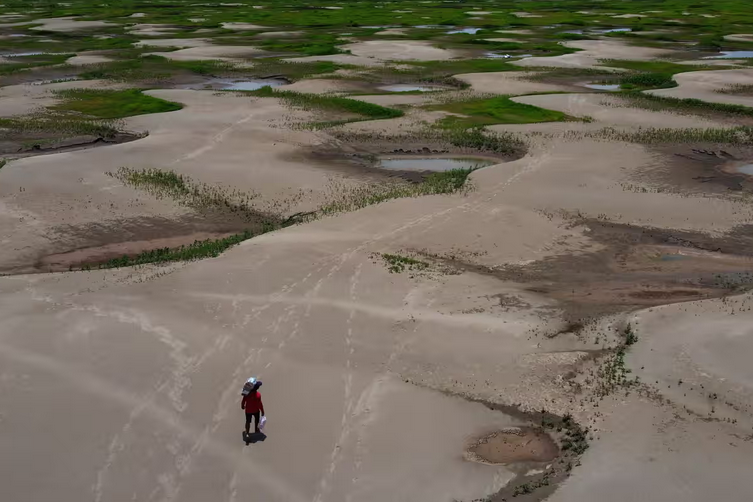
Deforestation and a warming climate in tandem with weather phenomena such as El Niño have scorched the rainforest and left vast sandbanks where rivers once flowed.

In October, the Solimões and the Rio Negro – some of the Amazon’s largest tributaries – reached their lowest levels since records began in 1902.

A member of a Solimões riverside community carries food and drinking water distributed by the state due to the ongoing drought, Careiro da Várzea, Amazonas state, October 2023. Photograph: Edmar Barros/AP


Riverside communities rely on travelling by boat to towns for everything from food and water to medical treatment and schools but the water levels have dropped so much that travel has been paralysed.


 Half of families surveyed in 14 communities in the southern Amazon in Brazil said their children were currently out of school due to dry conditions.

Teachers have been unable to get to work, closing schools and leaving children more vulnerable to being recruited into the armed groups that rule over vast swathes of the rainforest, Unicef says.

Children aged five and under are at a higher risk of infections, malaria and malnutrition, while studies have found that babies born during extreme drought or flooding in the Amazon were more likely to be premature or underweight.

“This, the worst drought in the last century, is a clear demonstration that climate change is unfortunately already here and it’s getting stronger and stronger,” Marro said. “Rivers in the Amazon are our roads and they are drying up. Neither us nor our grandfathers have ever seen anything like this.”

The Amazon is a bulwark against the climate crisis, regulating regional weather patterns and sucking in carbon, but it is being transformed by warming temperatures and deforestation.

Local communities also say fish are dying off en masse. Hundreds of pink river dolphins have died in the extreme temperatures, concerning conservation organisations.


Gentil Gomez, a member of the Ticuna Indigenous community in Lake Tarapoto in the Colombian Amazon, said: “We rely on the river for everything, but it’s raining maybe once a month, so now it takes a long time to get to town and sometimes we just give up pushing and pulling our boats because the river is too low.

“We hope a politician or someone somewhere can help us with climate change because we are feeling it here.”

Unicef estimates that $10m is needed in the coming months to address urgent needs such as delivery of essential supplies and medicines while strengthening public services in Indigenous communities in Brazil, Colombia and Peru.

“The health of the Amazon affects the health of us all,” said the organisation’s executive director, Catherine Russell.


Wednesday, November 6, 2024

Nearly all of US states are facing droughts, an unprecedented number. More than 150 million people and 318m acres of crops are affected by droughts after summer of record heat


Lone Rock, surrounded by cracked earth where water once reached at the Lake Powell Wahweap Bay area in Utah on 2 September 2022. Photograph: Robyn Beck/AFP/Getty Images


Every US state except Alaska and Kentucky is facing drought, an unprecedented number, according to the US Drought Monitor.

A little more than 45% of the US and Puerto Rico is in drought this week, according to the tracker. About 54% of land in the 48 contiguous US states is affected by droughts.

Even as the country experiences autumn and heads further away from a summer of record heat, the droughts continue to rise. More than 150 million people in the country – and 149.8 million in the 48 contiguous states – are in a drought this week. That is about a 34% increase since last week and an over 150% increase since last month.

The drought is also affecting more than 318m acres of crops, a 57% increase since last month, according to the tracker.

That reality is only the latest illustration of global warming and the climate crisis, spurred primarily by humans’ burning of fossil fuels.


Last month, it was reported that world’s water cycle was out of balance “for the first time in human history”. Nearly 3 billion people face water scarcity.

Drought conditions are not simply caused by a decrease in rain – but are driven and exacerbated by abnormally high temperatures that can quickly suck moisture from the atmosphere and the earth.

The problem, however, is more complicated than simply counting rainy days. Droughts can occur even when there is slightly more rain than usual, depending on the frequency of rainfall. If there is a lot of rain all at once, it’s difficult for the water to be properly absorbed into the ground.


“Climate change can cause extremes in both directions,” Dr Lifeng Luo, a professor of environmental science at Michigan State University, said. “When it rains really hard, it’s not going to really penetrate into the soil. It becomes runoff, which produces floods.”

Different city and state leaders across the US have acknowledged the drought issue and have tried various ways of beginning to address it. In New York City, the mayor, Eric Adams, encouraged residents to water their lawns less frequently and to “only flush when necessary”.

“Taking shorter showers means more water could be allocated for other purposes, which is good,” Luo said. “But its impacts in terms of reversing a drought is very small.”

According to the National Integrated Drought Information System, droughts will increase an area’s reliance on groundwater. Groundwater provides more than 40% of the water used for US agriculture and domestic water supplies. Increased pumping during droughts can reduce the future availability of those supplies.


California, which relies heavily on the agricultural industry to support its economy, lost $1.7bn in crop revenue in 2022 due to the ongoing drought.

Dry conditions can also result in low water levels on rivers and other waterways. Ports and other water-borne transportation may become limited due to a reduction in available routes and cargo-carrying capacity, which increases transportation costs.

That cost increase is ultimately transferred to consumers, who see it in the form of higher-priced products, groceries and other commodities.

“Droughts affect water resources, agriculture, transportation, which can overall impact the economy,” Luo said. “To have a broad relief, we need regular precipitation, and there’s no simple answer to getting that.”


Saturday, November 2, 2024

O que antes era floresta e água agora parece deserto: fotos mostram efeito da seca recorde na Amazônia; veja - Brazil


Seca recorde forma ‘desertos’ na Amazônia e ameaça criar onda de refugiados climáticos

Barcos e casas flutuantes encalham no leito dos rios; estiagem tira renda de quem vive da pesca e da agricultura 


Brazil


Amazon Rainforest


Por Juliana Domingos de Lima e Musuk Nolte (Fotos)
 
 Manacapuru, na região metropolitana de Manaus, é um lugar antigo. Com 100 mil habitantes, já foi vila no fim do século 18 e terra do povo indígena Mura muito antes disso.

Nesse tempo todo, o curso d’água foi a via para o sustento, as tradições e a mobilidade dos moradores da cidade conhecida como “princesinha” do Rio Solimões.

Em 2024, porém, essa estrada fluvial foi bloqueada pela maior seca já registrada no afluente do Amazonas.

O que antes era floresta e água, agora parece deserto. 

Em 12 de outubro, o trecho do Solimões em Manacapuru atingiu 2 metros, segundo a Defesa Civil do Amazonas. É o menor nível desde o início dos registros, há 120 anos.


Em alguns locais do Solimões, no leito do rio totalmente exposto há enormes bancos de areia.


Só no Amazonas, são mais de 800 mil pessoas afetadas. Não apenas a Bacia do Solimões, mas todos os 62 municípios do Estado estão em emergência.

Pelo segundo ano seguido, a seca extrema encalha barcos e casas flutuantes, agora escoradas só em troncos, na lama e na areia, o que isola comunidades e obriga moradores a percorrerem longos trechos a pé.

A falta de chuva também está por trás da explosão de incêndios no bioma, que fazem explodir a degradação florestal e espalham a fumaça pelo País. 


Bloco de concreto jaz em banco de areia em área que deveria estar coberta pelo Rio Negro no bairro de Tarumã, em Manaus • Musuk Nolte/Bertha Foundation


Henrique Freitas, de 21 anos, mora com a mãe e os irmãos em Manacapuru, e vive da pesca. Com a seca no Solimões, caminha sob sol forte mais de meia hora todo dia para chegar ao rio, que antes estava na porta de casa e recuou dois quilômetros. “Era só descer e entrar na canoa”, disse ao Estadão.

“Às vezes a gente pensa em ir pra cidade, mas tinha de ter ao menos um trabalho fixo”

Henrique Freitas - Pescador


 A seca também atrapalha a agricultura, que completa a (pouca) renda da família Freitas. O principal produto é a banana, mas metade da plantação morreu por falta de chuva.
Fotos: Musuk Nolte/Bertha Foundation


Para vender o que restou, eles transportam no ombro cargas de 25 a 40 quilos, por quilômetros, até chegar ao rio. Antes, bastava colocar diretamente no barco.


Como o Solimões está na cabeceira da Bacia Amazônica, o impacto se estende para várias regiões da floresta.
 
 
Restos de barco que sofreu acidente em 2023 devido à baixa vazão do Rio Negro, em Iranduba


“Até pegar água pra tomar banho e beber está difícil”, relata outro pescador de Manacapuru, Josué Oliveira, de 51 anos.

A renda caiu praticamente a zero e ele tem andado “mais a pé que de canoa” pelo curso do rio. “Os peixes somem.”

Quando o rio subir, o barco de Oliveira precisará de reforma - ele estima ao menos R$ 6 mil. Por ora, encalhada na terra, a embarcação se deteriora pelo calor.

O governo estadual diz que já distribuiu 3 mil toneladas de alimentos no interior, além de 41 purificadores e 2,4 mil caixas d'água. Já o Ministério da Integração e Desenvolvimento Regional informa repasses de R$ 48,5 milhões ao Amazonas neste ano. 


Janderson, filho de Josué, também vive da pesca e da agricultura, inviabilizadas pela seca • Musuk Nolte/Bertha Foundation


Eventos extremos desse tipo serão cada vez mais frequentes. Estudo da World Weather Attribution, que reúne pesquisadores do mundo todo, mostrou que a crise climática torna 30 vezes mais prováveis secas como a do ano passado na Amazônia. Em 2024, a estiagem já se repetiu.

A Cúpula do Clima das Nações Unidas (COP-29) será realizada este mês no Azerbaijão para discutir saídas. Os esforços e metas até agora são insuficientes para livrar o planeta do colapso. 


Cristiane Cardoso em sua casa flutuante em Iranduba (AM), danificada pela seca • Musuk Nolte/Bertha Foundation

Em Iranduba, cidade na margem esquerda do Solimões, Cristiane Cardoso, de 42 anos, era garçonete de um barco-restaurante, mas perdeu o emprego por causa da seca. E, sem a sustentação da água, a casa flutuante onde vive com os três filhos se partiu. Ela cogita se mudar, o que a tornaria uma refugiada climática.

Bacia amazônicaEm seca recorde pelo segundo ano consecutivo, trechos de afluentes do Rio Amazonas chegam a menor nível em mais de um século


Segundo relatório da Organização Internacional de Migrações das Nações Unidas, o Brasil registrou 745 mil deslocamentos internos em 2023 por desastres naturais. Para ter segurança de vida nova, porém, os moradores do interior do Amazonas terão de ir mais longe do que a capital.

Em Manaus, o Solimões encontra o Rio Negro e forma o Amazonas, maior curso d’água do mundo em vazão e extensão. Mas em 2024 o Negro também atingiu a menor marca desde o início do século passado.

Chico Carnaúba, pescador de 49 anos, conta que também faltam água potável e peixes em Puraquequara, um dos lagos que secaram perto da capital. O jaraqui, o pacu e o tucunaré, os que mais costuma pegar, desapareceram. “Estamos esquecidos.” 


Canais secam e casas encalham em São Francisco do Mainã, deixando comunidade isolada • Musuk Nolte/Bertha Foundation


Cientistas calculam prejuízo bilionário provocado por ventos fortes no Brasil ( mudança climática )


Cientistas calculam prejuízo bilionário provocado por ventos fortes no Brasil — Foto: Reprodução/TV Globo 


Desde 2013, os vendavais afetaram 10 milhões de pessoas no país e causaram mais de R$ 12 bilhões em prejuízos. De janeiro a outubro de 2024, o Inmet já registrou 33 vendavais.

Por Jornal Nacional 


No Brasil, ventos cada vez mais fortes e frequentes estão provocando um prejuízo bilionário.

O teto de um shopping foi pelos ares em São Paulo. Uma ameixeira tombou em Minas Gerais. No Rio Grande do Sul, uma ventania atingiu 51 municípios. Tudo isso no mês de outubro. 


Desde 2013, os vendavais afetaram 10 milhões de pessoas no Brasil e causaram mais de R$ 12 bilhões em prejuízos.

"Mil e quinhentos municípios no Brasil ainda não têm uma Defesa Civil organizada. Se houver prevenção, a gente praticamente elimina, no mínimo, 70% a 80% dos óbitos. Os danos materiais também se reduziriam muito”, afirma Paulo Ziulkoski, presidente da Confederação Nacional dos Municípios.


 São considerados vendavais ventos com mais de 80 km/h. A medição é feita pelo Inmet desde 2002. Até 2007, os registros desses fenômenos eram raros, não chegavam a dez por ano. A partir daí, passaram a ser feitos com mais frequência: 31 em 2012 e em 2015; 36 em 2017. Em 2023, foram 51. E, de janeiro a outubro de 2024, o Inmet já registrou 33 vendavais - mais da metade deles com ventos acima de 100 km/h. 

 Uma escala, criada no século XIX e usada mundialmente até hoje, mostra o poder destrutivo dos vendavais. Ela começa com ventos fracos que deslocam a fumaça, movimentam folhas de árvores e bandeiras, balançam galhos e provocam danos em pequenas construções a partir dos 75 km/h. Quando passam dos 80 km/h, podem arrancar árvores inteiras. E, dos 100 km/h, provocam estragos generalizados. Com mais de 118 km/h, são considerados furacões. 


O professor Ricardo de Camargo, da USP, diz que, além das chuvas e das secas, os vendavais serão mais frequentes.

"É o que a gente já adiantava bastante nesse cenário de aquecimento global e de mudanças climáticas. Mas essas ocorrências de eventos extremos de ventania, a gente tem que se preparar”, afirma Ricardo de Camargo, professor de Meteorologia IAG/USP.


No túnel de vento do Instituto de Pesquisas Tecnológicas de São Paulo é possível reproduzir o efeito de um vendaval sobre uma construção e calcular a resistência que ela precisa ter para evitar prejuízos ou, pior, acidentes. Um teste mostra que o primeiro impacto de um vendaval é no telhado de uma construção. Mas existem medidas para aumentar a resistência.


"Vento muito forte incidindo sobre uma casa tem, tanto a partir da incidência, ele vai descer um pouco e também vai subir. Se tem o forro primeiro, ele pode bater no forro, desviar e, pode ser que, ele arranque o forro. Mas é um problema menor. Agora, se não tem o forro, se está direto nas telhas, quando ele subir, ele vai arrancar telha. Procure, então, vedar as frestas entre o telhado e a alvenaria. Tente manter tudo fechado, e se tiver frestas na janela, procure também colocar algum elemento de vedação”, afirma Gilder Nader, pesquisador do IPT - Instituto de Pesquisas Tecnológicas.


Friday, November 1, 2024

Climate Change Is Making Disasters Deadlier. Here’s How Much. More than half a million people were killed in 10 disasters that climate change worsened, according to a new report.


Rescue workers escorted a stranded couple to safety from their damaged home after heavy flooding in Letur, Spain, on Wednesday. In some areas of the country, a month’s worth of rain fell in less than a day.Credit...Susana Vera/Reuters


Two weeks before world leaders meet to debate the climate crisis, a report released on Thursday shows the 10 deadliest extreme weather events in the past two decades were made worse by burning fossil fuels.

More than half a million people around the world were killed in those disasters since 2004.

“Many people now understand that climate change is already making life more dangerous,” said Friederike Otto, a senior lecturer at Imperial College London and co-founder of World Weather Attribution, the group that published the report. “What did not work yet is turning knowledge into action on a large-enough scale.”

Even with the abundance of evidence on how a warming world is endangering human life, the world keeps burning fossil fuels: 2023, the hottest year on record, also set a record for greenhouse gas emissions.

The stakes are high for how the world will respond in November, with a pivotal U.S. election and an annual climate summit of world leaders, known as COP29, hosted in Azerbaijan. Developing countries, hit hard by climate disasters, are pressing for rich countries to make good on their pledges to curb emissions and fund climate adaptation projects.


“The U.S. and really the world face a very sharp fork in the road,” said Michael Gerrard, a professor of environmental law at Columbia Law School.

Next week, the United States, the highest per-capita emitter of greenhouse gas emissions in the world, will vote on its climate future. A Kamala Harris presidency could continue the work of the Biden administration in transitioning to renewable energy, largely through tax credits and increased American manufacturing on clean energy technologies.

 
Portraits of the dead hung on what was left of a home in Myasein Kan, a village in Myanmar, after Cyclone Nargis in 2008. The storm killed more than 138,000 people.Credit...Getty Images


If returned to office, Donald J. Trump could roll back environmental regulations, including those that limit greenhouse gases, and continue development of fossil fuels. He could also pull out of international agreements to fight climate change, as he did in his first term as president.

“It will be extremely difficult for the world to take on the climate crisis if Trump is president of the United States,” said Lena Moffitt, executive director for Evergreen Action, a climate nonprofit.


A week after the Election Day, the world’s leaders will meet at COP29. In Azerbaijan, a tiny petrostate on the borders of Russia and Iran they will seek to agree on how to lower global emissions fast enough that temperatures remain below 1.5 degrees Celsius, or 2.7 degrees Fahrenheit, above preindustrial levels.

But the planet has already warmed 1.3 degrees Celsius, or 2.3 degrees Fahrenheit, since rich countries began burning fossil fuels like coal, oil and gas on an enormous scale. The world may now be on track to reach 3 degrees Celsius of warming by the end of the century, according to Dr. Otto and other climate scientists.

Last year, summit attendees pledged to transition away from fossil fuels, but the pact came with heavy caveats. Dr. Otto said she hoped this year’s conference would create a stricter timeline for that transition that could hold countries accountable.

The group of nations also set up a damages fund to help poorer countries with historically low emissions adapt to climate change. The fund, which currently has about $700 million pledged, is dwarfed by the hundreds of billions of dollars in climate-related damages developing countries may incur by 2030.

 Health workers tending to a person who fainted during a heat wave at the Acropolis of Greece last year.Credit...Milos Bicanski/Getty Images

“It’s a ridiculously and insultingly low sum of money to help the most vulnerable countries with dealing with the losses and damages,” Dr. Otto said. “That needs to be orders of magnitude bigger.”

The new study showed that death tolls from extreme weather events are often higher in poor countries. Researchers culled the list of weather episodes from the International Disaster Database, and included three tropical cyclones, four heat waves, two floods and a drought. They noted that the high death toll was “a major underestimate,” with potentially millions of unreported heat-related deaths not included.

Europe faced well-documented heat waves in 2015, 2022 and 2023 that led to almost 94,000 deaths. Another report released this week shows that during a 2022 heat wave in Europe that caused 68,000 deaths, more than half of those deaths could be traced back to human-induced climate change.

But poor countries suffered more in extreme weather. In Somalia, a 2011 drought made worse by rising temperatures that sucked water vapor from plants led to 258,000 deaths; in Myanmar, Cyclone Nargis formed in 2008 over warmer seas and most likely had higher wind speeds and more intense precipitation as a result of climate change. It killed more than 138,000 people.

Climate attribution studies are now 20 years old, and more than 500 have been published by researchers. The first was published in 2004, according to World Weather Attribution; it showed that the likelihood of Europe’s 2003 summer, the hottest the continent had seen since 1500, was doubled by climate change.

To make such assessments, scientists pair weather observations with climate models and work with local experts and meteorological agencies.

 
Burying a 4-year-old who died in a refugee camp in Dadaab, Kenya, during the famine that struck Kenya and Somalia in 2011.Credit...Tyler Hicks/The New York Times


Attribution studies can help raise awareness of climate change, but researchers have a hard time finding funding, said Michael Wehner, a senior scientist in applied mathematics at the Lawrence Berkeley National Laboratory.

“We have the technology and we have the methodology and the machines, the data and the experts,” Dr. Wehner said. “But they’ve got to be paid to do this, and they’re not.”

In its report, World Weather Attribution highlighted the need for protecting vulnerable people, improving early warning systems, and strengthening infrastructure like homes from flooding events, before the world reaches its limit for resilience.

But some events are now so extreme, experts warned, that governments could reach the limits of adaptation, underscoring the need to try to curb global warming as quickly as possible.

“Climate change has already made life incredibly hard and really dangerous, and we’re only at 1.3 degrees of warming,” said Joyce Kimutai, a researcher at Imperial College London. “We’re likely to see an escalation of impacts and the continual suffering of vulnerable people.”

Austyn Gaffney is a reporter covering climate and a member of the 2024-25 Times Fellowship class, a program for journalists early in their careers. More about Austyn Gaffney


More than 80,000 people flee as wildfires spread in south-west France and Spain

Lacanau - France  by  Jon Henley in Paris and Sam Jones in Madrid   ‘Unpredictable’ blaze forces evacuation of holiday spot Cap Ferret and...