Sunday, August 14, 2022

Martianization - Europe’s rivers run dry as scientists warn drought could be worst in 500 years. The Guardian


Crops, power plants, barge traffic, industry and fish populations devastated by parched waterways


In places, the Loire can now be crossed on foot; France’s longest river has never flowed so slowly. The Rhine is fast becoming impassable to barge traffic. In Italy, the Po is 2 metres lower than normal, crippling crops. Serbia is dredging the Danube.

Across Europe, drought is reducing once-mighty rivers to trickles, with potentially dramatic consequences for industry, freight, energy and food production – just as supply shortages and price rises due to Russia’s invasion of Ukraine bite.

Driven by climate breakdown, an unusually dry winter and spring followed by record-breaking summer temperatures and repeated heatwaves have left Europe’s essential waterways under-replenished and, increasingly, overheated.

With no significant rainfall recorded for almost two months across western, central and southern Europe and none forecast in the near future, meteorologists say the drought could become the continent’s worst in more than 500 years.

“We haven’t analysed fully this year’s event because it is still ongoing,” said Andrea Toreti of the European Commission’s Joint Research Centre. “There were no other events in the past 500 [years] similar to the drought of 2018. But this year, I think, is worse.”

Germany’s Federal Institute of Hydrology (BfG) said the level of the Rhine, whose waters are used for freight transport, irrigation, manufacturing, power generation and drinking, will continue dropping until at least the beginning of next week.

On Friday the water at the critical Kaub marker 50km downstream from Mainz – which measures navigability, rather than the water depth – fell below 40cm, the level at which many shipping firms consider it is no longer economical for barges to operate. It could fall to nearer 30cm over the next few days, the BfG has said.

Many barges, which carry coal for power plants and vital raw materials for industrial giants such as steelmaker Thyssen and chemical giant BASF, are already operating at about 25% capacity to reduce their draft, raising shipping costs up to fivefold.

A vital part of northwest Europe’s economy for centuries, the 760 miles (1,233km) of the Rhine flow from Switzerland through Germany’s industrial heartland before reaching the North Sea at the megaport of Rotterdam.

A total halt in Rhine barge traffic would hit Germany’s – and Europe’s – economy hard: experts have calculated that a six-month suspension in 2018 cost around €5bn (£4.2bn), with low water levels forecast to cost Germany 0.2 points of economic growth this year.

While the EU has said boosting waterborne freight by 25% is one of the bloc’s green transition priorities, Germany is now working to divert it to rail and road – although between 40 and 100 trucks are needed to replace a standard barge load.

France’s rivers might not be such key freight arteries, but they do serve to cool the nuclear plants that produce 70% of the country’s electricity. As prices hit all-time highs, power giant EDF has been forced to reduce output because of the drought.

Strict rules regulate how far nuclear plants can raise river temperatures when they discharge cooling water – and if record low water levels and high air temperatures mean the river is already overheated, they have no option but to cut output. With Europe’s looming energy crisis mounting and the Garonne, Rhône and Loire rivers already too warm to allow cooling water to be discharged, the French nuclear regulator last week allowed five plants to temporarily break the rules.
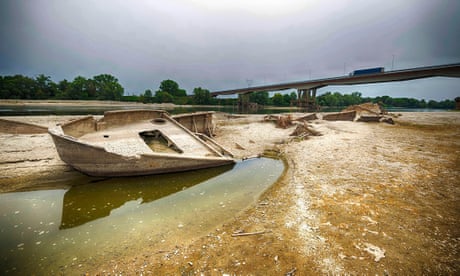
In Italy, the flow of the parched Po, Italy’s longest river, has fallen to one-tenth of its usual rate, and water levels are 2 metres below normal. With no sustained rainfall in the region since November, corn and risotto rice production have been hard hit.

The Po valley accounts for between 30% and 40% of Italy’s agricultural production, but rice growers in particular have warned that up to 60% of their crop may be lost as paddy fields dry out and are spoiled by seawater sucked in by the low river level.

In the protected wetlands of the river’s delta, near Venice, its high temperature and sluggish flow have reduced the water’s oxygen content to the extent that an estimated 30% of clams growing in the lagoon have already been killed off.

Low river levels and high water temperatures can prove fatal to many species. In Bavaria, the Danube reached 25C last week and could hit 26.5C by mid-month, meaning its oxygen content would fall below six parts per million – fatal for trout.

Freight on the 2,850km of the Danube has also been heavily disrupted, prompting authorities in Serbia, Romania and Bulgaria to start dredging deeper channels while barges carrying mainly fuel for the power generators wait to advance.

Even Norway, which relies on hydropower for about 90% of its electricity generation, has said the unusually low levels of its reservoirs may ultimately oblige it to limit power exports.

Saturday, August 13, 2022

Martianization - Brazil - Taxa de desmatamento na Amazônia ainda é alarmante, dizem EUA


Governo Biden diz que vai trabalhar com setor privado e povos indígenas pela preservação no Brasil


Thiago Amâncio

WASHINGTON

As taxas de desmatamento da Amazônia "ainda são alarmantes e exigem atenção redobrada e ação reforçada" do governo, disse o Departamento de Estado dos Estados Unidos nesta sexta-feira (12), após a divulgação dos dados mais recentes do Inpe (Instituto Nacional de Pesquisas Espaciais).

Os números apontam que, de agosto de 2021 até julho de 2022, foram derrubados 8.590,33 km² do bioma, o equivalente a mais de cinco cidades de São Paulo. O novo dado só fica atrás dos períodos de 2019-2020 e de 2020-2021, respectivamente o primeiro e o segundo ano com maiores desmates, segundo o Deter.

O Deter não tem a função de mensuração precisa de desmatamento. Para isso, o Inpe conta com o Prodes, sistema com maior precisão que divulga os dados de desmate —computados sempre de agosto de um ano a julho do ano seguinte— nos últimos meses do ano. Mesmo assim, a partir do Deter, cujo objetivo primário é o auxílio a operações de combate ao desmate, é possível ver se há tendências de queda, manutenção ou aumento de destruição.


À Folha, o Departamento de Estado afirmou que os EUA "continuarão a trabalhar" com partes interessadas na preservação da floresta, "inclusive no setor privado, sociedade civil, povos indígenas e governos subnacionais" na conservação e restauração de florestas, além de "incentivar o governo a implementar políticas" para cumprir os objetivos acordados na COP26, entre os quais acabar com o desmatamento ilegal até 2028 e reduzir as emissões de poluentes em 50% abaixo dos níveis de 2005 até 2030.

"Saudamos as metas ambiciosas anunciadas pelo governo brasileiro na COP26 e em outros fóruns internacionais. O foco agora mudou para a implementação desses objetivos."

"Também estamos aumentando nosso foco em apoiar os esforços de fiscalização do Brasil para combater o desmatamento ilegal. Estamos ansiosos para saber mais sobre os esforços do governo do Brasil para reduzir o desmatamento à luz dos números mais recentes", disse o órgão.

O compromisso com as pautas de preservação ambiental foi um dos principais pontos de tensão entre os governos Jair Bolsonaro e Joe Biden, com o democrata e correligionários criticando o mandatário brasileiro pelo pouco apreço à pauta ambiental.

Os números divulgados nesta sexta deixam ainda mais consolidados os patamares altíssimos de desmatamento alcançados durante o governo Bolsonaro.

Só no ciclo mais recente (agosto/21 até julho/22) foram cinco meses com os números mais elevados de destruição já vistos para aqueles meses: outubro (876,56 km²), janeiro (430,44 km²), fevereiro (198,67 km²), abril (1.026,35 km²) e junho (1.120,2 km²).

Levando em conta dados do Deter, já foram derrubados mais de 31 mil km² de Amazônia desde o início do governo Bolsonaro, em 2019. Isso equivale a, aproximadamente, mais de 720 km² de floresta indo ao chão mensalmente, o que representa mais de 450 parques Ibirapuera destruídos todo mês.

O valor é consideravelmente superior ao que se via em mandatos presidenciais anteriores. De agosto de 2015 (início do novo Deter) até o afastamento da presidente Dilma Rousseff (PT) pela abertura do processo de impeachment, em maio de 2016 (nove meses), foram derrubados cerca de 364 km² de Amazônia por mês.

Nos 32 meses do governo de Michel Temer (MDB), já levando em conta os meses de afastamento de Dilma, foram desmatados cerca de 420 km² de Amazônia por mês.

Bolsonaro chegou também a desautorizar operação de combate ao desmate em andamento. No primeiro ano de governo, conforme dados do Deter apontavam uma disparada na destruição, o presidente questionou a qualidade do trabalho do Inpe, afirmando que o então diretor do instituto, Ricardo Galvão (agora pré-candidato a deputado federal pela Rede Sustentabilidade), poderia estar a "serviço de alguma ONG". Galvão respondeu ao ataque sofrido e acabou deixando o Inpe.


Martianization - EU countries rush to help France tackle ‘monstrous’ wildfires


Firefighters from Romania, Poland, Austria, Greece and Italy fight blazes in show of ‘European solidarity’


Hundreds of firefighters from across the EU have been rushed to France to help battle wildfires in an unprecedented show of international solidarity.

Most are stationed along a 26 mile (40km) active fire-front in the south-west, where a blaze described as “monstrous” continued to devastate pine forests.

German firefighters and their vehicles arrived in the early hours of Friday morning to help tackle the massive Landiras fire in the Gironde and the Landes, south of Bordeaux, which had sparked up again this week after destroying swathes of forest in July.


Romanian firefighters and teams from Poland, Austria, Greece and Italy were also deployed to help more than 1,100 French firefighters try to contain the blaze. President Emmanuel Macron tweeted of the more than 360 firefighters arriving with vehicles and planes: “Our partners are coming to France’s aid against the fires. Thank you to them. European solidarity is at work!”

In a summer of extreme heat and drought, France has faced its most serious forest fires in years. One local firefighter described the Landiras blaze in south-west France as “a sleeping monster which can wake at any gust of wind”.

The French state broadcaster reported that since the start of the year, 56,000 hectares of forest had burned in France – three times the annual average this decade. There have also been forest fires in northern regions not usually hit by summer blazes, including in Brittany, where firefighting planes arrived from Sweden to help.

Authorities in the Gironde said in a statement that more than 7,400 hectares of forest had burned in the Landiras fire, France’s biggest blaze. They said that although the fire had not developed further overnight, high temperatures and dry conditions expected on Friday meant there was a “severe risk” of the fire spreading, and it would be a “complicated” day for fire teams.

The fire had already destroyed 14,000 hectares in July – the driest month in France since 1961 – before being contained, but it had never been fully extinguished and had continued to smoulder in the region’s peat-rich soil before erupting again this week in the tinder-dry pine forests.

Since flaring up again on Tuesday, the fire, which officials suspect may have been caused by arson, has burned through 7,400 hectares, destroyed or damaged 17 homes, and forced 10,000 people to flee, Lieut-Col Arnaud Mendousse of the Gironde fire and rescue service told AFP.

There can be no more hiding, and no more denying. Global heating is supercharging extreme weather at an astonishing speed, and it’s visible in Brazil and beyond. Guardian analysis recently revealed how human-caused climate breakdown is accelerating the toll of extreme weather across the planet. People across the world are losing their lives and livelihoods due to more deadly and more frequent heatwaves, floods, wildfires and droughts triggered by the climate crisis. At the Guardian, we will not stop giving this life-altering issue the urgency and attention it demands. We have a huge global team of climate writers around the world and have recently appointed an extreme weather correspondent. 


Our editorial independence means we are free to write and publish journalism which prioritises the crisis. We can highlight the climate policy successes and failings of those who lead us in these challenging times. We have no shareholders and no billionaire owner, just the determination and passion to deliver high-impact global reporting, free from commercial or political influence.


And we provide all this for free, for everyone to read. We do this because we believe in information equality. Greater numbers of people can keep track of the global events shaping our world, understand their impact on people and communities, and become inspired to take meaningful action. Millions can benefit from open access to quality, truthful news, regardless of their ability to pay for it. 


Every contribution, however big or small, powers our journalism and sustains our future. Support the Guardian from as little as $1 – it only takes a minute. If you can, please consider supporting us with a regular amount each month. Thank you.


Martianization - Onda de calor na Europa provoca incêndio gigante na França - Países da Europa ajudam no combate francês


A França enfrenta pelo terceiro dia consecutivo nesta quinta-feira (11) as chamas de um imenso incêndio florestal perto da cidade de Bordéus, no sudoeste do país. Mais de 10 mil pessoas foram forçadas a deixar suas casas e 6.800 hectares de floresta viraram cinzas. Devido às proporções do fogo, ele vem sendo chamado de "monstro".


O serviço de meteorologia local previu que as temperaturas na região chegariam a 40ºC e permaneceriam altas até sábado (13). Nesta quinta (11), a luta contra o incêndio ganhou o reforço de bombeiros enviados por diversos países da Europa.


O governo francês disse ter recebido dois aviões-tanque gregos, duas aeronaves suecas, mais de 100 bombeiros da Polônia, dezenas da Alemanha, Áustria e Romênia. Só na operação desta quinta-feira, mais de 1.000 homens tentavam conter as chamas, apoiados por aviões.


Em 2022, mais de 57 mil hectares de florestas já foram incendiados na França. O número é quase seis vezes a média anual registrada no período entre 2006 e 2021 no país, segundo dados do Sistema Europeu de Informações sobre Incêndios Florestais.


A ocorrência de incêndios nas florestas explodiu em parte da Europa em 2022, em meio a sucessivas ondas de calor que atingem o continente, com países registrando temperaturas recordes. O problema desafia os gestores e coloca no centro do debate público os riscos das mudanças climáticas para a indústria e para os meios de subsistência. Em visita ao local atingido pelo incêndio, a primeira-ministra francesa Élisabeth Borne disse que o país deve lutar “mais do que nunca” contra o colapso climático, mas também se adaptar a ele. A autoridade afirmou que trabalhará em um “planejamento ambiental” para ajudar o país na tarefa.


(Com informações da Reuters)


Friday, August 12, 2022

Martianization - Arctic Warming Is Happening Faster Than Described, Analysis Shows


The warming at the top of the globe, a sign of climate change, is happening much faster than previously described compared with the global average, scientists said Thursday.


By Henry Fountain

Aug. 11, 2022


The rapid warming of the Arctic, a definitive sign of climate change, is occurring even faster than previously described, researchers in Finland said Thursday.

Over the past four decades the region has been heating up four times faster than the global average, not the two to three times that has commonly been reported. And some parts of the region, notably the Barents Sea north of Norway and Russia, are warming up to seven times faster, they said.

One result of rapid Arctic warming is faster melting of the Greenland ice sheet, which adds to sea-level rise. But the impacts extend far beyond the Arctic, reaching down to influence weather like extreme rainfall and heat waves in North America and elsewhere. By altering the temperature difference between the North Pole and the Equator, the warming Arctic appears to have affected storm tracks and wind speed in North America.


Manvendra K. Dubey, an atmospheric scientist at Los Alamos National Laboratory and an author of an earlier study with similar findings, said the faster rate of warming of the Arctic was worrisome, and points to the need to closely monitor the region.

“One has to measure it much better, and all the time, because we are at the precipice of many tipping points,” like the complete loss of Arctic sea ice in summers, he said.

The two studies serve as a sharp reminder that humans continue to burn fossil fuels and pump greenhouse gases into the atmosphere at rates that are dangerously heating the planet and unleashing extreme weather.

Just weeks after a deadly heat wave clamped down on European capitals, shattering records in Britain, extreme temperatures are again engulfing western Europe this week. The heaviest rainfall in decades inundated Seoul, South Korea, killing at least nine and damaging nearly 3,000 structures. And the McKinney wildfire continues to rage in Northern California, destroying 60,000 acres, killing four people and triggering a mass fish kill.

If the rate of warming in the Arctic continues to speed up, the influence on weather could worsen, one of the researchers said. And projections of future climate impacts might need to be adjusted, said Mika Rantanen, a researcher at the Finnish Meteorological Institute in Helsinki.


Even as Congress is on the cusp of passing historic climate legislation, the United States is still far from its goal to stop adding carbon dioxide to the atmosphere by 2050. That’s the target all major economies must meet, scientists say, for the planet to constrain average global temperature rise to 1.5 degrees Celsius (2.7 degrees Fahrenheit) above preindustrial levels. Beyond that threshold, the likelihood increases significantly of catastrophic droughts, floods, wildfires and heat waves. The planet has already warmed an average of about 1.1 degrees Celsius.


While scientists have long known that average temperatures in the Arctic are increasing faster than the rest of the planet, the rate has been a source of confusion. Studies and news accounts have estimated it is two to three times faster than the global average.

Dr. Rantanen said he and his colleagues decided to look at the issue in the summer of 2020, when intense heat waves in the Siberian Arctic drew a lot of attention.

“We were frustrated by the fact that there’s this saying that the Arctic is warming twice as fast as the globe,” he said. “But when you look at the data, you can easily see that it is close to four.”

Their study was published Thursday in the journal Communications Earth and Environment.

The findings are bolstered by the earlier study, by Dr. Dubey and others at Los Alamos and elsewhere, which found similar rates of warming, although over a different time span.

The Arctic is heating more rapidly in large part because of a feedback loop in which warming melts sea ice in the region, which exposes more of the Arctic Ocean to sunlight and leads to more warming, which in turn leads to even more melting and warming. The result of this and other oceanic and atmospheric processes is called Arctic amplification.


How the rate of warming in the Arctic is described compared with the global average is related in part to the time period that is analyzed and how the region is defined.

The new analysis begins with data from 1979, when accurate temperature estimates from satellite sensors first became available. The researchers also defined the Arctic as the area north of the Arctic Circle, above about 66 degrees latitude.

Thomas Ballinger, a researcher at the University of Alaska Fairbanks, said how the region is defined “is a very, very relevant conversation for understanding Arctic change.” A bigger Arctic would include more land, reducing the impact of the ice-ocean feedback on average temperatures.

Dr. Ballinger, who was not involved in either study, is an author of the annual Arctic Report Card prepared for the National Oceanic and Atmospheric Administration.

The latest report card, for 2021, details a region undergoing vast change, overwhelmed by rising temperatures. Indeed, some scientists now say that the Arctic’s fundamental climate has changed, to one characterized more by liquid water than ice, with profound effects on the plants, animals and people living there.

Loss of sea ice is putting polar bears in jeopardy, which in turn affects the well-being of the people who have hunted them for centuries. Sailing routes that were once perpetually choked with ice are opening up, bringing the environmental risks of ocean shipping to pristine waters. Shorelines are eroding more quickly, and more permafrost is thawing, leading to increased greenhouse gas emissions and damaging Arctic infrastructure.

Dr. Ballinger said some of the findings in the Finnish study were especially interesting, including those showing very high rates of warming in the late 1980s and 1990s. “That really was when Arctic amplification rates were the strongest,” he said


The earlier study, published last month in Geophysical Research Letters, looked at data from 1960 onward and defined a larger Arctic, north of 65 degrees latitude, which includes more land. It found that the rate of warming reached four times the global average starting about 20 years ago. And unlike the Finnish study, it found that there were two decade-long periods, from the mid-1980s to the mid-1990s, and in the 2000s, with large jumps in warming in the region.

“It doesn’t change continuously, it changes in steps,” Dr. Dubey said. And because the data spanned decade-long periods, they suggest a connection to natural climate variability, as well as warming resulting from increased emissions of greenhouse gases from human activity.

Dr. Rantanen said his group’s results also point to a role played by natural variability in the rate of warming, perhaps some long-term changes in ocean or atmospheric circulation.

But clearly the interaction between water temperature and ice is most important, he said, especially in areas like the Barents Sea where the warming rate is even higher.

“The warming trends are quite strongly coupled with the decline of sea ice,” he said. “They’re most highest over those areas where the sea ice has been declining the most. That’s the primary reason.”


Sunday, August 7, 2022

Martianization - Seca histórica atinge metade do México e leva a espiral de violência e desespero


Crise climática impacta chuvas, e dois terços do país enfrentam problemas no fornecimento de água


Maria Abi-HabibBryan Avelar

CIDADE DO MÉXICO | THE NEW YORK TIMES


​O México —ou grande parte do país— está ficando sem água. Uma seca extrema tem deixado as torneiras secas, e quase dois terços dos municípios enfrentam escassez que vem obrigando as pessoas a encarar horas em filas para entregas de água feitas pelo governo em alguns locais.

A falta d’água está tão grave que moradores já fizeram barreiras em rodovias e sequestraram funcionários para exigir mais carregamentos. Os números são mesmo assustadores: em julho, 8 dos 32 estados enfrentaram estiagem de extrema a moderada, levando 1.546 dos 2.463 municípios a enfrentar cortes no fornecimento, segundo a Comissão Nacional de Água.

Em meados de julho, a seca atingia 48% do território do México —no ano passado, a situação afetou 28% do país.

Vincular uma seca isolada à crise climática requer análise, mas cientistas não têm dúvida de que o aquecimento global pode alterar os padrões de chuva no mundo e está elevando a probabilidade de ocorrência de secas.

Do outro lado da fronteira norte, nos últimos anos a maior parte da metade ocidental dos EUA sofre com estiagem de moderada a severa. São as duas décadas mais secas na região em 1.200 anos.

A crise está especialmente aguda em Monterrey, um dos centros econômicos mais importantes do México, com uma região metropolitana de 5 milhões de habitantes. Alguns bairros estão sem água há 75 dias, levando escolas a fechar as portas antes das férias de verão. Um jornalista percorreu várias lojas à procura de água potável, incluindo um supermercado Walmart, em vão.

Baldes estão em falta no comércio ou são vendidos a preços astronômicos, enquanto os habitantes juntam recipientes para coletar a água distribuída por caminhões enviados aos bairros mais afetados. Alguns usam latas de lixo limpas, e crianças lutam para ajudar a carregar a água.

A crise afeta inclusive as regiões de alta renda. "Aqui a gente tem que sair à caça de água", diz Claudia Muñiz, 38, cuja família frequentemente tem passado uma semana sem água corrente. "Num momento de desespero, as pessoas explodem."

Monterrey fica no norte do México e viu sua população crescer nos últimos anos, acompanhando o boom econômico. O clima tipicamente árido da região não ajuda a suprir as necessidades da população, e a crise climática reduz as chuvas já escassas.

Hoje os moradores podem caminhar sobre o leito da represa da barragem de Cerro Prieto, que no passado era uma das maiores fontes de água da cidade e uma importante atração turística, com animados restaurantes à beira da água, pesca, passeios de barco e esqui aquático.

A chuva que caiu em julho em partes do estado de Nuevo León, que faz divisa com o Texas e cuja capital é Monterrey, representou apenas 10% da média mensal registrada desde 1960, segundo Juan Ignacio Barragán Villareal, diretor-geral da agência local de recursos hídricos. "Nem uma gota caiu no estado inteiro em março", diz. Foi o primeiro março sem chuvas desde que se começou a registrar esses dados, em 1960.

Hoje o governo distribui 9 milhões de litros de água por dia para 400 bairros. O motorista de caminhão-pipa Alejandro Casas conta que, quando começou na função há cinco anos, ajudava os bombeiros e era chamado uma ou duas vezes por mês para levar água a um local incendiado. Ele passava muitos dias de trabalho apenas olhando para o telefone.

Mas desde janeiro ele trabalha sem parar, fazendo até dez viagens por dia, para suprir cerca de 200 famílias a cada vez. Quando ele chega a um local, uma longa fila já serpenteia pelas ruas. Pessoas levam recipientes que comportam até 200 litros e passam a tarde sob o sol para receber água só à meia-noite —e ela pode ser a única entregue por até uma semana.

Ninguém policia as filas, por isso é comum ocorrerem brigas, com moradores de outras comunidades tentando se infiltrar. Em maio o caminhão de Casas foi assaltado por jovens que subiram no assento do passageiro e o ameaçaram, exigindo que ele levasse o veículo ao bairro deles. "Se a gente não fosse para onde eles queriam, iam nos sequestrar."

Casas seguiu a ordem, encheu os baldes dos moradores e foi libertado.

Maria de los Angeles, 45, nasceu e cresceu em Ciénega de Flores, cidade próxima a Monterrey. Ela diz que a crise está afetando sua família e seu negócio. "Nunca antes vi isso. Só temos água nas torneiras a cada quatro ou cinco dias", diz.

O viveiro de plantas de jardim é a única fonte de renda de sua família e requer mais água do que a que chega apenas ocasionalmente às torneiras. "Toda semana sou obrigada a comprar um tanque que me custa 1.200 pesos [R$ 300] de um fornecedor particular", diz. É metade de sua receita semanal. "Não aguento mais."

Pequenos e microempresários como ela estão frustrados por serem abandonados à própria sorte, enquanto as grandes indústrias podem operar quase normalmente: as fábricas conseguem receber 50 milhões de metros cúbicos de água por ano, devido a concessões federais que lhes garantem acesso especial aos aquíferos da cidade.

O governo está tendo dificuldade em responder à crise. Para tentar mitigar estiagens futuras, o estado está investindo US$ 97 milhões na construção de uma estação de tratamento de águas servidas e pretende comprar água de uma estação de dessalinização em construção num estado vizinho. Também gastou US$ 82 milhões para alugar mais caminhões, pagar motoristas adicionais e cavar mais poços.

O governador de Nuevo León, Samuel García, recentemente exortou o mundo a agir em conjunto para combater a crise climática. "Ela nos alcançou", escreveu no Twitter. "Hoje precisamos cuidar do ambiente, é uma questão de vida ou morte."

Tradução de Clara Allain


Saturday, July 23, 2022

Martianization - See How Far Water Levels in Lake Mead Have Fallen


A comparison of satellite images from NASA’s Landsat 7 and 8 show Lake Mead’s water levels on a 22-year course of shrinking. Images by Lauren Dauphin/NASA Earth Observatory

In 2000, Lake Mead was full of deep, midnight-blue water that flooded the banks of the rivers that fed it. But 20 years later, it has shrunken drastically. And its basins are lighter, too, almost teal in places, a sign of increasingly shallow waters connected by extraordinarily skinny canyons.

In new images from this month, the lake is encircled now by a puckered shoreline and a white shadow, the so-called bathtub ring, remnants of salts and minerals left behind on the canyon walls by receding water.

“These reservoirs were stunningly full 20 years ago,” said Jennifer Pitt, the Colorado River program director for the National Audubon Society, referring to Lake Mead and Lake Powell, the two large reservoirs on the Colorado River. The low levels at Lake Mead are indicative of dangerously low levels throughout the entire Colorado River basin. Now the basin “finds itself perilously close to a Day Zero situation,” Ms. Pitt said, referring to the point at which the reservoir goes dry.


The satellite imagery underscores how acute the Southwest drought has become. Lake Mead, the largest reservoir in the United States, is a critical source of water for 25 million people across seven states as well as some of the country’s largest agricultural valleys.

In response to the growing crisis, the federal government has taken steps to conserve the water in the Colorado River basin. Last summer, the federal government declared a water shortage at Lake Mead for the first time. In June, in response to worsening conditions, the Bureau of Reclamation, which manages water and power in the West, issued an emergency request to states to propose immediate cuts for 2023 in order to prevent the reservoirs from falling further.


The images, taken by NASA’s Landsat program in 2000 and 2022, showcase the driest two-decade period since A.D. 800, according to a recent analysis of tree-ring data.

Researchers have determined that human-caused global warming has played a role in the continuation of this current drought, which has persisted despite some years with good precipitation over the past two decades. One reason for that may be that rising temperatures, more than rain and snow conditions, are driving this drought.

The images of Lake Mead provide “a stark illustration of climate change and a long-term drought that may be the worst in the U.S. West in 12 centuries,” NASA wrote in a statement accompanying the images.

The lake is just 27 percent full, its lowest level since the reservoir was filled in 1937. But Ms. Pitt warned that the available water supply downstream was much lower because of the “dead pool,” which occurs when water in the reservoir is too low to pass through the dams.

In the two decades that separate these images, the lake’s water level as measured at the Hoover Dam has fallen 158 feet to 1,041 feet, the Bureau of Reclamation said. The lake levels must stay above 1,000 feet to continue operating the dam’s hydropower turbines.

Usually, the reservoir is replenished by snowmelt in the Rocky Mountains that flows down into the Colorado River watershed. But snowpack this year has been below average. 


Drone footage shows severe drought hitting river in Brazil – video

  Drone footage from 17 September shows the Araguaia River drying up, as severe drought grips parts of Brazil. The country is preparing for ...